S&P 500 correction: AI rout and December Fed repricing cap the worst week for stocks in over a year


The week's defining move was a December Fed rate hike repricing that tightened the yield dollar bind while an AI led rout pushed the S&P 500 below 7,000 and into correction terrain, dragging silver down roughly 16% on the week to about $41 and bitcoin under $60,000. Every major asset class that had carried the bull market into autumn gave ground in the most brutal five day stretch equities have suffered in well over a year.
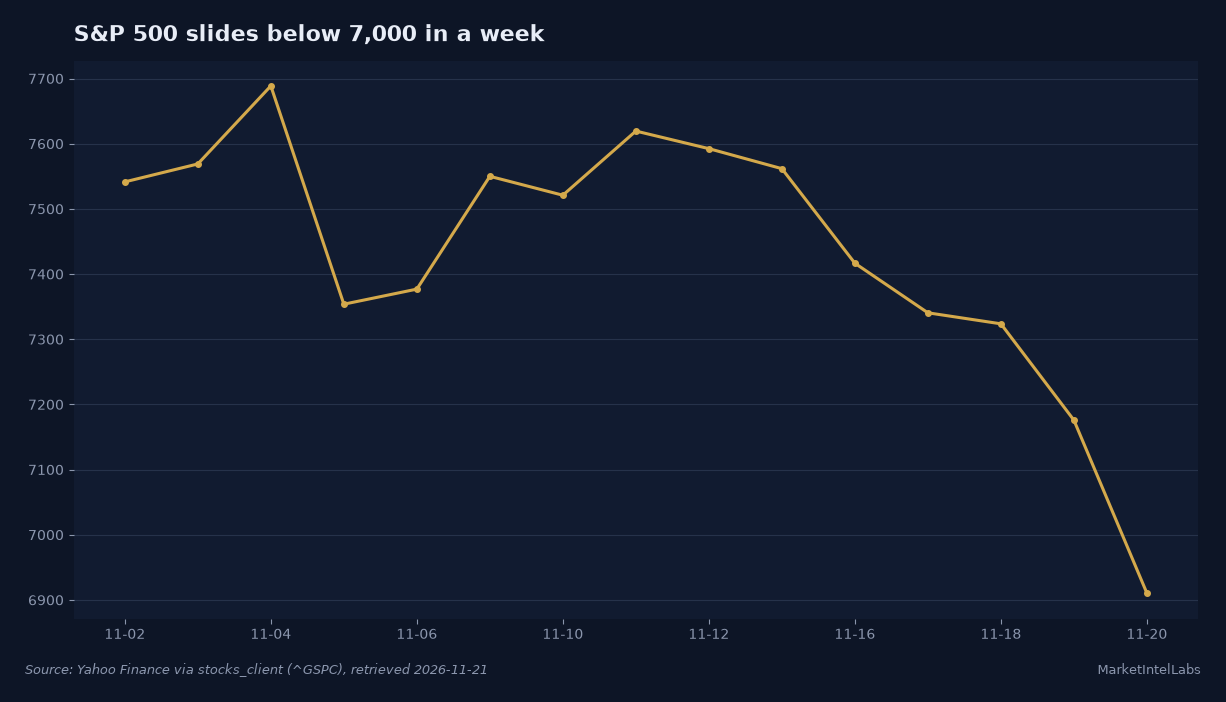
The index closed Friday at 6,910.39, down 8.61% on the week and 11.9% below the record it set in mid October, a decline that formally puts stocks in correction territory. The Nasdaq Composite fell even harder, losing 10.02% to end at 22,617.73, while the Dow Jones Industrial Average slid 8.02% to 48,147.33 and the Russell 2000 gave up 7.48% to 2,581.79.
The sequence of events mattered as much as the scale. Early in the week, hot inflation data and hawkish commentary pushed the market to price a December Fed rate hike that had been all but written off a fortnight earlier, lifting the dollar to the top of its 52 week range at 103.81 and compressing the room central banks had to keep policy loose. That repricing set the tone; what followed was a de-risking that fed on itself.
By Friday the selloff had become unmistakably an AI led de risking that pulled US stocks into their worst week in over a year, with the megacap names that anchor the index leading the slide. The fear was a S&P 500 move below 7,000 and into correction as the AI led rout deepened, and the close at 6,910.39 confirmed it. What had been a healthy digestion of elevated valuations became a stampede as speculative positioning unwound across the board.
For the broader framework, see our gold coverage.
The same repricing pounded the assets that had been the year's biggest winners on the other side of the trade. Silver dropped to roughly $41.03, down 16.32% on the week, its lowest level in close to a year, as a firmer dollar and higher real yields stripped the metal of its appeal. Gold fell 9.54% to $3,515.40. Bitcoin slid below $60,000 to about $58,799, down 13.85% and its lowest since July.
What reversed, and what did not. The prior week's story had been a 10 year yield climbing toward 5.2% and a dollar that would not break, narrative that favored a defensive tilt. This week confirmed the dollar part of that thesis, with the index up 0.39% at 103.81. But the long end behaved as a safety valve instead of a cause: the 10 year Treasury yield fell to 4.91% from 5.15% as the equity rout sent money into government paper, undoing much of the week's earlier tightening even as dollar strength did the real damage.
Commodities took the same blow. WTI crude ended at $83.98, down 5.17% for the week, and Brent at $92.57, a 3.41% loss, with the demand destruction from a stock market correction adding to the pressure of a firmer dollar. None of the moves was a single bad print or one earnings shock; the pattern across every line of the table below is the signature of a repricing that reached into every corner of the market at once.
| Instrument | Friday close (Nov 20) | Weekly change |
|---|---|---|
| S&P 500 | 6,910.39 | -8.61% |
| Nasdaq Composite | 22,617.73 | -10.02% |
| Dow Jones Industrial Average | 48,147.33 | -8.02% |
| Russell 2000 | 2,581.79 | -7.48% |
| 10-year Treasury yield | 4.91% | -24 bps |
| US dollar index (DXY) | 103.81 | +0.39% |
| WTI crude | $83.98 | -5.17% |
| Brent crude | $92.57 | -3.41% |
| Gold | $3,515.40 | -9.54% |
| Silver | $41.03 | -16.32% |
| Bitcoin | $58,798.98 | -13.85% |
None of this happened in a vacuum of market mechanics alone. The repricing collided with a calendar of structural stress: 2027 retirement contribution limits published with increases too small to offset the squeeze households feel from mortgage rates that remain near 7.35% with pending home sales at a record low of 63.0, the backdrop against which a leading indicator report now points to a slowdown. Those are separate stories, but they are the reason this correction lands on households that had been counting the rally as a cushion.
The honest reading of the tape is that the market did the repricing the easier way first. It moved the dollar, then it moved prices, and the bond market's late week rally is the tell that investors now believe the Fed's tightening will do more than pinch sentiment. If the hike actually arrives at the December meeting, the 10 year yield near 4.9% is not saying the economy can absorb it, it is saying investors are already buying the insurance against the aftermath.
The descent was not evenly paced, and the shape of the tape matters for what comes next. Monday's losses looked like ordinary pullback mechanics, a modest give back after a long run. Tuesday brought the first real damage as the Fed repricing took hold and the dollar firmed into a level that historically chokes foreign appetite for US risk. By Thursday the selling had tipped into forced liquidation, with the largest AI names that had powered the index's gains to new highs now the biggest weights on the scale. Friday's close simply ratified a move that had been building for three sessions, the kind of finish that empties a market of its most speculative holders first.
The depth of the retreat is best measured against how far the rally had come. The S&P 500 sat 11.9% beneath its mid-October record, a mathematically unambiguous correction by the standard definition of a 10% decline from a recent high. The Nasdaq's 10.02% weekly loss, the single worst week for the index in more than a year, shows the pain was concentrated exactly where enthusiasm had been highest: long duration technology names trading on the promise of an AI capital supercycle. When those promises get repriced against a potentially tightening Fed, the multiple compression is brutal, and nothing about the Friday close suggested the process is finished.
The macro read argues against a fast bounce. A December hike was priced with rising conviction all week, and a firmer dollar at 103.81 leaves no room for a goldilocks resolution: either the Fed hikes and growth slows, or it blinks and markets conclude it is behind the inflation curve. Silver's 16.32% collapse to $41.03, its weakest level in roughly a year, and bitcoin's slide to $58,798.98, the lowest since July, are the same trade from two different directions, both an exit from assets that had been priced for a world of easy money. Gold at $3,515.40, down 9.54%, is the tell that even the traditional hedge was repriced rather than embraced.
Oil added a second order stress. WTI at $83.98 and Brent at $92.57 both fell more than 3% on the week, and while a softer crude price eventually helps consumers and inflation readings, a decline driven by equity market contagion rather than supply abundance is not a clean win. It signals global growth expectations are being marked down in real time, which compounds the earnings pressure on the very index that just broke its support. Risk assets rarely bottom on a day when bonds, metals, crypto and crude all break together; the synchrony itself argues the repricing still has work to do.
This content is for informational purposes only and does not constitute financial advice. Past performance is not indicative of future results. Consult a qualified financial advisor before making investment decisions.
Get daily intelligence delivered
Create a free account for the Daily Brief every weekday and The Week Ahead every Sunday. No card required.