Wall Street Week in Review: Why did the 10-year top 5.17% and reprice a December Fed hike?


The week's defining move was the bond market repricing a December hike, and it did so hard. The 10 year Treasury yield touched 5.17% intraday Friday and closed the week at 5.15%, its worst weekly performance of the year, after October CPI and PPI both ran hotter than expected and Fed Governor Christopher Waller backed a December increase. What is striking is how narrow the damage was. The S&P 500 still rose 2.5% for the week, and the Nasdaq climbed 2.3%, even as long bonds sold off, gold sank to a 52 week low near $3,886 and bitcoin slid below $70,000. Investors did not flee risk. They repriced the cost of money, and then picked which risk to own.
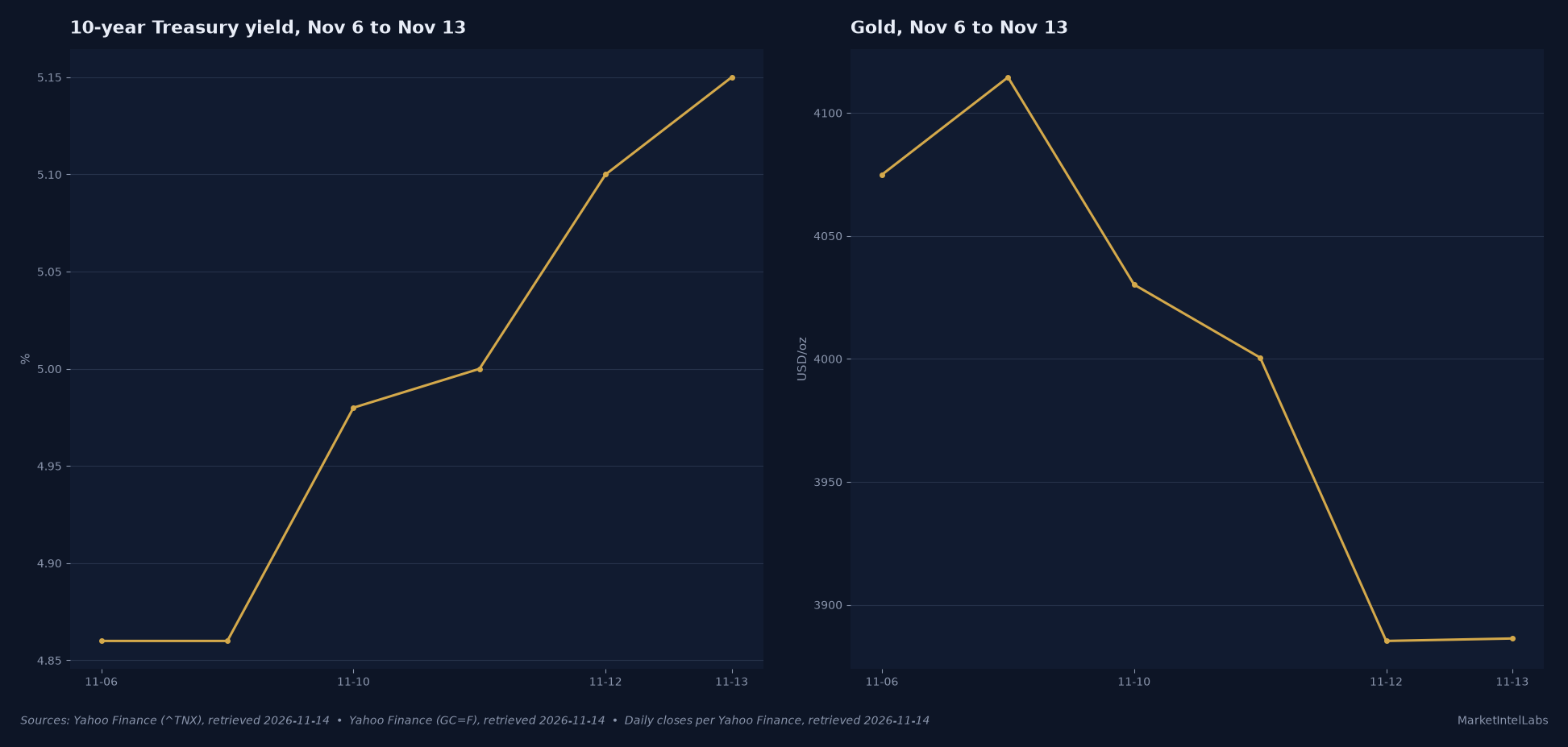
The spine of the week, the one move every other headline flowed from, was the 10 year Treasury yield. As our coverage of the move laid out, the yield touched 5.17% on Friday before settling near 5.15%, wrapping up a climb of about 29 basis points from the November 6 close of 4.86%. The trigger was data and a Fed official. October CPI published Tuesday kept core inflation at a firm 0.3% monthly pace, and October PPI landed at 0.3% with core at 0.5%, a producer price reading that reinforced the hike case. Waller's public support of a December increase, noted in our PPI and December hike coverage, was the final explicit signal. Prediction markets did the rest. Kalshi priced a December quarter point hike near 87%, up from the mid 80s reading a week earlier. The full logic, how a producer price report fits a rate decision, is the subject of our explainer on the decision.
The move confirmed and intensified what the prior week had only flirted with. Seven days earlier the 10 year had closed the prior Friday at 4.86%, pressing against a 5% line the market still treated as a ceiling, and our note on the yield approaching 5% had flagged the level as the one to watch. December was priced as likely but not locked, and the market was comfortable enough that gold could still trade near its highs and bitcoin above $75,000. This week changed all three assumptions. Hot CPI confirmed the inflation problem, PPI intensified it, and Waller's comments closed the last gap. The yield promptly broke through the round 5% level it had hesitated at, and by Friday it had not only cleared that ceiling but pushed to 5.17% before settling at 5.15%, a full 29 basis points above where it closed a week earlier. Markets did not merely confirm the prior pricing. They repriced December as effectively done business and took the whole curve with them.
Three developments that drove the week
Rates repricing led the week and showed up across every asset class. In equities the question became how much multiple compression a 5% plus 10 year could force, and the answer was a choppier but still positive week. The S&P 500 closed Friday at 7,561.67, up 2.5%, the Nasdaq at 25,136.27, up 2.3%, the Dow at 52,347.55, up 2.1%, and the Russell 2000 at 2,790.49, up 1.3%. Most of the gain came early in the week, and the tape ground lower through Wednesday and Thursday as the rate signal hardened. The 10 year's rise also did its usual work on the mortgage market, with the 30 year fixed easing to 7.11% as our mortgage coverage detailed, and on gold, which our gold coverage recorded at a 52 week low of about $3,886.30, a casualty of a rising real yield that makes the non yielding metal less attractive. Silver fell farther, down 5.4% on the week.
A second, company-specific shock hit at the top of the AI trade. Nvidia's board removed Jensen Huang as chief executive on November 12 and named finance chief Colette Kress interim CEO, and the stock fell 4.3% on Thursday as investors repriced leadership risk at the center of the AI infrastructure build. Our coverage of the shake up has the details. For the weekly recap the important point is that this was a company specific event layered on top of the rate repricing, and it is a reminder that this market can punish a bellwether's governance just as quickly as it can reward a macro tailwind. The dedicated explainer on why the board acted dives deeper, but the takeaway for the week is that the AI trade now carries two open questions, the December cost of capital and the future of its flagship company.
Oil was the third thread, where conflict risk and supply disruption collided with a market that barely moved. War risk premia spiked after supertanker blasts near the Strait of Hormuz, pushing shipping costs sharply higher as our Hormuz coverage reported, and the renewed sanctions squeeze cut Iran's oil exports to roughly 255,000 barrels per day, down sharply from recent levels, per our Iran export coverage. Against that backdrop crude still ended the week down. WTI settled Friday at $88.56, off 2.5%, and Brent at $95.84, off 2.5%. The oil market looked past the headlines, helped by peace talk hopes and ample non affected supply, even as the shipping and insurance side priced the risk. It is a reminder that in the energy complex the logistics contract and the crude contract can trade completely different weeks.
The closes
Weekly changes are measured Friday to Friday, from the November 6 close to the November 13 close against Friday's settlement prices, using daily bar data retrieved from Yahoo Finance on November 14.
| Asset | Friday close | Weekly change |
|---|---|---|
| S&P 500 | 7,561.67 | +2.5% |
| Nasdaq Composite | 25,136.27 | +2.3% |
| Dow Jones Industrial Average | 52,347.55 | +2.1% |
| Russell 2000 | 2,790.49 | +1.3% |
| 10 year Treasury yield | 5.15% | +0.29 percentage point |
| US Dollar Index (DXY) | 103.41 | +1.1% |
| WTI crude | $88.56 | -2.5% |
| Brent crude | $95.84 | -2.5% |
| Gold | $3,886.30 | -4.6% |
| Silver | $49.03 | -5.4% |
| Bitcoin | $68,249 | -9.9% |
The dollar is the quiet winner of the whole exercise. The DXY firmed to 103.41, up 1.1%, its strongest in months, as higher US yields drew capital home. That is the same force that is squeezing gold, silver and bitcoin, all of which fell because a stronger dollar and a higher real American yield leave less room for assets that pay nothing. Equities were the exception because earnings and the AI narrative still offered an offset, though the grind lower into the end of the week suggests the buffer is thinning.
The balance of risk now sits with the data. If the December hike lands at the quarter point Kalshi expects, the selloff in gold and crypto may be the washout and equities could hold their gains. If PPI's 0.5% core proves to be a one off and the Fed signals patience, bonds would rally back toward 5%, and the assets that sold off this week would likely reclaim most of the ground. If inflation stays hot, a second move in 2027 becomes a live question and 5.25% rather than 5% becomes the new ceiling the whole market calibrates against. The next hard inputs are the November CPI and the Fed's December 9 to 10 meeting, and every portfolio decision for the next month is really a bet on which door the data opens. Our Fed policy coverage will track each release.
This content is for informational purposes only and does not constitute financial advice. Past performance is not indicative of future results. Consult a qualified financial advisor before making investment decisions.
Get daily intelligence delivered
Create a free account for the Daily Brief every weekday and The Week Ahead every Sunday. No card required.