October Employment Situation: What It Means


October nonfarm payrolls rose by 165,000, more than double the roughly 65,000 jobs economists had expected, and the unemployment rate slipped to 4.1% from 4.2%. The beat was the story, and it landed well above the top of the published estimate range, even as flat wages took the inflationary sting out of a stronger-than-expected hiring month.
Here is the actual versus the call. The consensus recorded ahead of the release was a 65,000 gain, with the quality-weighted estimates clustering between 56,000 and 94,000. The Bureau of Labor Statistics employment situation report for October, pulled from the official CES series, shows total nonfarm employment rising from 159,128 thousand in September to 159,293 thousand in October, a monthly increase of 165,000. That is a beat roughly 100,000 jobs above the midpoint of expectations, and a sharp acceleration from the 29,000 gain the previous report showed.
Related reading: October Employment Situation: What to Watch in Friday's Jobs Report.
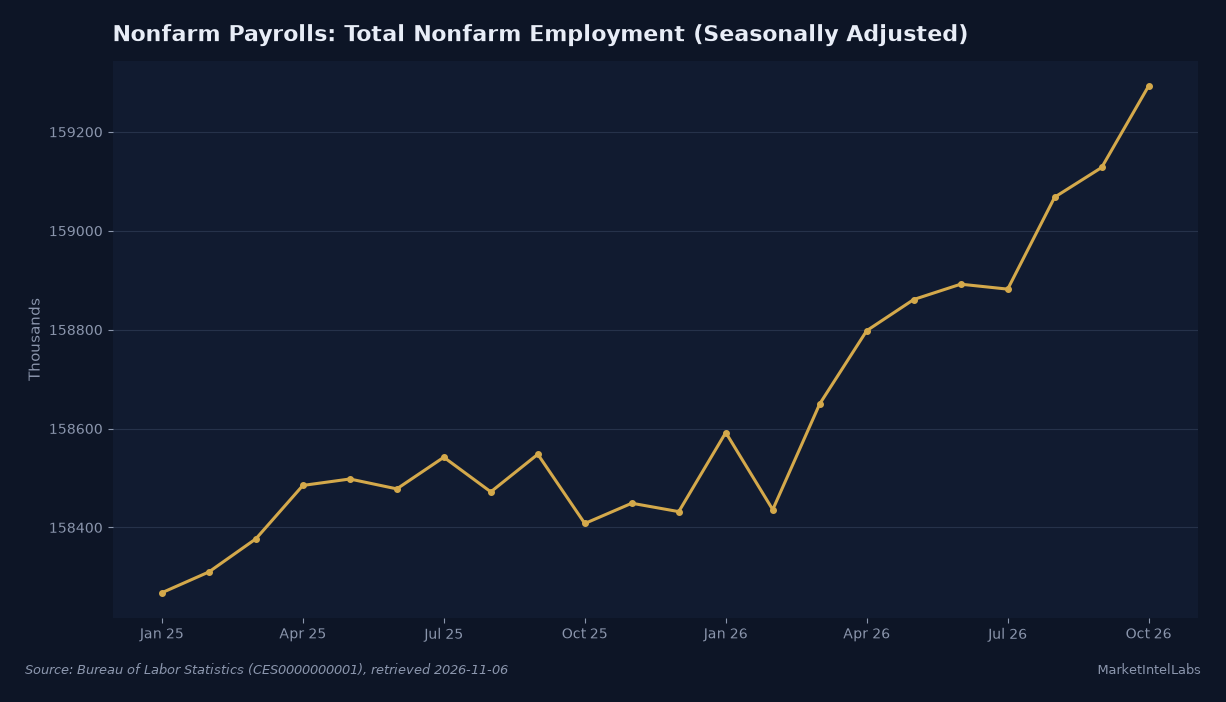 alt="Nonfarm payrolls climbed to 159,293 thousand in October, a 165,000 jump from September (159,128 thousand). Source: Bureau of Labor Statistics (CES0000000001)" />
Unemployment was the second surprise. The market had priced a steady print near 4.2%. Instead the jobless rate fell a tenth to 4.1%, back to the August level, while labor force participation rose to 61.9% from 61.8%. A lower unemployment rate alongside a higher participation rate is the constructive combination: more people looking for work and finding it, rather than a drop explained by discouraged workers leaving the search.
For the broader framework, see our gold coverage.
Related reading: FOMC rate decision October 27-28: Fed holds at 3.75%-4.00%, December hike stays live.
The wage line is what kept this print from reading as a hot, inflation-feeding number. Average hourly earnings for all private employees came in at $34.40, effectively unchanged on the month. Strong hiring with contained pay growth is the configuration a central bank most wants to see, and it is the reason the day's bond and equity moves were not simply a hawkish shock.
Now the first market response, with live prints captured Friday morning after the 8:30 a.m. eastern release. SPY traded to $740.34, up 1.00%, and QQQ rose 2.32% to $662.05, the growth complex bouncing hardest after the artificial-intelligence selloff that had knocked the Nasdaq into a confirmed correction on Wednesday. Volatility crushed that move into reverse: the VIX fell about 11% to 25.19. The Russell 2000 was essentially flat at 2,731.68, a sign the bounce was concentrated in the beaten-down tech leaders rather than broad small-cap strength.
Related reading: The Week Ahead: Jobs report Friday, Apple and AMD earnings anchor a heavy slate.
The rates and currency complex moved against the trend in stocks. The 10-year Treasury yield rose about 7 basis points to 4.87%, and the dollar index firmed 0.68% to 102.24, both consistent with a labor market still too strong to let the Federal Reserve cut. Bullion softened, with the gold ETF down 1.22% to $370.94, pressured by the firmer dollar. Bitcoin slipped about 1% to $75,218, largely a spectator to a day owned by rate-sensitive and oversold equity names.
What does this confirm, and what does it break, in our existing coverage? This morning's macro brief carried the setup: the Fed holding at 3.75 to 4.00% with roughly 80% of a December hike priced, and this jobs report named as the first test of whether the labor market gives it cover. The print largely confirms that posture. A 165,000 gain with unemployment falling to 4.1% is exactly the kind of strength that keeps the Committee comfortable staying put, or moving up, and it did not produce the wage spike that would have forced a more aggressive repricing.
Related reading: AMD Q3 earnings beat: data-center revenue +97% reverses the AI de-rating.
Where it nudges the story is the market reaction. After Wednesday's AI-crackdown shock, the natural fear was that a hot number would extend the de-risking. Instead, contained wages flipped the tape into a relief rally, lifting exactly the technology names that had borne the brunt of the selloff. That is a divergence our coverage flagged as the open question: whether the labor market would pressure the equity complex or rescue it. For now, this print chose rescue, though the flat small-cap index and the still-elevated VIX near 25 say the calm is provisional rather than settled.
What to watch next is the inflation leg of the same policy question. October CPI prints on November 10, and it is the second decision point our macro desk has been tracking alongside this report. The combination to watch is this jobs strength with a soft CPI, which would reinforce the contained-wage read and give the equity rally room to extend. A hot CPI on top of a 165,000 payroll month would instead re-assert the hawkish case, put fresh pressure back on yields and bullion, and test whether the broad market can hold outright gains while the growth complex carries the day.
Data sources: Bureau of Labor Statistics Employment Situation, series CES0000000001 (total nonfarm employment), LNS14000000 (unemployment rate), LNS11300000 (participation rate) and CES0500000002 (average hourly earnings), retrieved from the BLS public API November 6, 2026; market quotes from Yahoo Finance, Friday November 6, 2026.This content is for informational purposes only and does not constitute financial advice. Past performance is not indicative of future results. Consult a qualified financial advisor before making investment decisions.
Get daily intelligence delivered
Create a free account for the Daily Brief every weekday and The Week Ahead every Sunday. No card required.