October Employment Situation: What to Watch in Friday's Jobs Report


The October Employment Situation lands Friday at 13:30 UTC carrying the clearest data test of the year's most stubborn dilemma: a Federal Reserve that cannot cut and a labor market that is visibly cooling. Consensus looks for nonfarm payrolls near +65,000, a figure that would more than double September's soft +29,000 print, with the unemployment rate steady near 4.2 percent. Both numbers matter, but neither is the actual story. The story is what each does to December, when rate futures already price roughly 72% odds of a hike.
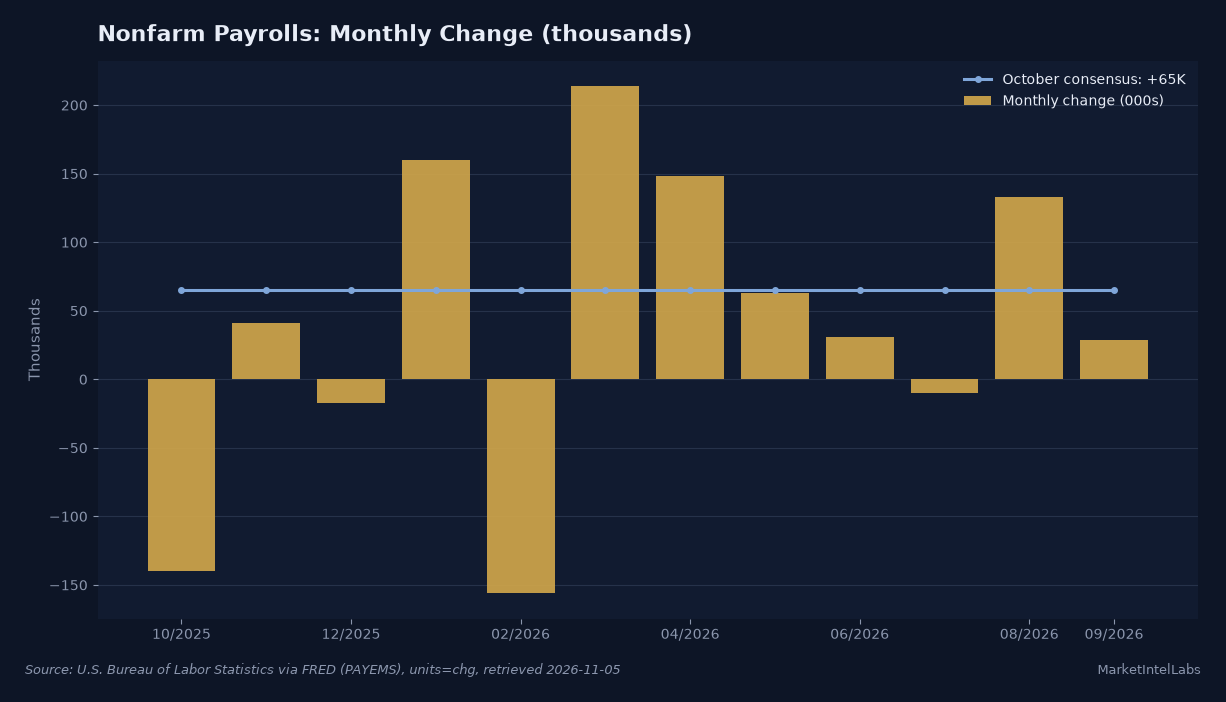
The consensus figure sits near the center of a wide forecast range. Seeking Alpha's October labor-market preview sees +65,000, more than double the September print, while for-ex.news also pencils +65,000, forecasts.org runs lower at 56,000, and a quality-weighted consensus from Headline Arena sits higher near 94,000. That 56K to 94K spread is the market's honest uncertainty about whether September was an outlier or the new base, and it means even a print that lands on consensus leaves the debate unresolved.
Related reading: September Employment Situation: 29,000 Jobs Added, Well Below an Already Softened Consensus.
The starting point is a weak recent base. September added just +29,000 jobs, the softest reading in the run, and the unemployment rate ticked up to 4.2 percent from 4.1 percent in August, per the Bureau of Labor Statistics Employment Situation summary. Wednesday's ADP report was more constructive on the private side, showing +86,000 private payrolls for October with base pay up 3.2 percent year over year, but ADP has repeatedly diverged from the BLS headline this cycle, so it reads as color rather than confirmation.
Here is the reaction function in both directions. An upside surprise, a print well above consensus toward or beyond the 94,000 top of the forecast range, tells the Fed the labor market is too firm to let December slip, and the market reprices toward a hike. That flows through rates first: the 10-year, already at 4.89 percent and within sight of its 5.36 percent 52-week high, extends higher, the dollar gains from its already-elevated 101.60, and rate-sensitive corners of the equity market, long-duration growth and homebuilders above all, come under pressure. Crypto, with its high beta to liquidity conditions, tends to take the downside with it.
For the broader framework, see our Fed policy coverage.
Related reading: Fed December rate hike odds near 74%: a 10-2 hold, a payroll test, and the 10-year's run at 5%.
A downside surprise, a print near zero or a rising unemployment rate, does the opposite. December-hike odds collapse, the 10-year backs down from the 5 percent zone, the dollar softens, and the same rate-sensitive sectors that sell off on strength rally hardest on weakness, with crypto re-pricing to the upside on a friendlier liquidity track. There is a catch worth naming: a genuinely weak number stops reading as a pause and starts reading as the leading edge of a slowdown, at which point falling yields stop helping equities and the market starts pricing the recession itself. That asymmetry, bond-optimistic and equity-nervous, is the one the curve already encodes with the 10s2s spread flattened to 0.32.
Because the consensus sits squarely in the middle of a soft month, the report stays informative even if the headline matches expectations exactly. When the top-line number is a non-event, the market pivots to the internals: the unemployment rate, average hourly earnings, and the scale of revisions to prior months. In a cycle where September was revised into a 29,000 print and prior months have been marked down repeatedly, the revisions column can move the market as much as the new headline.
Related reading: Fed December rate hike odds near 72% as the midterm vote lands and the 10s2s curve flattens.
The Fed context stiffens the stakes. The FOMC held at 3.75 percent to 4.00 percent on October 28 on a 10-2 vote, with one dissenter arguing for an immediate hike, per Advisor Perspectives. Core PCE still runs at 3.12 percent and headline CPI at 3.72 percent, both far above target, so the Committee enters December with no inflation case for standing down and a labor market that no longer justifies holding the line on hawkishness. The employment report is the first of the two inputs, payrolls now and CPI roughly a week later, that decide whether that hold survives.
Full reaction coverage of the October Employment Situation follows here after the BLS releases the report Friday at 13:30 UTC. Until then, watch the three numbers that transmit anything: the payrolls headline, the unemployment rate, and average hourly earnings, each read against December rate-hike odds near 72 percent.
Related reading: October Jobs Report Preview: Sept Hiring Slowed to 29k.
This content is for informational purposes only and does not constitute financial advice. Past performance is not indicative of future results. Consult a qualified financial advisor before making investment decisions.
Get daily intelligence delivered
Create a free account for the Daily Brief every weekday and The Week Ahead every Sunday. No card required.