September Employment Situation: 29,000 Jobs Added, Well Below an Already Softened Consensus


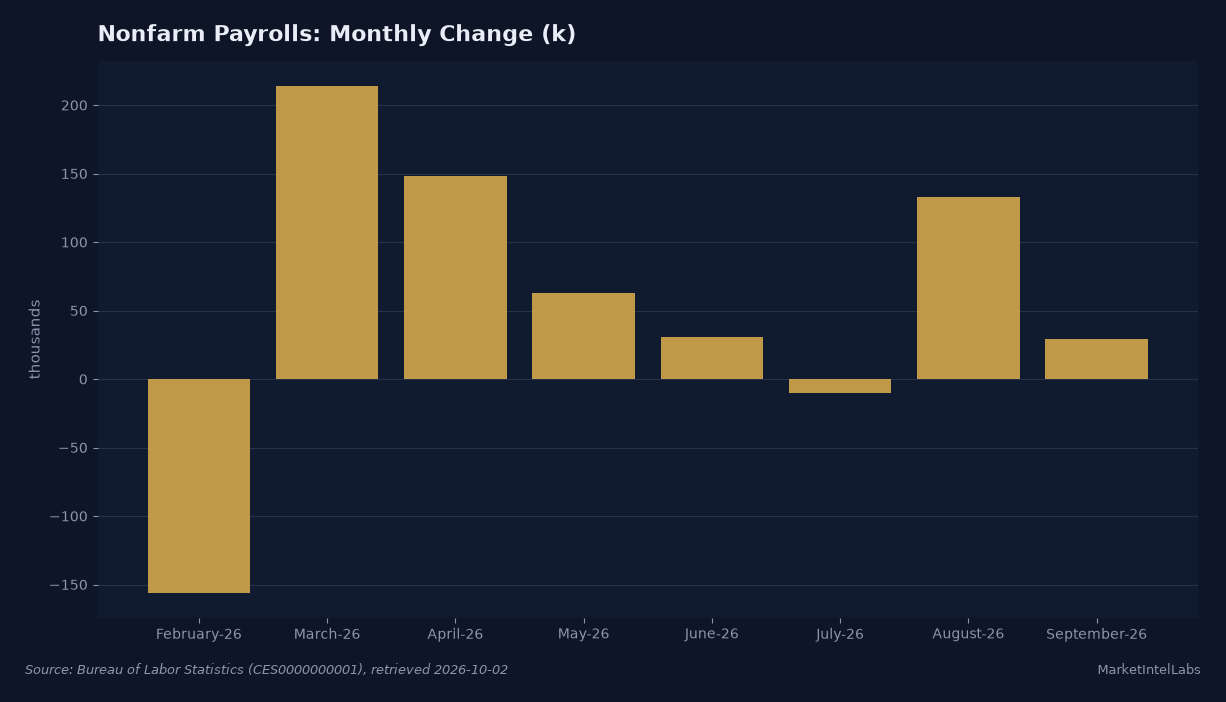
The September Employment Situation delivered 29,000 nonfarm payrolls, roughly 40 percent below the about 50,000 consensus recorded in our pre-release coverage, while the unemployment rate rose to 4.2 percent from 4.1 percent. Average hourly earnings were flat on the month at $34.40. This is a weak print against an already softened bar, and on the surface it undercuts the case for a hike at the October 27-28 FOMC meeting, where a second consecutive strong report was the condition that would lock one in.
The headline payroll figure flatters the report less than the number alone suggests. The Bureau of Labor Statistics revised July down from a gain of 21,000 to a loss of 10,000 and cut August from 162,000 to 133,000, a combined 60,000 downward revision to the prior two months, a detail we documented in our companion piece on the payrolls revisions. On a three-month look, hiring has effectively stalled: July's revised decline, August's smaller gain, and September's 29,000 amount to a labor market that is adding far fewer workers than it did in the first half of 2026.
The central macro contest of this report was always the Federal Reserve, the anchor of our Fed policy coverage. Our expectations coverage framed it correctly: August's 162,000 print (now revised to 133,000) had forced the October 27-28 meeting into a live hike debate, and the question was whether September would make it two strong months in a row or break the run. It broke the run. At 29,000, with the jobless rate climbing and wages flat, the two-strong-months condition is no longer on the table, and futures repriced the hike probability lower within the hour of the release.
What the market did with it
The first response was a textbook dovish repricing. The S&P 500 exchange-traded fund SPY traded up about 1 percent at 771.43, the Nasdaq-tracking QQQ gained roughly 1.4 percent to 752.30, and the small-cap IWM rose about 1.5 percent to 283.17. The benchmark 10-year Treasury yield slipped toward 5.21 percent, and the long-duration TLT fund edged higher. The dollar index eased to near 101.7, and the VIX fell more than 5 percent to about 15.4, a sign traders read the print as removing a hawkish risk rather than flagging a growth scare. Bitcoin rose around 1 percent to roughly $85,700 on the same liquidity stance.
That constellation is meaningful. A genuinely bad-for-growth number would have hit equities even as it boosted bonds. Instead, stocks, bonds, and crypto moved together in a direction consistent with one specific read: the Fed is now less likely to hike, and rate pressure is the risk that had been holding the tape back. The move confirms, rather than contradicts, the preview framing we published ahead of the report: the employment data was the swing variable for October policy, and a weak print undercuts the hike.
What it breaks in the rate story
Before today, the hawkish case rested on two things: an environment where long yields had pinned near the upper 5 percent range, and one strong August reading that implied momentum. The revisions remove some of the momentum, and the September miss removes the mandate for an urgency. If the labor market is genuinely cooling, a hike becomes a policy error with no overheating to justify it, and the FOMC's natural path is to hold and watch inflation data rather than to preemptively tighten.
The bull case for risk assets is that this report takes hikes firmly off the near-term menu: no second strong month, no hike, and the reach for October becomes a pause followed by data-dependence. The bear case is that a cooling labor market is not a reason to celebrate when it comes alongside wages that are now flat, because it raises the question of whether a soft landing is turning into a gloss on stagnation. That ambiguity is exactly why the market's stripe is an easing of hike risk, not an all-out relief rally to new highs: indices are up handily but the response is measured.
What to watch next
The immediate focus is the October 27-28 FOMC, where the next jobless claims prints, the September CPI reading, and any upward surprise in inflation will now decide whether hike risk stays dormant. The window for a hike is effectively closed on labor evidence alone; it now reopens only if inflation forces the issue. Also watch downward force in long yields: if the 5 percent handle on the 10-year holds under the weight of weaker payrolls, the cost-of-capital narrative for growth and AI-infrastructure names improves, which would extend today's equity gains. The first clues come with the weekly jobless claims series in the days ahead, and the September inflation data that lands before the meeting.
This content is for informational purposes only and does not constitute financial advice. Past performance is not indicative of future results. Consult a qualified financial advisor before making investment decisions.
Get daily intelligence delivered
Create a free account for the Daily Brief every weekday and The Week Ahead every Sunday. No card required.