Fed Funds Rate Today Explained: Target Is 3.75% to 4%


The fed funds rate today has a 3.75% to 4.00% target range, set at the Federal Reserve's September 16, 2026 meeting. The most recent effective rate visible in the New York Fed's published table as of this writing is 3.88% for October 21. Those are different numbers: one is the Federal Open Market Committee's instruction to the market, the other is the measured price of overnight loans. The next scheduled FOMC decision is October 28 after its October 27 to 28 meeting, not a fresh rate announcement today. For a separate look at how markets are pricing later decisions, see our December rate-odds report; odds are not the current policy rate.
A search for the current rate often returns a single figure without explaining which figure it is. The September FOMC statement specifies a range, 3.75% to 4.00%, after a quarter-point increase. The New York Fed's effective-rate table supplies the latest observed transaction-based rate. Neither is the interest rate on your savings account, a 30-year mortgage or a Treasury note. Our answer is to watch the target and the observed rate together, then read the projections as conditional judgments rather than a schedule.
Related reading: Fed Funds Rate Today: 3.75% to 4.00%, October Odds Favor Hold.
How the current range came about
The change was not an October decision. In its June 17 statement, the Fed kept the target range at 3.50% to 3.75%. The same band survived the July 29 decision, although the vote was 9 to 3: Beth Hammack, Neel Kashkari and Lorie Logan preferred an increase then. The committee subsequently voted 12 to 0 on September 16 to raise the band by 0.25 percentage point. That chronology is useful because a search result that quotes the July ceiling of 3.75% will now mistake the old ceiling for today's floor.
The September statement described expanding activity and resilient domestic spending alongside inflation that remained elevated. Its stated rationale was a timelier return to the 2% inflation goal, not an emergency response to a single asset price. The target range went from 3.50% to 3.75% to 3.75% to 4.00%; both endpoints moved together. One percentage point equals 100 basis points, so this was a 25-basis-point increase. A 3.75% floor is not a prediction that every private borrower will pay 3.75%.
For the broader framework, see our Fed policy coverage.
There is a second, observable sequence. The New York Fed's daily reference-rate table lists an effective rate of 3.63% for September 16, inside the old 3.50% to 3.75% range. September 17, the first effective date under the new instruction, shows 3.88%. It still reads 3.88% on September 30, October 7, October 14 and October 21 in that table. The immediate 25-basis-point jump in the observed measure is the cleanest way to see the policy change in the overnight market. It does not show a further October hike.
Why had the Fed waited in July? The July statement described solid growth, relatively little change in unemployment, and inflation above the 2% goal, including pressure linked to energy supply shocks. Three dissenters wanted a quarter-point increase. September's unanimous vote tells us the committee converged on an increase at that meeting; it does not tell us that every member now wants another increase at the next one. A vote is a decision about that meeting's rate, not a binding vote about all later meetings.
What the federal funds rate actually measures
The federal funds market is an overnight, unsecured market in which eligible institutions borrow dollar balances. The FOMC chooses a target range for that market. According to the New York Fed's methodology, the effective federal funds rate, or EFFR, is the volume-weighted median of eligible transactions reported in its money-market survey. It publishes the rate for the prior business day at about 9 a.m. New York time. That publication lag is why the latest rate visible when an article is written may be for a prior date rather than for the date in the headline.
The word "median" matters. EFFR is not an arithmetic average of every advertised bank rate, and the posted target is not itself a measured transaction. A volume-weighted median finds the level at which transaction volume is balanced on either side. The Fed sets the range; participating institutions negotiate and transact; the New York Fed measures the result. On October 21, the published 3.88% stood 13 basis points above the lower edge and 12 basis points below the upper edge. That near-middle reading says the overnight market was trading inside the chosen corridor, not that the committee had quietly chosen 3.88% as a new target.
The September implementation note supplies the plumbing. Interest paid on reserve balances rose to 3.90% effective September 17. The standing overnight repo facility was set at 4.00% and the standing overnight reverse repo offering rate at 3.75%. These tools, plus open-market operations, are intended to keep the actual funds rate within the announced range while maintaining ample reserves. They are operational settings; they are not three separate votes about three separate consumer interest rates.
Reserve remuneration gives banks an alternative use for balances; the overnight facilities also influence the prices at which eligible counterparties can lend or borrow cash against collateral. Differences in access, balance-sheet costs and the fact that fed funds loans are unsecured mean the effective rate need not equal the 3.90% reserve rate. Indeed, the 3.88% reading sits two basis points below that reserve setting. The September minutes said EFFR had been steady relative to the reserve rate and noted stable short-term funding conditions during the intermeeting period.
That overnight anchor transmits outward, but imperfectly. A floating-rate loan may reset with its contract's reference index and margin. A savings bank may change its posted annual yield quickly, slowly or not at all. Longer Treasury yields incorporate expectations of future short rates as well as term premiums, inflation expectations and supply. A 25-basis-point FOMC move therefore does not mean a 25-basis-point move in the 10-year Treasury yield or a matching change in a mortgage quote. The minutes attributed a roughly 35-basis-point increase across the 2-year to 10-year part of the Treasury curve in the intermeeting period partly to expected policy and strong data, while also noting other sources of term premium.
This is why our 10-year yield analysis should be read beside, not substituted for, the funds target. The 10-year is a market price for a long-maturity government obligation. Fed funds is an overnight market. If inflation expectations or the compensation investors require for holding long bonds changes, the two rates can diverge. The consequence for households is concrete: an unchanged overnight target next week would not guarantee that a mortgage offer or bank deposit yield stays put.
What the chart does and does not show
The six observations in our original chart are transcribed from the New York Fed's daily EFFR table: September 16 at 3.63%, followed by September 17, September 30, October 7, October 14 and October 21, each at 3.88%. We chose the day before and the day after implementation, then a handful of later published dates to test whether the initial move persisted. This is a selected-date chart, not a claim that every business day between those dates was sampled. The primary table also displays the target band beside each daily rate.
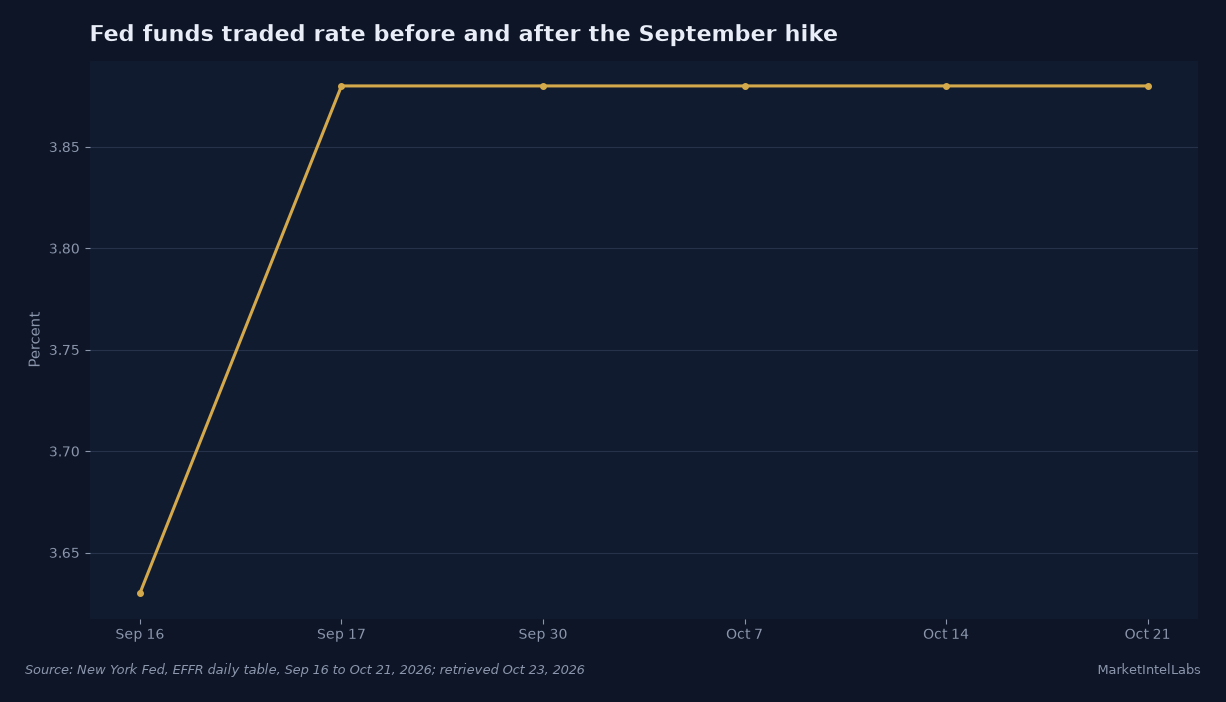
The distinction is visible: an actual rate rose when the new target took effect, and the selected later readings remained level. The figure is not a forecast for October 28. It is not a chart of mortgage rates, an average of bank lending rates, or a chart of market-implied probabilities. If the FOMC makes a different decision, readers should compare the next statement's target endpoints with the subsequent day's EFFR rather than treating an intraday market quote as the committee's action.
Our interpretation is narrow. The September policy instruction passed through to the overnight benchmark; the sampled October data do not evidence a new policy move. Whether a target change reaches borrowing costs farther out depends on what those costs had already priced in. Markets can anticipate an increase long before the Fed votes. A change matching that expectation may move longer yields less than the full quarter point, while a surprise can move them more. The chart documents the overnight transmission, not the final bill on anyone's loan.
How to read the Fed's projections without mistaking them for a decision
At September's meeting, participants also submitted a Summary of Economic Projections. The median participant put the appropriate federal funds rate at 4.1% at the end of 2026, 4.1% at the end of 2027, 3.9% at the end of 2028 and 3.6% at the end of 2029. The longer-run median was 3.2%. These are year-end projections under each participant's own outlook and preferred policy, not four newly approved target ranges. September's 2026 median was above June's 3.8% projection for the same year.
Read the 4.1% with some care. It is a projected year-end level for an appropriate policy rate, rounded in the published table, while today's policy is a band with a 4.00% ceiling. A reader cannot mechanically subtract 4.00 from 4.1 and infer that the October vote must raise the upper bound by exactly 10 basis points. Decisions normally move the target range by increments that can differ from a rounded projection. The documents give a view about the year-end path under certain assumptions, not a dated instruction for the October meeting.
The same September projection table placed median 2026 PCE inflation at 3.7%, core PCE inflation at 3.4%, unemployment at 4.1% and real GDP growth at 2.3%. June's corresponding projections were 3.6%, 3.3%, 4.3% and 2.2%. Higher inflation alongside a lower projected unemployment rate is a coherent reason the median appropriate rate rose between June and September. It does not settle the effects of any new energy shock or subsequent employment print, because the projections used information available in September.
The Fed's explanation of its projection process says officials provide forecasts four times a year, in March, June, September and December, conditioned on their own assessment of appropriate policy. The dots belong to individual officials, not a single committee forecast, and the median can move even if there is no new vote. Dispersion matters too: the September table shows a 2026 central tendency of 4.1% to 4.4% and a full range of 3.9% to 4.4% for the appropriate year-end rate. A 4.1% median does not mean unanimity about the future.
The September minutes explain the debate underneath the dots. Many participants described a higher path as insurance against persistent inflation caused by stronger demand or new supply shocks; a number judged a higher path warranted by their central outlook rather than insurance. Some worried that price increases in specific sectors could spread. Those are reasons, not a promise to act on a particular October date. The minutes also described an economy that was expanding while inflation risks tilted upward and labor-market risks looked more balanced.
There is a credible case for waiting as well. The September step already lifted the effective rate by 25 basis points. If later prices cool and job growth softens, the argument for a second quick increase weakens; a committee can observe how the earlier move works before changing the band again. Conversely, if inflation broadens while activity holds up, the September minutes' risk-management argument gains force. We give the inflation case more weight in reading September's documents because the published inflation projections moved up and the committee actually tightened. That is a judgment about its September evidence, not a claim to know the October vote.
Market odds add another layer, not a replacement for the documents. Our October and December meeting-price overview discusses how event contracts price possible paths. The price of a contract on a December outcome is not today's EFFR and is not the Fed's September median dot. Different instruments can ask different questions, use different settlement rules and change price during the day. The practical reading order is therefore statement, implementation note, observed EFFR, projections, and only then the market's conditional pricing.
What happens next
The Fed's published calendar sets the next regular meeting for October 27 to 28, 2026, with a decision at the close. The calendar marks the December 8 to 9 meeting, not October, as the next meeting accompanied by a fresh Summary of Economic Projections. Do not expect a new October dot plot: September's dots will remain the latest published projection set until the next scheduled release. Minutes for a regular meeting generally appear three weeks after the decision, according to the Fed calendar.
For the immediate rate question, watch three specific items after October 28. Read the new statement for whether both endpoints are unchanged or move; read its implementation note for reserve remuneration and facility settings; check the New York Fed's later EFFR print for whether overnight trades remain inside the announced band. If the committee keeps 3.75% to 4.00%, the September target remains the answer until another decision. If it changes the band, the new dated statement supersedes this October 23 snapshot. An updated market price alone does neither.
The more demanding test is the Fed's explanation. A rate increase tied to renewed, broad inflation pressure would fit the insurance argument in the September minutes. A hold while the Fed waits for more employment or price data would fit the case for measuring the earlier move first. Either outcome should be checked against the latest dated data rather than the September forecasts in isolation. Search snippets age fast; the committee statement and the observed overnight rate carry dates you can verify.
Frequently Asked Questions
What is the fed funds rate today?
As of October 23, 2026, the Federal Reserve's latest announced target range is 3.75% to 4.00%, set September 16. The latest daily effective federal funds rate visible in the New York Fed's table for this report is 3.88% for October 21. The target and observed rate answer different questions, so specify which one you mean.
Why is the effective fed funds rate 3.88% instead of 4%?
The FOMC sets a band rather than a single transaction price. Institutions trade overnight funding within that band, and the New York Fed calculates a volume-weighted median of the eligible trades. Its 3.88% October 21 reading is inside the 3.75% to 4.00% range; it does not need to equal either endpoint. The 3.90% interest rate on reserves is a separate operational tool.
When is the next Fed interest rate decision?
The Fed calendar schedules its next regular meeting for October 27 to 28, 2026. A statement after the meeting will give the next target decision. December 8 to 9 is the next meeting marked for new economic projections, so there is no October dot plot on the current calendar.
Does the dot plot say rates will rise in October?
No. The September projections show a 4.1% median appropriate federal funds rate at year-end 2026. That is a rounded year-end projection of individual policymakers' preferred paths, not a committee decision or a forecast tied to the October meeting. An October increase, hold or decrease requires its own FOMC vote and statement.
Will a Fed rate change alter my mortgage rate by the same amount?
Not necessarily. The FOMC targets overnight interbank funding, while a mortgage offer reflects a longer-horizon funding cost, credit risk, lender expenses and expectations. Treasury yields and mortgage rates may move before the decision as investors revise their forecasts. A quarter-point target move does not mechanically reset a fixed-rate mortgage by a quarter point.
This content is for informational purposes only and does not constitute financial advice. Past performance is not indicative of future results. Consult a qualified financial advisor before making investment decisions.
Get daily intelligence delivered
Create a free account for the Daily Brief every weekday and The Week Ahead every Sunday. No card required.