Fed December 2026 hike odds: Polymarket prices 74.5% for a 25 bps move after jobless claims print at 194,000


Prediction markets price a 74.5 percent probability that the Federal Reserve raises rates by 25 basis points at its December 9 meeting, against a 3.05 percent chance of a 50 basis point move. Both figures come from Polymarket's Fed Decision in December market, captured at 15:52 UTC on October 23. The more important number for the market structure is the implied total: the two hike outcomes sum to 77.55 percent for any increase by year end, while the no change outcome sits at just 21.5 percent.
The October 28 meeting, by contrast, is priced as a near-certain hold. Polymarket shows 91.5 percent no change for October, with a 25 basis point hike at 7.5 percent and the decrease and 50 plus basis point legs each under half a percent. Kalshi's ladder implies the same direction, with the 4.00 percent rung priced at 7.5 cents and the 4.25 percent rung essentially at zero. The two venues agree to well within a point on the October view.
Related reading: October Fed Ladder Priced Near a Coin Flip While the CPI Strip Quietly Reprices.
What moved the December leg today was the jobless claims print, not any new Fed communication. Initial claims for the week ending October 17 came in at 194,000, below the roughly 200,000 the market and the Kalshi ladder had centered on. A sub-200,000 claims number takes the labor market slack argument off the table. It gives the Federal Open Market Committee room to move in December without waiting for more evidence that employment is cooling, which is exactly the scenario the 74.5 percent hike line encodes.
This is a prediction market story as much as a macro one because the two venues express the same event differently. Polymarket compresses the December decision into five discrete outcomes, so the read is direct: 74.5 percent for 25 basis points, 3.05 percent for 50 or more, 21.5 percent for no change. Kalshi instead builds the event as a strike ladder of rate ceilings. Adding the December rungs gives a cumulative any hike probability near 76 to 77 percent, with the 4.50 percent rung at 4.5 cents and the 4.25 percent rung at 11.5 cents, per the Kalshi ladder captured at 15:52 UTC.
For the broader framework, see our Fed policy coverage.
Related reading: Fed Rate Hike Odds Hit 83.5% for December as the 2-Year Backs the Move.
The table below shows the full decision strip for both meetings on Polymarket as of 15:52 UTC on October 23.
| Outcome | October 28 | December 9 |
|---|---|---|
| Decrease 50+ bps | 0.05% | 0.50% |
| Decrease 25 bps | 0.15% | 0.65% |
| No change | 91.5% | 21.5% |
| Increase 25 bps | 7.5% | 74.5% |
| Increase 50+ bps | 0.35% | 3.05% |
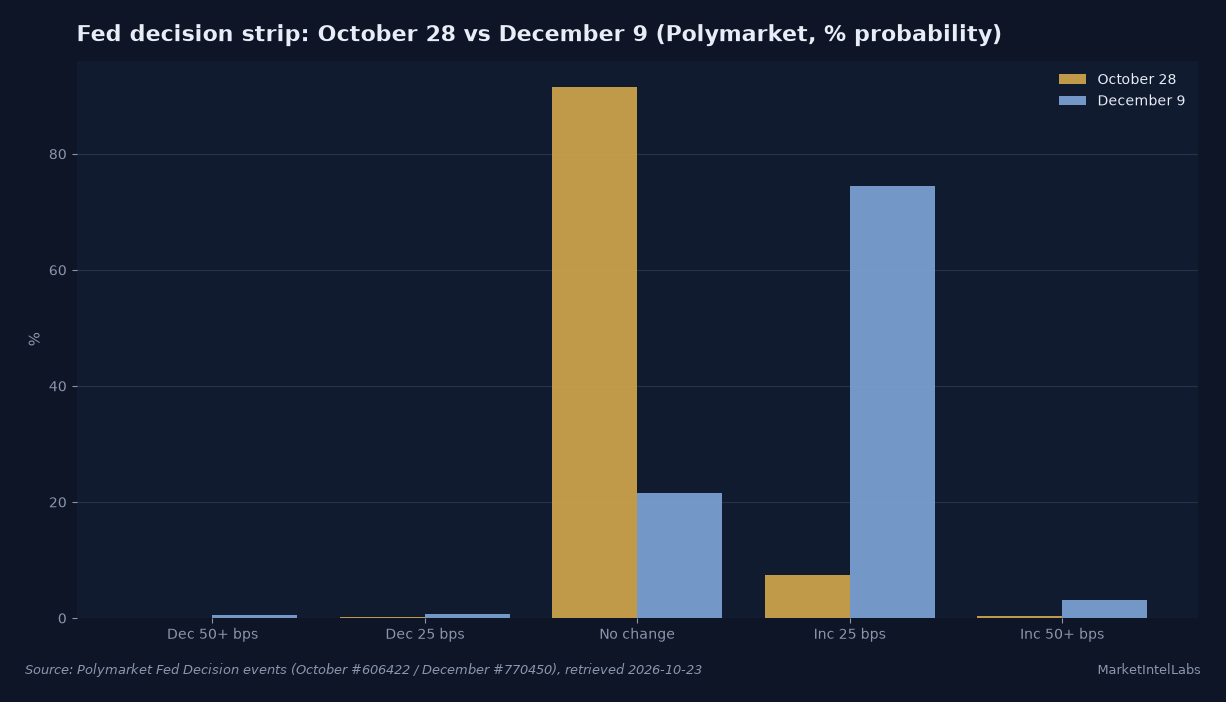
The spread between the October and December strips is the cleanest signal in the market right now. October holds at 91.5 percent and December hikes at 74.5 percent, and the market is comfortable holding both at once. That combination is only coherent if participants expect the committee to acknowledge the energy shock in October, decline to act, and then normalize policy once the shock has a full meeting cycle to pass through the base effect. Prediction markets are often accused of chasing the last headline; here the strips are pricing a deliberate sequencing rather than a snapshot.
Related reading: October Fed decision odds: no-change market holds 85.5% as the Oct 28 meeting closes in.
The December numbers matter for what they imply about the path, not just the single meeting. A 74.5 percent probability on a 25 basis point hike means the market is not pricing a long holding pattern into year end. It is pricing the start of a tightening cycle, one the market expects to continue. The 50 plus basis point rung is small at 3.05 percent, but its presence is the market's way of saying the committee could skip a measured step and move in a half point should oil, near 113 dollars a barrel, keep pushing on the inflation side.
The October hold is the anchor that keeps the December repricing disciplined. With Brent near 113 dollars and the 10 year at levels that pulled gold back to 4,103 on October 22, an October hike was never a real proposition for the market. The 7.5 percent October hike line has held through the energy shock. Today's claims print worked on the December leg in the opposite direction: by removing labor slack, it argued for a hike sooner rather than later, and the December strip responded.
Related reading: Weekly jobless claims odds: Kalshi ladder settles as initial claims print 194,000.
There is a structural risk in the December read, and it lives inside the venue design. Ladder markets such as Kalshi's concentrate volume and open interest on the near rungs. The December 4.00 percent and 4.25 percent rungs carry the bulk of the book, with 31,735 and 19,446 dollars of open interest respectively, which can push the cumulative hike probability a point or two above what fed funds futures would imply. Polymarket's single line read of 77.55 percent for any December hike is the cleaner estimate, and it is the one I weight in the analysis. Registration of the odds is the part of this market that is easy to get wrong, so the distinction between a single line quote and a cumulative ladder total is worth holding in mind.
The second-order variable is the next data, not the current quote. The November jobs report lands November 6 and November CPI around November 11, and both will move the December strip directly. If claims hold under 200,000 into November 6, the 25 basis point line drifts toward 80 percent. If CPI runs hot on top of the oil shock, the 50 plus rung, currently 3.05 percent, becomes the market's vehicle for pricing catch up risk rather than a measured move.
One caveat on resolution mechanics. Polymarket is scheduled to settle the December decision shortly after December 9 against the actual target range the Fed sets, and Kalshi's ladder is set to settle the same day at 18:55 UTC. All probabilities here are dated as of October 23 and sourced to the two venues. No figure in this piece is a recommendation, and the gap between the 74.5 percent single line and the cumulative ladder total is the honest uncertainty the market carries into the final meeting of the year.
Watch three things between now and December 9. First, the November 6 jobs report, which is the next real input and likely to move the 25 basis point line several points in either direction. Second, the November CPI just after, which is the inflation check on the oil shock. Third, and most quietly, the December ladder 4.50 percent rung at 4.5 cents, which prices a second hike of the year. If that rung climbs toward 10 cents before Thanksgiving, the market is no longer pricing a single December move but the start of a series, and the tenor of the whole strip changes.
Track the conventional side of the strip as a sanity check, not as a competitor. Fed funds futures embed December expectations that have been converging on the prediction market view through October, which is the pattern you want to see when a repricing is driven by data rather than by a thin order book. Convergence matters because ladders can drift on volume alone. When the futures curve, the Kalshi ladder and the Polymarket line all point at the same interval, the odds are carrying information; when they diverge, the divergence is the story, and this week the three are unusually close.
Resolutions. A morning piece on this desk settled the weekly jobless claims ladder. Initial claims for the week ending October 17 printed at 194,000, which resolved the 194,000 rung to yes and the higher rungs to no. Four pending track record rows tied to that print were patched to resolved against the Bureau of Labor Statistics release and the Kalshi settlement, with a follow up slug referencing the claims ladder piece.
This content is for informational purposes only and does not constitute financial advice. Past performance is not indicative of future results. Consult a qualified financial advisor before making investment decisions.
Get daily intelligence delivered
Create a free account for the Daily Brief every weekday and The Week Ahead every Sunday. No card required.