Weekly jobless claims odds: Kalshi ladder settles as initial claims print 194,000


Kalshi's weekly jobless claims ladder settled with only one rung resolving yes when the Labor Department printed 194,000 seasonally adjusted initial claims for the week ending October 17. The print landed inside the narrow band the market had priced as most likely, yet it still knocked out three of the four ladder arms the desk tracks, including the at or above 195,000 contract that carried a 71 percent price at coverage.
The Labor Department's advance report, published October 22, put the seasonally adjusted total at 194,000, down 6,000 from the prior week's upwardly revised 200,000 at the Labor Department unemployment insurance data page. A year earlier the comparable week ran about 231,000, so the current reading keeps claims near the top of the range of low prints recorded through 2026.
Related reading: September CPI market: Kalshi 0.5% contract settles YES, October Fed hike odds jump to 36.5%.
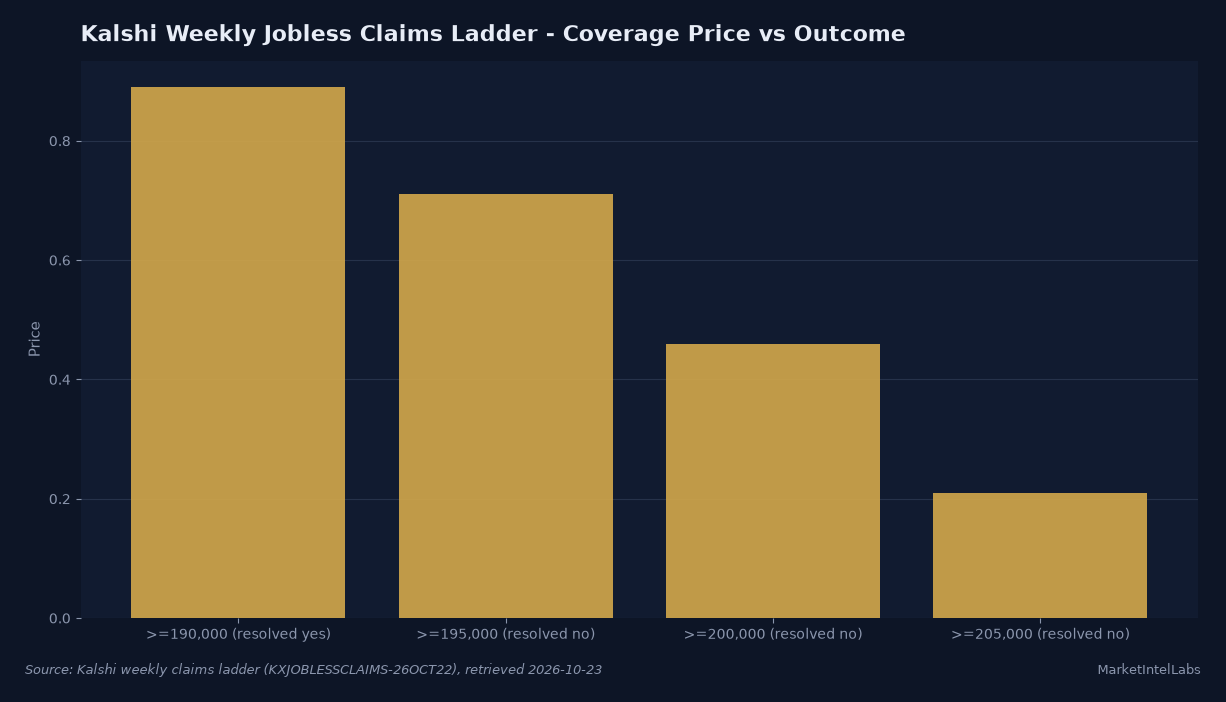
On Kalshi, the weekly ladder asks how many initial claims will be filed for the reference week, with one contract per threshold. The desk's covered prices, locked in before the release, were 89 percent for at or above 190,000, 71 percent for at or above 195,000, 46 percent for at or above 200,000, and 21 percent for at or above 205,000. The settlement made the picture clean. The 190,000 arm resolved yes because 194,000 clears it. The 195,000, 200,000, and 205,000 arms all resolved no because the print fell short of each.
The most useful signal sits on the 195,000 arm. It was the only losing rung that had traded above even money, priced at 71 percent at coverage, and it collapsed to zero on a print that was barely below the threshold. That is the shape of a market that had the direction right but drew its central mass one notch too high. The winning rung at 190,000, priced at 89 percent, was the safe anchor, while the market treated 200,000 and 205,000 as long shots even before the number came in.
For the broader framework, see our Fed policy coverage.
Related reading: Jobless Claims Forecast: 200K Before Fed's October Decision.
What the settlement says about the rate path
Claims at 194,000 carry a straightforward read for the Federal Reserve debate. A labor market this firm is not the setup that usually argues for near-term rate cuts, which is why the October meeting still trades as a near-certain hold. On Kalshi the October decision was priced around an 85 percent hold as of the October 22 preview published on this section's home desk, while Polymarket's no change contract for the October 27-28 decision was trading near 93.5 percent.
The December leg is where opinion splits, and the claims settlement reinforces the hawkish side. The macro desk led an October 22 piece flagging Kalshi pricing a roughly 76 percent chance of a December rate hike as October appears set to pause. The low claims print feeds that same direction, because it gives the committee no sign of labor market slack when the inflation side is already under pressure from oil.
Related reading: Kalshi CPI Ladder: The 0.5% Threshold Slips to 58.5% as Neighboring Brackets Narrow.
The offsetting view keeps a floor of skepticism. One 194,000 reading is one week, and the prior week was revised up by 1,000 from 199,000 to 200,000, which muddies the trend. The four week moving average smooths some of the noise, and the ladder showed the market itself was not convinced the 200,000 or 205,000 thresholds were in play. If claims drift back up toward 200,000 in the next two prints, the December contract reprices quickly, which is the live variable to watch between now and the December 9 decision.
The odds asymmetry is worth spelling out. A ladder arm that carries a 71 percent price but resolves no is a heavier miss than a long shot that fails, and it is the kind of outcome that tells you where the marginal dollar of conviction sat. Because the 195,000 rung drew that much money and still settled at zero, the market's read on labor market tightness ran slightly more hawkish than the data delivered. That gap between market expectation and realized print is exactly the divergence prediction markets exist to surface.
Related reading: September CPI ladder resolves: Kalshi 0.6% threshold settles NO as BLS prints 0.59%.
Resolutions
Recorded to the prediction-markets ledger against the Labor Department's advance claims report. The at or above 190,000 contract (KXJOBLESSCLAIMS-26OCT22-190000) resolved yes, priced 0.89 at coverage. The at or above 195,000 contract (KXJOBLESSCLAIMS-26OCT22-195000) resolved no, priced 0.71. The at or above 200,000 contract (KXJOBLESSCLAIMS-26OCT22-200000) resolved no, priced 0.46. The at or above 205,000 contract (KXJOBLESSCLAIMS-26OCT22-205000) resolved no, priced 0.21.
Two Polymarket ceasefire rows tied to October 22 were recorded as void rather than resolved. The US x Iran ceasefire-through-October-22 market still showed an open and disputed settlement at the time of checking, with the venue's own resolution flag not finalized, so neither a yes nor a no could be confirmed against a settled binary. Those rows carry a void status and a follow-up slug pointing to this piece.
The next data point on this beat is the October 27-28 Federal Open Market Committee decision, followed a day later by the October 29 initial claims release. The October claims contract for the week ending October 24 is already listed, and the December rate contract keeps the widest spread between the October hold and the December hike camps. Both are the markets to watch for the next repricing.
This content is for informational purposes only and does not constitute financial advice. Past performance is not indicative of future results. Consult a qualified financial advisor before making investment decisions.
Get daily intelligence delivered
Create a free account for the Daily Brief every weekday and The Week Ahead every Sunday. No card required.