Why Bitcoin ETF outflows hit $3.47B in November: the Fed repricing behind the exodus


Bitcoin's November slide is an institutional liquidity unwind, not a broken thesis. US spot Bitcoin ETFs recorded about $3.47 billion in net outflows for the month through Nov 20, 12 of 14 sessions in the red, and BlackRock's IBIT capped the exodus with a record $541 million single-day exit on Nov 19. The same macro repricing that revived talk of a December Fed hike is pulling the money that entered digital assets through traditional brokerage rails back out.
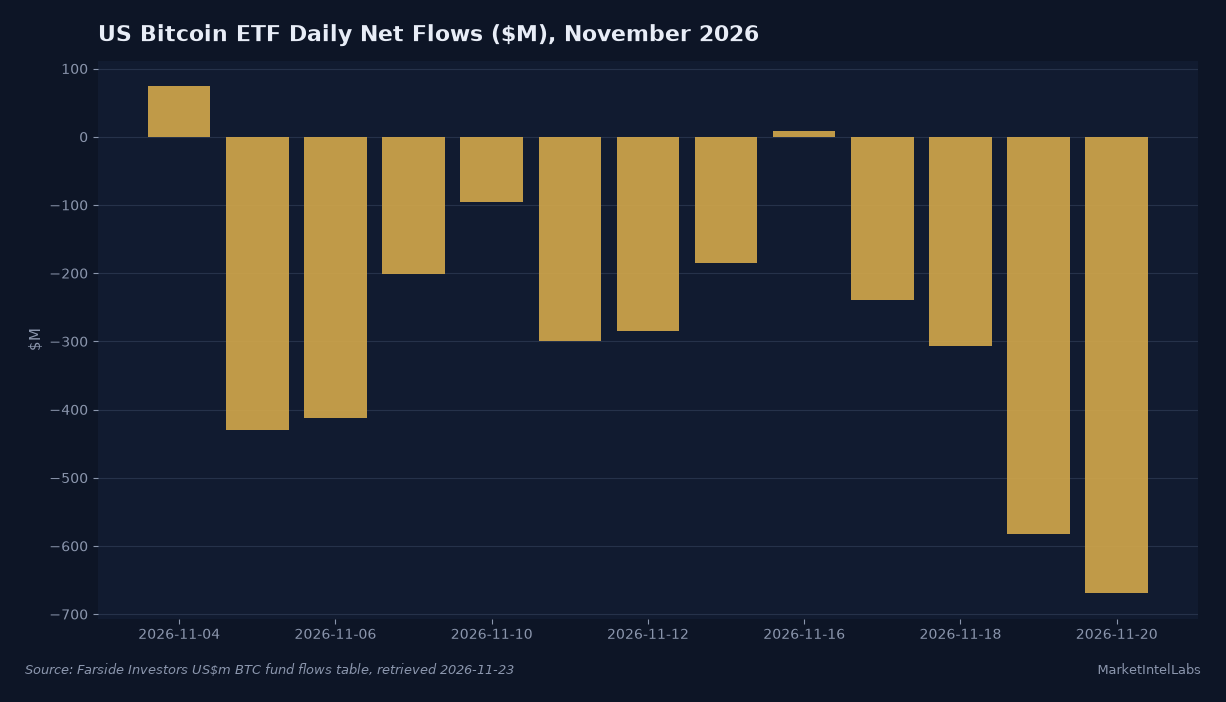
The numbers from Farside and issuer reports tell the story plainly. The week of Nov 16-20 alone produced about $1.79 billion in net Bitcoin ETF outflows, and the month-to-date figure of roughly $3.47 billion makes November the worst stretch since June, when ETFs shed $4.51 billion. The selling is concentrated, not broad.
Related reading: Ether ETF Outflows Hit ~$1.08B, Largest Since November 2025.
IBIT drove the exodus with outflows in 13 of 14 sessions, and its $541 million single-day redemption on Nov 19 amounted to about 93 percent of everything that left the category that day. Fidelity's FBTC, Grayscale's GBTC and ARK's ARKB all bled alongside it, but the leader of the pack is leaving the fastest.
This is a macro trade way before it is a crypto trade
What changed in November was not anything specific to Bitcoin. It was the interest-rate path. Revived tightening fears and a firmer dollar removed the cheap-money backdrop that had carried risk assets higher through the summer, and crypto sits at the high-beta end of that exposure. The correlation with liquidity conditions is well documented, and when the market begins to price a live December hike, the near-zero-rate-asset competition tightens and the institutional bid pulls back.
For the broader framework, see our Fed policy coverage.
Related reading: Bitcoin ETF Flows Reverse: $635M Oct 22 Exodus Ends $997M.
The Cleveland Fed nowcasts November PCE at 3.78 percent on the year and core at 3.32 percent, numbers that keep a December move on the table. That is the backdrop the ETF flow data is responding to, and it is why the pain has spread beyond Bitcoin. Ethereum ETFs snapped a six-day outflow streak with a modest $2.3 million inflow on Nov 13 but still lost about $336 million that week and roughly $0.7 billion for the month. Ether retreated to about $1,728, down 16 percent month to date.
Solana ETFs shed about $28 million on the week while keeping $1.6 billion in cumulative net inflows, and SOL last traded near $71.81.
Related reading: The Rotation Inside Crypto: Bitcoin ETF Outflows Meet a Record Ether Inflow Streak.
The broader tape confirms the reading. Crypto is behaving like the tail of a risk-appetite contraction rather than an isolated accident, with the same drawdown marked in equities and a firmer dollar dragging on gold's safe-haven bid as well. None of that is a forecast of permanent damage. It is a liquidity regime change showing up first in the asset with the highest beta to liquidity.
Watch the composition and the read sharpens. Redemptions concentrate in the largest, most liquid funds, the names that took in the bulk of this cycle's inflows, and IBIT alone carried about 93 percent of one session's selling. That is the signature of an institutional desk trimming under a repricing, not of a damaged product losing its faithful holders, and it is why the headline outflow number deserves context before anyone reads it as a verdict on bitcoin.
Related reading: Bitcoin ETF Flows Pause, Not Reverse, as Custody Clarity Advances.
Retrenchment, not exit
The bull case rests on the cumulative ledger. Even after a month of record redemptions, net inflows into US spot Bitcoin ETFs since launch remain near $54.7 billion as of Nov 13, per Farside. That is the distinction that matters: money that rotated out through brokerage rails is down sharply, but the base of the position that built over two years is still very much intact. This reads as a retrenchment inside a long-building position, not a wholesale exit from the asset class.
The pattern supports the retrenchment reading. This month's exodus is front-loaded and short-window, consistent with macro positioning being taken off in a repricing, and the shape of the outflow month differs from the steady, broad bleed that marks a durable loss of confidence.
There is precedent for the correction to reverse on the same catalyst that caused it. June's $4.51 billion outflow month gave way to a September rally once rate fears faded and flows reversed. The current setup echoes that pattern, though with caution flags: the November streak has been both deeper and longer, and a record single-day IBIT exit suggests the unwind still has momentum.
If Wednesday's PCE prints hot and the Fed turns explicitly hawkish in December, the outflow streak extends and Bitcoin's 52-week low zone near $55,150 becomes the next technical reference rather than a floor. The bounce that carried Bitcoin back toward $61,600 on Nov 23 looks so far like a reflex off a liquidity low, not a reversal signal.
What to watch is therefore macro, not on-chain. Wednesday's PCE print and the Dec 8-9 FOMC decide whether this becomes a sharp but contained repricing or a deeper drawdown. Nothing about the flow picture has broken the fundamental demand case, and a regulatory tailwind, the SEC's proposed Regulation Crypto Assets framework, remains in public comment unchallenged by the price move. The institutional story, meanwhile, is unchanged: the money that built this position in dollars is the money that can take it out, and it will follow the rate path until it turns.
This content is for informational purposes only and does not constitute financial advice. Past performance is not indicative of future results. Consult a qualified financial advisor before making investment decisions.
Get daily intelligence delivered
Create a free account for the Daily Brief every weekday and The Week Ahead every Sunday. No card required.