Week in Review: Oil's Supply Shock Keeps the December Fed Hike on the Table


Two things happened to markets this week at once, and the combined effect is what mattered. An energy supply shock pushed Brent crude to a week high near $118 a barrel and held it above $115 for all five sessions, while a Federal Reserve that left its target at 3.75% to 4.00% on October 28 kept a December rate hike squarely on the table. Investors spent the week repricing both forces at the same time, and the closing data shows the tension is unresolved. This is the week in review.
For the broader framework, see our Fed policy coverage.
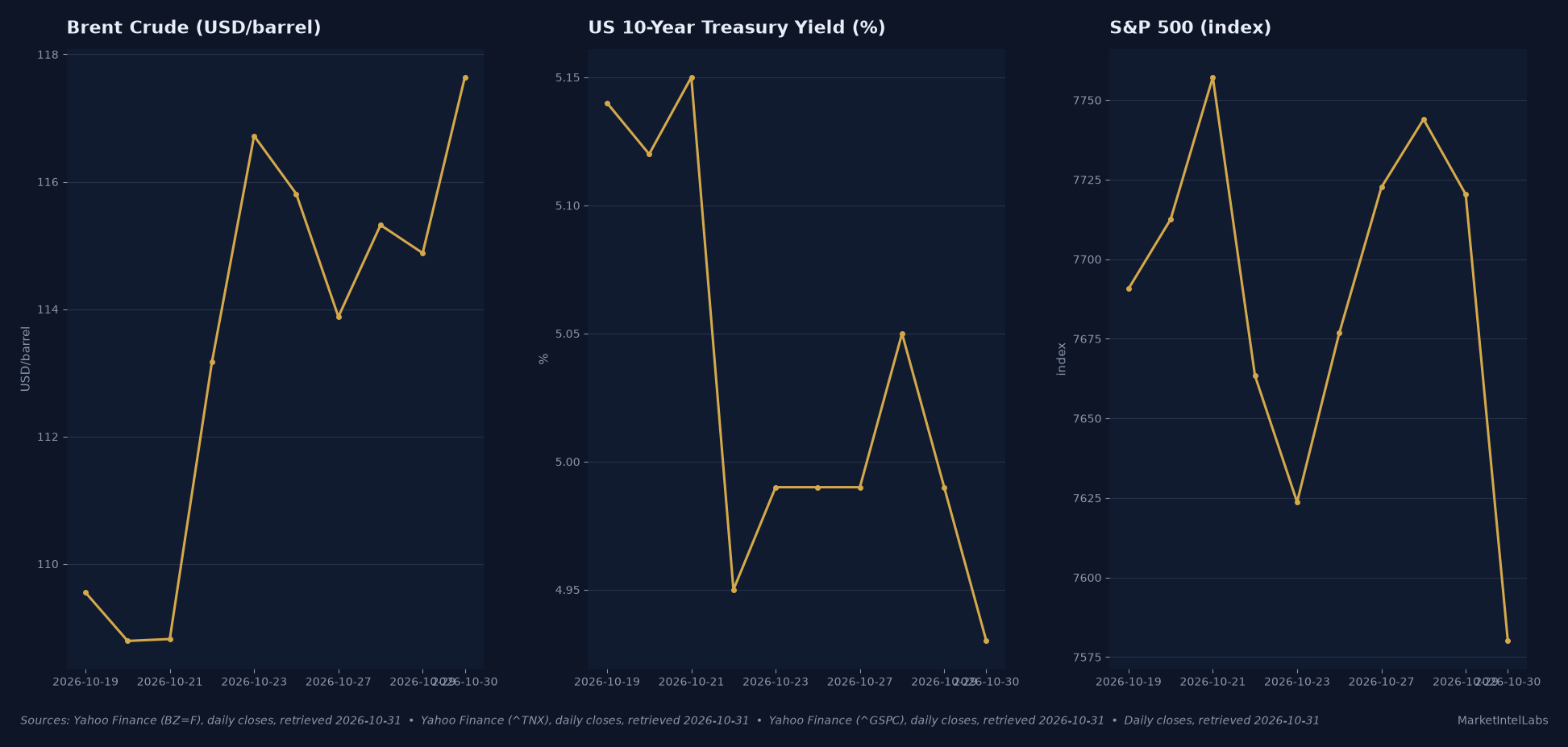
Three headlines carried the week's defining repricing. On October 28 a claim surfaced that workers at the Ras Tanura refinery had halted operations, putting one of the world's largest export hubs at the center of the story and helping push Brent toward $115 <a href="https://marketintellabs.com/research/ras-tanura-refinery-strike-brent-115">in our breakdown of the strike claim</a>. Thursday a tanker attack in the Strait of Hormuz added a war-risk premium to shipments through the most important oil chokepoint on the planet <a href="https://marketintellabs.com/research/strait-of-hormuz-tanker-attack-oil-103">in our coverage of the attack</a>. The result was a crude complex that stayed bid all week: Brent spent every session above $115, pressed past $118 intraday Friday, and closed at $117.64, while West Texas Intermediate (WTI) finished at $104.12 after peaking near $105, leaving the Brent-WTI spread near $13.50. Refining stress and war-risk premia were the transmission, not just the spot price, and tanker economics moved with them <a href="https://marketintellabs.com/research/strait-of-hormuz-tanker-attack-oil-103">in the same shipping analysis</a>. A Saudi denial that Ras Tanura had actually been damaged then pulled oil off its highs to close the week <a href="https://marketintellabs.com/research/oil-prices-slide-saudi-denies-ras-tanura-damage">in our update on the denial</a>.
The second force came from the Federal Reserve and the arithmetic that surrounds it. The Federal Open Market Committee held the fed funds target at 3.75% to 4.00% on October 28 and, on the market's reading, kept December alive <a href="https://marketintellabs.com/research/fomc-rate-decision-fed-holds-december-hike">in our read of the decision</a>. Traders began the week pricing a December hike at about 81.5% on Kalshi. Third-quarter Employment Cost Index data arrived cooler than the wage pressure the market had feared and knocked those odds to roughly 74% <a href="https://marketintellabs.com/research/fed-december-hike-odds-ease-q3-eci-kalshi">in our piece on the Kalshi repricing</a>. September Personal Consumption Expenditures (PCE) inflation at 3.6% then held them near 73% to 74% into the weekend <a href="https://marketintellabs.com/research/september-pce-december-fomc">in our analysis of the PCE print</a>. The advance estimate that put third-quarter gross domestic product (GDP) growth above forecasts complicated the call, since a strong economy can absorb another hike <a href="https://marketintellabs.com/research/q3-gdp-advance-estimate-beat">as we covered</a>. Against that backdrop the 10-year yield tested 5% again, holding at or above the round number until Wednesday's 5.05% peak before settling at 4.93% Friday.
A week earlier the setup looked different. The prior Friday closed with December hike odds still above 80% and a freshly delivered Fed hold, and the market's job was to figure out how much of that hike was already in the price. The ECI and PCE prints did most of the resolving, easing the wage pressure narrative and pulling odds down. Oil pushed in the other direction, because every barrel of supply taken off the market is, in the Fed's inflation math, a reason to stay hawkish. That is the tug of war this week's close represents.
The third thread was narrower but it shaped Friday's tape. Alphabet posted the biggest one-day drop on record, down roughly 12%, and Microsoft said its planned capital spending would roughly double, refocusing investors on the cost side of the AI trade <a href="https://marketintellabs.com/research/alphabet-stock-drop-record-12-selloff">in our Alphabet coverage</a> and <a href="https://marketintellabs.com/research/microsoft-q1-earnings-capex-doubles">in our read of Microsoft</a>. The Nasdaq-100 fell 3.46% on Friday alone as that repricing hit the index, and the weekly loss followed. That settles the story for the purposes of this wrap; the AI capital cycle gets the full treatment elsewhere on this desk.
The bull case for the week is that the damage was contained and targeted. Small caps rose as money rotated away from the megacap names, the S&P 500 lost a modest 0.57%, and if the Saudi denial on Ras Tanura holds and the Hormuz situation does not escalate, crude's inflation impulse fades, December odds can ease further, and the 5% yield scare unwinds. The bear case is that investors are now paying for two risks at once: an inflation shock that argues for staying hawkish, and an AI capital cycle the market has decided is too expensive. Gold fell 2.72% and silver dropped 8.58% for the week, a reminder that a firm Fed plus firmer real yields is an uncomfortable place for risk assets, and bitcoin lost 4.78%. Both readings are defensible from the same close.
Here is where the major benchmarks ended the week, set against the prior Friday close. All prices are daily closes from Yahoo Finance, retrieved 2026-10-31.
| Asset | Friday close (2026-10-30) | Prior Friday close (2026-10-23) | Weekly change |
|---|---|---|---|
| S&P 500 | 7,580.07 | 7,623.68 | -0.57% |
| Nasdaq-100 | 28,384.85 | 28,957.53 | -1.98% |
| Dow Jones Industrial Average | 51,770.31 | 52,215.16 | -0.85% |
| Russell 2000 | 2,811.84 | 2,775.90 | +1.29% |
| 10-Year Treasury Yield | 4.93% | 4.99% | -6 bps |
| US Dollar Index (DXY) | 101.88 | 101.81 | +0.07% |
| WTI Crude | $104.12 | $103.27 | +0.82% |
| Brent Crude | $117.64 | $116.72 | +0.79% |
| Gold | $3,898.90 | $4,007.90 | -2.72% |
| Silver | $49.10 | $53.71 | -8.58% |
| Bitcoin | $77,198.21 | $81,074.19 | -4.78% |
The week ends with the two forces still fighting. What matters next is the path of crude through a still threatened Hormuz, whether the Ras Tanura situation is actually resolved, and the next inflation and labor prints that will test how much of the December hike the market can hold onto. War-risk premia squeezing shipping economics would only reinforce the Fed's stated caution, and even a fully priced hike leaves the market little room to be wrong. The AI capital spending reset is also unfinished, and whether the selloff spreads from the largest platforms to the wider supply chain is the open question into next week. The honest summary is that rates stayed pinned near 5%, oil stayed bid, and the market spent the week paying for both.
This content is for informational purposes only and does not constitute financial advice. Past performance is not indicative of future results. Consult a qualified financial advisor before making investment decisions.
Get daily intelligence delivered
Create a free account for the Daily Brief every weekday and The Week Ahead every Sunday. No card required.