US Strikes Iran Again: CENTCOM Extends Blockade Overland

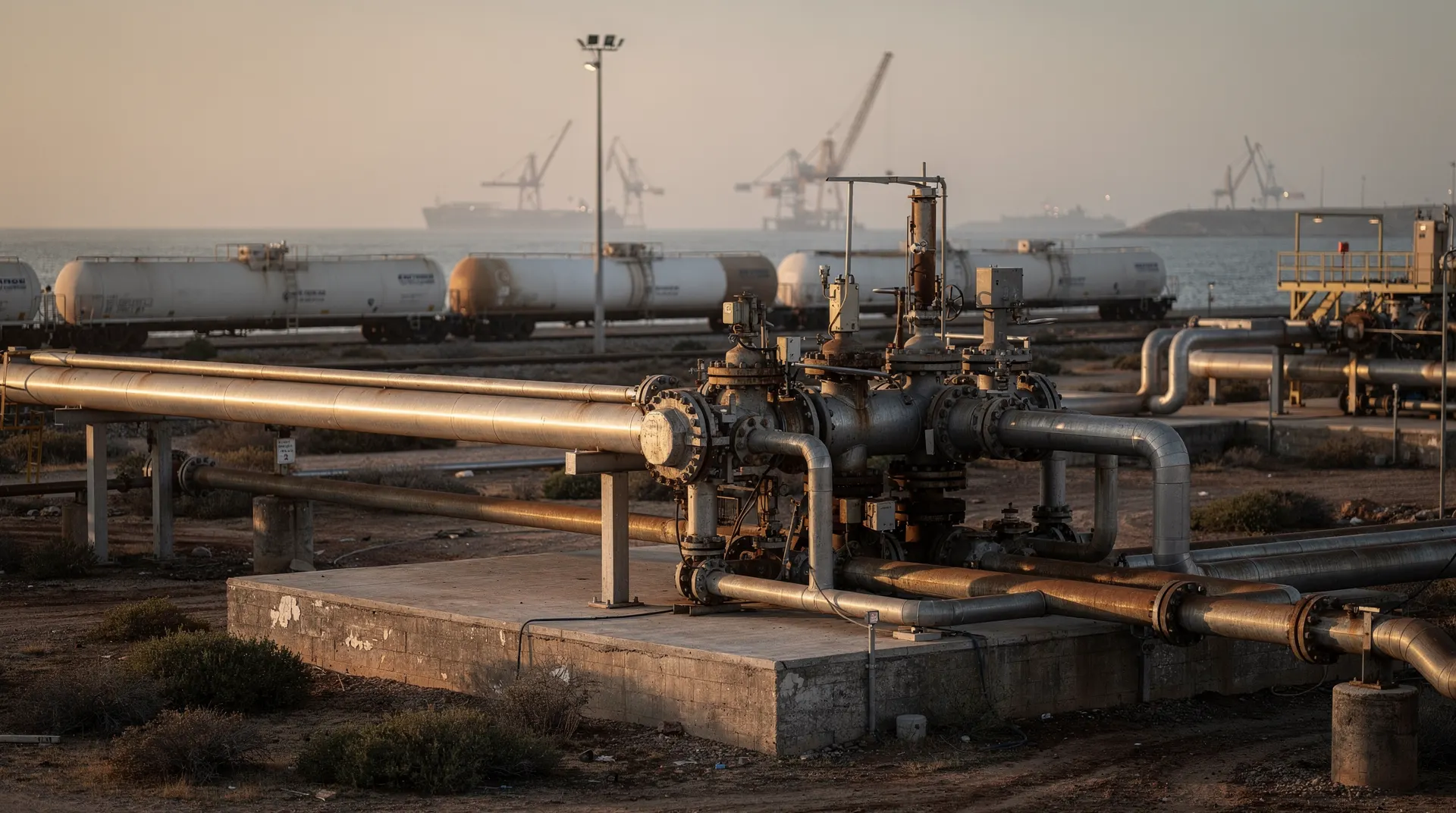
Trump confirmed Friday evening that U.S. forces carried out fresh, limited strikes on Iran, and over the following day Central Command announced it is pushing the Strait of Hormuz naval blockade overland into Iran's land-border and Caspian corridors. That double development re-rates the oil war-risk premium that slid on Iran-peace hopes, because the forces that compressed it and the forces that could reflate it are now both live at once.
The confirmed details come with the clash they usually carry. Iranian state media reported two missiles struck Qeshm Island around 13:47 UTC Friday with two explosions, according to the Tasnim news agency as carried by Reuters, and Reuters reported it as a strike on the island. Trump, speaking at West Palm Beach, said U.S. forces "knocked out" an Iranian anti-aircraft device near the Strait of Hormuz "in about 15 minutes, maybe five," per CNBC. The White House framed the actions as limited and minor; they are still the first U.S. attacks on Iran since the Nov 3 midterm elections.
Related reading: US strikes Iran's Qeshm Island and mines hit tankers: oil tops $106 and Brent $107 as Hormuz paralysis sets in.
Saturday brought the organizational step. U.S. Central Command announced Task Force Iron Gate, an expansion of the blockade to Iran's overland and Caspian Sea trade routes, with about 20 civilian and military personnel based in Florida, according to CBS, targeting advanced weapons, dual-use technology, sanctioned materials and illegal revenue across Iran's land borders and the Caspian. CENTCOM chief Adm. Brad Cooper said the task force "reinforces the success of our ironclad blockade against Iran at sea." The naval leg has already kept some $25 billion in Iranian crude sales off the market, per CBS, and the overland extension reaches the Chinese rail route through Central Asia and the Russia-to-Caspian channel that have been carrying what the marine blockade cannot stop.
The market transmission is the spine of this story. Crude and refined products re-enter a war-risk bid as the escalation file grows, but they do so from a market that just slid on the opposite thesis: the oil price fell sharply on Democratic-sweep and Iran-peace hopes, a slide the house reads as pulling the December Fed decision toward a cut. Both pressures are real and both run at once, which is exactly what makes this stretch hard to trade on direction alone.
For the broader framework, see our crude oil coverage.
Related reading: Oil Price Drops 6% Below $100 as Iran Peace Draft Circulates.
The bear case for the premium lives in the diplomatic track. Qatar has been mediating a ceasefire proposal that would lift the blockade, release frozen Iranian funds and reopen the Strait of Hormuz, with those details reported by CBS and ABC. The Democratic sweep creates its own de-escalation pressure, and the recent slide into peace expectations reflects a market that has been pricing a deal as the base case.
The bull case rests on observable escalation. The White House signaled continued military pressure even after the sweep, Iran has publicly refused to accept "paper commitments," and the IRGC lifted its self-imposed 1,200-mile missile range limit on Saturday, a move CBS attributed to Gen. Hossein Mohebbi. The reward layer thickens the conflict: a day before the task force announcement, CENTCOM and the State Department's Rewards for Justice program offered up to $20 million plus possible relocation for information on Iran's nuclear program, which the IAEA has noted involves 60 percent enriched uranium a "short technical step" from weapons-grade, per the program's posting. None of that is a forecast, but it is the set of dated catalysts that keep a Hormuz chokepoint premium priced.
Related reading: Brent price near $115 as Hormuz conflict premium holds: Brent-WTI spread stays near $13.7.
The numbers underneath the political theater are not flattering to Tehran's economy. The IMF's October World Economic Outlook, cited by CNBC, forecasts Iranian CPI at plus 78.6 percent in 2026, which is the inflation backdrop against which blockade-driven revenue losses land.
The dated inputs to watch are Iran's response to the strikes, progress or collapse of the Qatar mediation, any Iranian missile-range demonstration, and how Israel and Washington react to the $20 million nuclear reward. For crude, the trade is the tension itself: the peace-deal discount that built through the slide and the blockade-driven war-risk bid are now competing for the same few dollars in WTI and Brent, and the direction will be set by which catalyst lands first.
Related reading: Oil Prices Plunge 9% on Democratic Sweep and Iran Peace Hopes; WTI Falls to $87.74.
This content is for informational purposes only and does not constitute financial advice. Past performance is not indicative of future results. Consult a qualified financial advisor before making investment decisions.
Get daily intelligence delivered
Create a free account for the Daily Brief every weekday and The Week Ahead every Sunday. No card required.