Section 232 robotics tariffs: industrial machinery proclamation sets a 180-day clock
For the week of November 2, 2026, the trade-policy event on the calendar is a 180-day recheck, not a new rate. Proclamation 11077, signed October 28 and published in the Federal Register on November 2, adjusts imports of robotics, industrial machinery, and their parts and components under Section 232 of the Trade Expansion Act. The adjustment it makes this week is to negotiations, and that distinction matters for anyone pricing the sector. Neither the text published in the Federal Register nor the White House fact sheet of the same date imposes a duty.
What the commerce finding said
The Commerce Department investigation, summarized in the proclamation's recitals, found robotics and industrial machinery are being imported "in such quantities and under such circumstances as to threaten to impair the national security," a finding the President concurred with. The text sizes the sector: about $7.1 trillion in shipments of manufactured goods in 2024 and about $86 billion in equipment production in 2024, with a U.S. base that, in the finding's language, "produces less robotics and industrial equipment than it consumes" and relies on foreign imports for most types. The White House fact sheet of October 28 adds the defense framing: nearly all modern defense systems and critical-infrastructure sectors use robotics or industrial machinery, which is what converts an industrial-equipment trade question into a national-security finding under Section 232.
Related reading: Foundry Robotics $100M October Series A funds autonomous assembly factory.
What the operative text does, and does not, do
Section 1 directs the Secretary of Commerce and the U.S. Trade Representative to "jointly pursue or continue pursuing negotiations of agreements" with trading partners whose imports threaten the national security. Section 2 is the consequential clause: "Depending on the status or outcome of such negotiations, I may consider alternative remedies in the future, including imposing or modifying tariffs, duties, quotas, and fees; and establishing a program to incentivize new investment in United States production of robotics and industrial machinery." No remedy is triggered by the proclamation itself.
The dates follow from that. The Secretary and the Trade Representative must update the President on the state of the negotiations "within 180 days of the date of this proclamation." Signed October 28, 2026, that checkpoint lands on or about April 26, 2027. Section 5 cites 19 U.S.C. 1862(c)(3)(A), under which the President may take further import-adjusting action if an agreement "is not entered into within 180 days," is not being carried out, or proves ineffective. Commerce is separately directed to keep monitoring imports between updates.
Related reading: Section 338 Canada Tariffs: 100 Lines Added to the 50% Duty List.
The robotics action is the second pattern inside the Section 232 program. Earlier proclamations imposed or strengthened tariffs on steel, aluminum, copper, automobiles and trucks, timber and lumber, semiconductors, pharmaceuticals, polysilicon, and drones. The recent equipment-adjacent actions have gone the negotiations-first route: processed critical minerals on January 14, commercial aircraft and jet engines on July 9, wind turbines on October 22, and now robotics and industrial machinery on October 28. EY's trade-practice analysis and the early trade-law briefs read the robotics proclamation the same way: a deferral with a defined timeline, not a tariff.
The priced consequence is a clock
For the robotics complex, the new information is the date, not the duty. The automation-and-robotics proxy has been de-rating for a month independent of this week's document: the ROBO ETF closed November 2 about 10.2 percent below its October 5 close, while the XLI industrials ETF ended the same window roughly flat. ROBO rose on the signature day itself, gaining from a 77.18 close on October 27 to 78.10 on October 28, then gave back the move to close at 74.81 on November 2, a 4.2 percent drop from that high. The chart below indexes both funds to 100 at the October 5 close.
Related reading: Agility Robotics AGLT: first US humanoid-robot stock nears $465M.
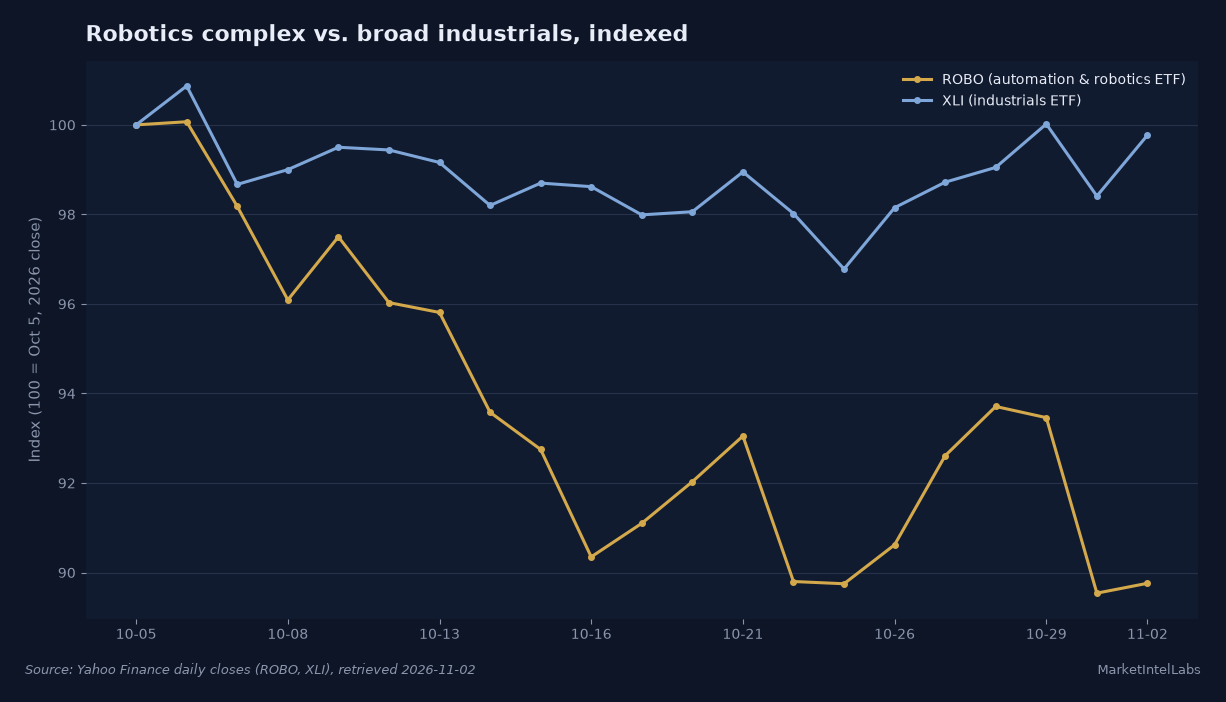
On the first session after the publication date, the broad industrials fund closed up 1.65 percent while the robotics-heavy ARKQ fund fell 3.33 percent. That divergence is consistent with a negotiation-first reading that defers a rate for wider industrials while leaving the robotics complex's structural exposure in place. A single session is not evidence of an effect; the month-long drift in the robotics proxy predates the proclamation.
Both sides of the deferral
The deferral narrows near-term pricing risk. For importers and buyers of robotics and industrial machinery, there is no tariff to carry today, and the negotiating window is a defined interval rather than an open-ended threat, with a dated recheck in April. The risk side is that a deferral is revocable. If talks stall, produce no entered agreement, or run ineffective, Section 5 preserves the full Section 232 toolbox of tariffs, duties, quotas, and fees, plus the investment-incentive program, and Commerce's standing monitoring duty can surface pressure before the April checkpoint. The finding that prompted the action, a U.S. base that consumes more than it produces, has not changed.
Related reading: FOMC Decision Today Explained: October Vote Due at 2 PM ET.
Three dated or recurring items follow from the proclamation itself. First, the negotiation update due on or about April 26, 2027. Second, whether the wind-turbine negotiations, opened October 22, reach an agreement in the interim and set a template for the machinery talks. Third, Commerce's import-monitoring reports, which can arrive between the 180-day updates. These are the events the proclamation calendars; they are not forecasts.
This content is for informational purposes only and does not constitute financial advice. Past performance is not indicative of future results. Consult a qualified financial advisor before making investment decisions.
Get daily intelligence delivered
Create a free account for the Daily Brief every weekday and The Week Ahead every Sunday. No card required.