Foundry Robotics $100M October Series A funds autonomous assembly factory
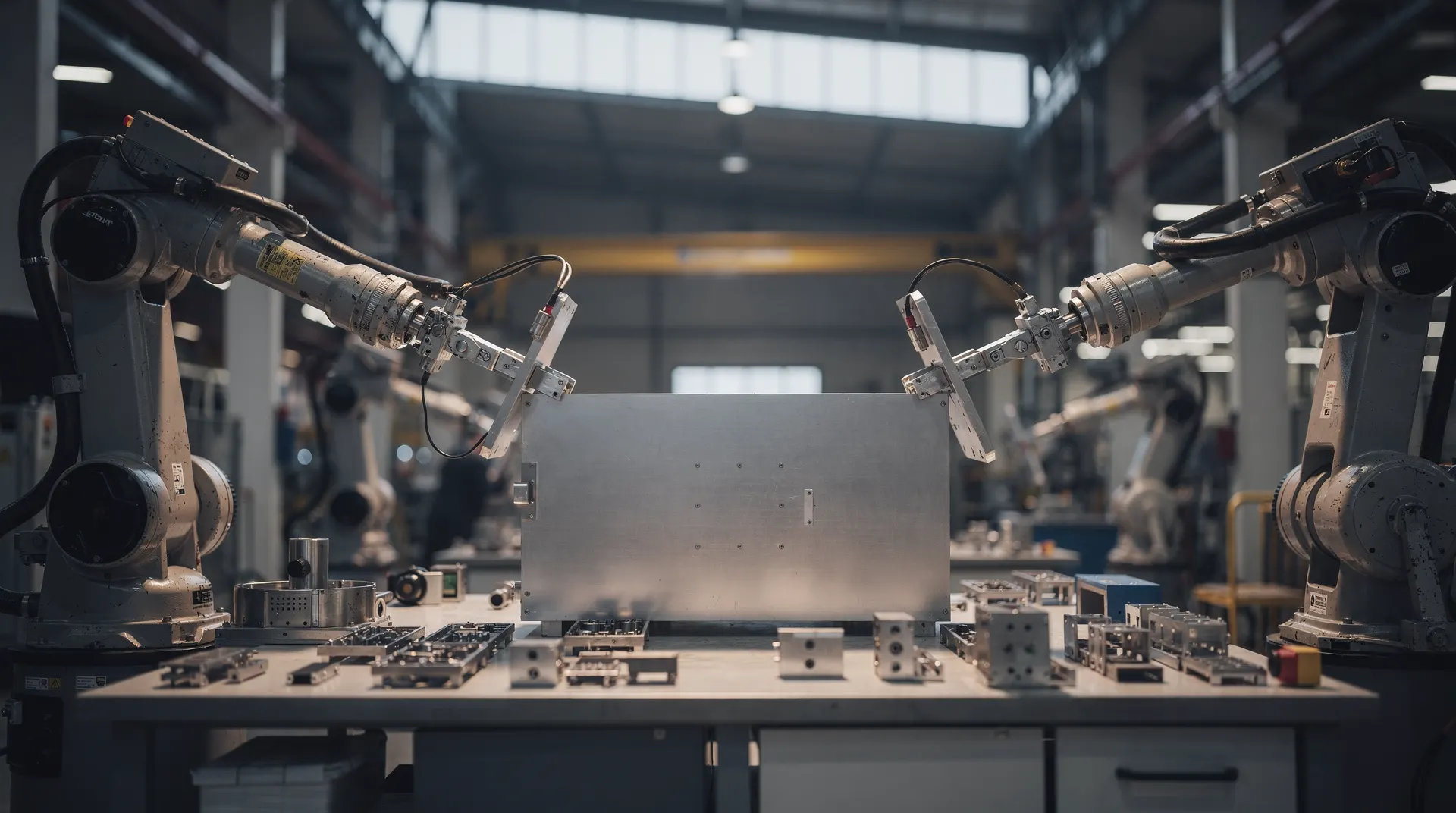
The most consequential print on the emerging-tech beat this week is a round, not a product. Foundry Robotics, a manufacturing-as-a-service startup that owns and runs assembly lines for defense and industrial hardware, announced on October 28 that it closed a $100 million Series A led by Marlinspike Partners. The release is the primary source: an oversubscribed round, early backers Khosla Ventures and Red Glass Ventures converted to participants, and new money came in from SE Ventures, Wing VC, and Axiom Ventures, alongside existing investors Hanabi and Zero Shot Fund. The company did not disclose a valuation.
What the money buys is a factory, and the number there is the story. Foundry said it has expanded its manufacturing footprint twentyfold to a 130,000-square-foot facility in Emeryville, California, and that the new capital will build that site out further, accelerate deployment of AI models into real-world manufacturing, and grow its robotics research, engineering, and factory operations teams. Foundry was founded in 2026 and is based in Emeryville. The build-out is a dated, verifiable industrial milestone attached to a dollar figure, which is exactly the kind of print this desk leads with.
Related reading: Weekly Jobless Claims Hold at 194,000; Continuing Claims Slip to Lowest Since Early October.
The second leg of the announcement is the acquisition of Avea Robotics, a robotics software company whose Sentinel platform provides real-time remote control of robots. The name matters because it explains how Foundry squares autonomy with reliability. Assembly is the compliance-heavy end of manufacturing: a single mis-torqued joint or reversed harness on a defense product has to be caught before it ships. Sentinel gives a human instant remote authority over a robot mid-task, which is how an operator de-risks an autonomous cell without slowing it down. The acquisition also feeds the data loop, because remote control sessions generate exactly the observation stream an AI model needs to learn a task. Goodwin, the law firm that advised Foundry on both the financing and the Avea deal, issued its own release on October 29 confirming the two transactions. Terms of the Avea acquisition were not disclosed.
Foundry's model is deliberately different from most of the robotics funding that crosses this desk. It does not sell robots or software. It sells capacity: manufacturing-as-a-service, where a customer brings a product design and Foundry delivers assembled units off a robot-run line. That position removes the go-to-market conflict a pure robotics vendor faces, where the buyer is often the person whose head count the robot would cut. Here the factory operator is the one capturing the automation upside, so the incentives line up on the vendor side of the transaction rather than against it.
Related reading: Gross Domestic Product Q3 Advance Estimate Explained Before the October 29 Release.
The application list in the release reads like the industrial wish list of the current defense build: drones, autonomous vehicle subassemblies, wire harnesses, underwater vehicles, telecom and data center infrastructure, ground robots, rugged computers, robot compute boxes, and satellites. These are all high-value, complex electro-mechanical products, and they share a property Foundry calls out directly: production is constrained. Labor for skilled assembly of defense hardware is scarce and expensive, lead times are long, and the products are too low-volume for the kind of fully dedicated automation a consumer-electronics factory would amortize. A flexible autonomous line that handles short runs is the manufacturing answer to that problem, which is why defense primes and the autonomy upstarts are both natural customers.
The comparable is worth stating on structure even before a listed comp prints a reaction. The closest public windows on this desk are the automation and robotics names and the sector ETF that tracks them, where autonomous factory and drone economics have been a running thesis for quarters. A $100 million round that values an assembly factory operator with committed floor space, a named customer channel in defense, and a teleoperation software bolt-on is the kind of private mark those vehicles price in when they buy robotics exposure. The private round carries no exchange price, so the discipline is to read it for what it signals about the cost of scarce assembly labor, not for a number on a tape. No valuation was published, and none of the investors have put a figure on the paper they hold, so the honest take is that the mark is large enough to attract defense and industrial attention but small enough to stay below the threshold of public disclosure.
Related reading: FOMC Decision Today Explained: October Vote Due at 2 PM ET.
The constraint that anchors this story is not capital. Foundry just raised it. The constraint is the supply chain underneath an autonomous assembly line, and specifically verification. An AI-managed cell can move fast once a process is proven, but proving it, and proving every unit after it, is the expensive part. That is exactly the gap Sentinel addresses, and it is the reason the software acquisition is not a side note but a core term of the same announcement. The hardware and the software were raised and bought together because neither works at industrial scale without the other.
What is dated next is the facility itself. The Emeryville site is operating today at 130,000 square feet, and the company's stated use of proceeds is to complete the build-out, embed more AI models in production, and grow the factory operations teams. The nearest named catalysts are the build-out schedule and, further out, the defense and commercial programs that name specific platform deliveries off that line. Investors who track this desk's beat should watch for the next customer announcement that attaches a platform name and a unit count to the Emeryville capacity, because that is the moment the private factory mark starts to translate into public backlog. Until then, the round stands on its primary facts: $100 million, October 28, a twentyfold factory, and a teleoperation software asset acquired in the same breath.
Related reading: Vertiv stock jumps 13% after AI data center earnings beat.
Sources: Business Wire, October 28, 2026, Foundry Robotics Raises $100 Million Series A to Build America's First Autonomous Factory for Assembly; Goodwin, October 29, 2026, Goodwin Advises Foundry Robotics on its $100 Million Series A Financing and Acquisition of Avea Robotics.
This content is for informational purposes only and does not constitute financial advice. Past performance is not indicative of future results. Consult a qualified financial advisor before making investment decisions.
Get daily intelligence delivered
Create a free account for the Daily Brief every weekday and The Week Ahead every Sunday. No card required.