FOMC Decision Today Explained: October Vote Due at 2 PM ET


The FOMC decision today is still pending. The Federal Open Market Committee meets October 27 and 28, and the decision is scheduled for 2:00 PM Eastern, or 18:00 UTC, on Wednesday, October 28. The last verified decision was the September 16 quarter-point increase, which set the federal funds target at 3.75% to 4.00%.
Read our decision preview for the immediate setup. Here, the important distinction is between a new vote and the market's interpretation of a vote that has yet to happen. The Federal Reserve calendar identifies the meeting and the September statement supplies the baseline.
Related reading: Fed Funds Rate Today: 3.75% to 4.00%, October Odds Favor Hold.
A hold would leave the target range unchanged, but that does not mean the statement's economic diagnosis must stay the same. A change to the target would require close attention to the size and wording of the move. In either case, the operating instructions and the Fed's discussion of inflation and employment tell readers more than a one-word headline. The official meeting schedule marks December 8 and 9 for the next projections, but not October.
This is an explainer rather than an advance report of the outcome. The September documents show what policymakers previously decided and expected. They cannot establish what today's Committee will decide at 18:00 UTC. That boundary is particularly important when a price move before the announcement is presented as though it were the central bank's instruction to the market.
For the broader framework, see our Fed policy coverage.
How we got to the October vote
The Fed came into the October meeting after increasing rates in September. Its September 16 release says the FOMC approved a 12 to 0 vote to lift the target by one quarter percentage point to 3.75% to 4.00%. The statement described economic activity as expanding at a solid pace, job gains as keeping pace with workforce growth, and inflation as elevated. Each of those descriptions can be compared with the corresponding October language when the new statement exists.
The September increase is easy to misread in a fast-moving search result. It was not an October action. If policymakers hold in October, they are making a new choice to keep the target where September left it.
If they adjust the target, the new statement will name the new range. The current range is a historical fact; the next vote remains unknown. Our fed funds rate explainer separates that target from the effective rate traded overnight.
The fuller account appears in the September meeting minutes. Participants supported the September quarter-point increase and discussed the evidence behind it. Several saw elevated increases in core services prices excluding housing and in core goods.
Some pointed to energy and business costs associated with the AI buildout. Those observations explain why September's statement emphasized inflation. They are evidence about a previous discussion, not a roll call for today's vote.
The minutes also show how apparently conflicting judgments can coexist. Participants saw the labor market near full employment while inflation remained above the Fed's goal.
According to the minutes, almost all participants viewed inflation risks as tilted upward; risks to the labor market had diminished and were broadly balanced. A policymaker may see both sets of risks and still disagree with a colleague over the right timing of the next change. The minutes identify arguments, not a mechanical voting rule.
September's Summary of Economic Projections provides another baseline. The median participant forecast 2026 PCE inflation of 3.7%, 2027 inflation of 2.3%, and 2026 real GDP growth of 2.3%.
The median projected 2026 year-end federal funds rate was 4.1%, and the 2027 median was also 4.1%. A median is the middle individual estimate, conditional on each participant's outlook. It is not a consensus announcement about the October vote.
Core inflation shows why one headline measure does not tell the whole story. In that September projections table, median 2026 core PCE inflation is 3.4%, versus 3.7% for overall PCE inflation. Core excludes food and energy. The distance between the two figures does not by itself prove what will happen to either measure next month; it does show why policymakers might distinguish underlying price pressure from a volatile component when explaining a decision.
The calendar lists the December 8 and 9 meeting with an asterisk indicating a Summary of Economic Projections. October 27 and 28 has no such mark. October's statement can differ from September's, but there is not a new October projections table to compare number by number with the September medians. A comment about the December path today is an interpretation of language or market pricing, not a freshly published October dot plot.
How a FOMC decision reaches borrowing costs
The FOMC chooses a target range for the federal funds rate, a rate tied to overnight transactions in reserves. The New York Fed rate reference distinguishes the effective rate drawn from transactions from the policy target range. The target is not the same as a bank's posted mortgage rate or a household's credit-card contract. A decision changes the Fed's overnight anchor, after which market rates and lenders respond through several channels.
September's implementation note tells the New York Fed's market desk to maintain the funds rate within 3.75% to 4.00%. It sets standing overnight repurchase agreement operations at 4.0% and overnight reverse repurchase operations at a 3.75% offering rate, with a $160 billion daily per-counterparty limit. The Board separately raised the interest rate paid on reserve balances to 3.90%, effective September 17. Those terms help steer money-market rates toward the chosen range.
These details matter even when the target range attracts all the attention. Repo and reverse repo settings influence how eligible counterparties manage overnight cash and collateral.
The September implementation note also authorizes Treasury bill purchases, if needed, to maintain ample reserves. A reader who scans only the rate number could miss an operational adjustment that affects the supply of liquidity. Neither a purchase authorization nor a standing facility rate is the same thing as a promise about a 30-year mortgage quote.
Longer rates respond to an expected series of future short rates and to compensation for risk. In the September minutes, the New York Fed's market manager said nominal yields rose around 35 basis points across the two- to 10-year Treasury segment over the intermeeting period. The account partly associated that move with a higher expected policy path and stronger economic data, while also naming other influences. A target hold, therefore, need not send the whole Treasury curve lower.
Bank lending adds another layer. A lender pays for deposits or wholesale financing, weighs a borrower's credit risk, and chooses a margin.
Existing fixed-rate borrowers generally keep their contracted terms, while variable-rate products may reset according to their own benchmarks and schedules. Markets may change quotes ahead of the FOMC meeting if investors think the vote is predictable. A later reversal in those expectations can affect rates even if the Fed itself does not change today's target.
For that reason we separate three objects: the FOMC's announced target, the effective overnight market rate, and the rates charged on longer or riskier lending. They are connected, but they are not interchangeable. The September statement describes the first, the New York Fed benchmark page addresses the second, and individual loan terms determine the third. A single headline saying “rates stayed the same” is incomplete unless it identifies which rate.
Expectations can also move after a hold. If the Fed changes its wording on inflation or employment, traders may revise what they think will happen in December.
That would be a market forecast, not a Fed pledge. Our policy and markets column covers the earlier positioning. The decision-day test is more concrete: compare the new range and statement with the dated September releases, then see whether the implementation instructions changed.
The Federal Reserve strategy review keeps the central bank's longer-run inflation goal at 2%; that goal was outside the review's scope. September's statement described inflation as elevated and tied the rate increase to the dual mandate. Neither statement sets a date on which inflation must return to 2%. Employment and price evidence can conflict, and the Fed has to judge their relative risks at each meeting.
The chart shows the gap between rates and inflation
Our original chart uses the medians in the Fed's September projections table. For 2026 through 2029, median PCE inflation runs 3.7%, 2.3%, 2.1% and 2.0%.
Median year-end federal funds rates for those same years are 4.1%, 4.1%, 3.9% and 3.6%. The series share a percentage axis, but one records annual inflation forecasts while the other is a projected year-end policy rate. The chart plots September estimates only, with no invented October observation.
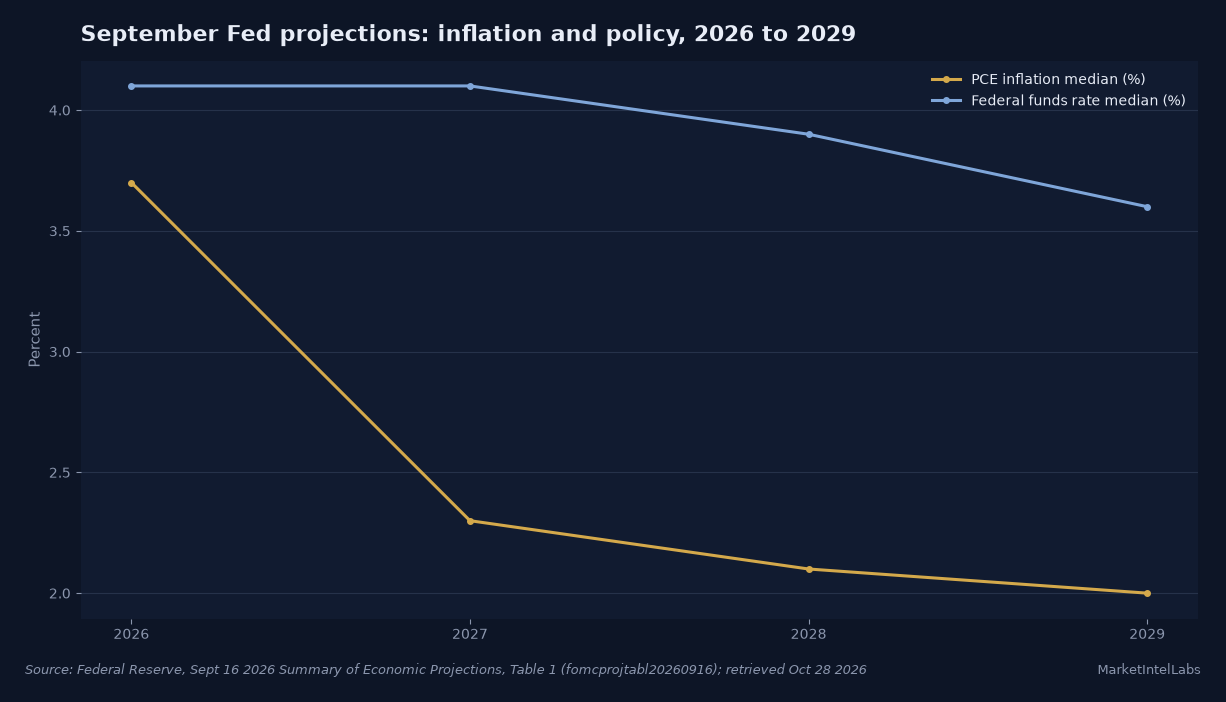
The gap between the lines needs interpretation, not a slogan. The September median envisions slower inflation and a policy rate that is still above 3.5% at the end of 2029.
It does not prove that policy will be equally restrictive throughout the period, because the chart compares an annual inflation projection with a point-in-time year-end rate estimate. Nor does it tell us whether a 4.1% median is the target-range upper bound on October 28. These are different objects.
A chart of medians also conceals disagreement. Each participant supplies a projection under the policy path that participant regards as appropriate; the Fed projections release includes central tendencies and ranges alongside the medians. A middle estimate is neither a 12 to 0 vote nor a commitment. The 2027 median staying at 4.1% does not mean every official expects the funds rate to sit there on every day of that year.
The chart is useful as a dated benchmark. If today's statement describes inflation more forcefully than September's, the September 3.7% projection is not silently updated.
It remains the projection made at the earlier meeting. December's scheduled table can show whether the median participant's forecast actually changed. That distinction lets readers hold a policy statement to its date rather than retrofitting an old number to a new headline.
What the primary documents say, and what they cannot
The September statement reports what the FOMC voted to do and its short economic assessment. The 12 to 0 tally concerns the September increase alone.
It does not show how each voter would respond to a different inflation or labor print in October. The September minutes provide more debate, including differing emphasis on core goods, services and energy. They are a record of the previous meeting, not a live transcript of this one.
The implementation note is more operational than either document. Its instructions on repo and reverse repo operations, Treasury bill purchases and reserve remuneration explain how the central bank tries to make its target meaningful in money markets. If October leaves the 3.75% to 4.00% range intact but alters implementation terms, the headline “hold” will still need a second sentence. A change in the desk's tools is not identical to a vote to change the target.
The projection materials are conditional views, not the vote and not a market odds screen. They put median 2026 unemployment at 4.1% and real GDP growth at 2.3%.
Those estimates help explain why September participants thought higher rates were compatible with economic expansion. Later data could challenge that assessment. Using the 4.1% median projected funds rate as though it were a probability of a hike confuses a rate estimate with an event probability.
The 2025 strategy review supplies the longer-run goal; it does not tell the Committee how to vote this afternoon. Our reading is that a change in the October statement's descriptions of inflation or employment could alter expectations for December even if the target is held. That is an analytical judgment, not a Fed forecast. The alternative is equally concrete: if the target changes, the new range becomes the first fact, and interpreting subtler wording should come second.
We are not publishing an unverified probability for today's decision. A numerical market-odds claim would need a time-stamped exchange quote or derivatives price.
The documents used here do not contain one. The distinction protects readers from mixing September's official estimates with an unsourced claim about what today's market expects. Once the October release arrives, the primary document rather than a preview will settle the outcome.
What happens next
The first date is October 28 at 18:00 UTC, the scheduled decision time. Start with the new target range and check it against September's 3.75% to 4.00%.
Then compare the sentences on inflation, employment and activity, and read the accompanying implementation note. These are separate tests. A shift in the Fed's language without a rate change would be relevant for interpreting the outlook but would not be an actual increase or decrease in today's target.
The meeting calendar places the next scheduled meeting on December 8 and 9, with updated projections expected. September's projected PCE inflation falls from 3.7% in 2026 to 2.3% in 2027 and 2.0% in 2029.
A December table that no longer shows that descent would change how to read the projected future rate path. A weaker labor outlook could change the balance of risks in a different direction. Neither possibility is an outcome already recorded.
The test of this feature is intentionally falsifiable. After 18:00 UTC, a fresh statement can replace the unknown outcome with a verified one; December can replace September's dated medians. Until those documents exist, the most accurate decision-day answer is the September starting range, the official release time, and the distinction between a forecast and a completed vote.
Frequently Asked Questions
What time is the FOMC decision today?
The October 27 and 28, 2026 decision is scheduled for 2:00 PM Eastern, or 18:00 UTC, on Wednesday, October 28. Before the release, September 16 remains the latest verified FOMC rate decision discussed here. Check the Federal Reserve calendar and the new statement when it arrives, rather than treating a preview as the result.
What is the Fed interest rate before the October decision?
The September 16 FOMC statement set a federal funds target range of 3.75% to 4.00% after a quarter-point increase approved 12 to 0. The target describes overnight money-market conditions. It is not a consumer lending rate that every bank must quote, and it should not be represented as an October decision before the new announcement.
If the Fed holds rates, can mortgage rates still change?
Yes. A hold leaves the funds target unchanged, but longer Treasury yields and lenders' funding costs can move as expectations change. A mortgage offer also depends on credit and contract terms. The New York Fed rate reference distinguishes the effective funds benchmark from the policy target; neither is identical to a fixed-rate home loan.
Does the October 2026 FOMC meeting have a new dot plot?
No new Summary of Economic Projections is scheduled for the October 27 and 28 meeting on the Federal Reserve calendar. The September table remains the latest set of dots until the December meeting. Its median 2026 year-end rate of 4.1% is a conditional estimate by participants, not an October decision or a promise about December.
When is the next FOMC meeting after October 2026?
The Federal Reserve calendar lists December 8 and 9, 2026, as the next scheduled meeting and marks it as a projections meeting. Its new economic forecasts will allow a direct comparison with September's median 2026 PCE inflation estimate of 3.7% and projected year-end funds rate of 4.1%. Until then, those numbers retain their September date.
This content is for informational purposes only and does not constitute financial advice. Past performance is not indicative of future results. Consult a qualified financial advisor before making investment decisions.
Get daily intelligence delivered
Create a free account for the Daily Brief every weekday and The Week Ahead every Sunday. No card required.