Russian refinery strike hits Yaroslavl's YANOS for a third time: governor confirms fire as crude holds its supply risk

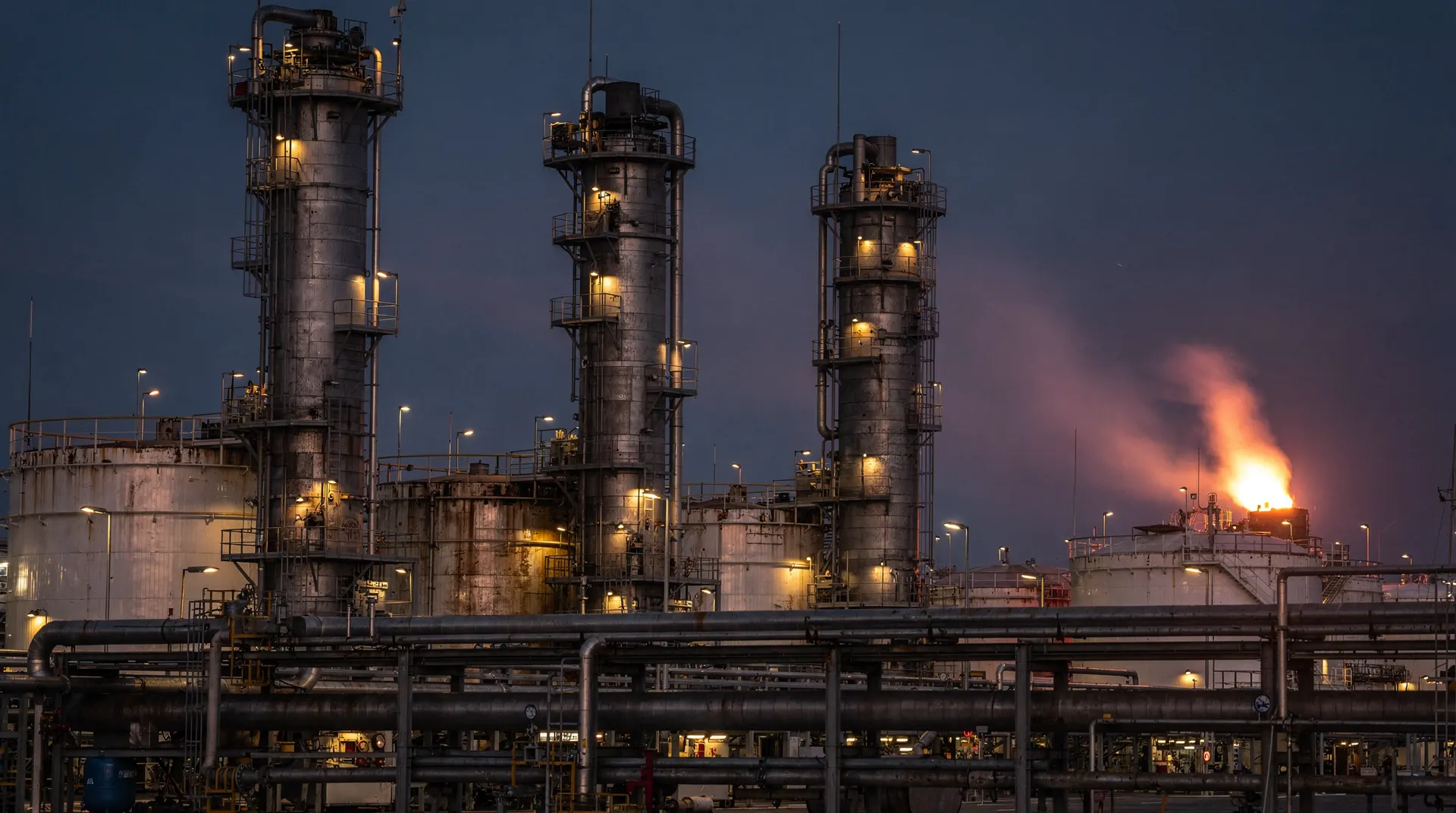
Ukraine's resumed long-range campaign struck the Slavneft-YANOS refinery in Yaroslavl for a third time, and regional governor Mikhail Yevrayev acknowledged the hit: infrastructure damage and a fire that emergency services were working to extinguish. The strike is news in its own right, but it is the setting that matters for crude. WTI is holding near $96.15 and Brent at $103.72, and both are carrying a geopolitical risk premium that keeps widening and narrowing on headlines, unresolved at the Strait of Hormuz even as Washington and Tehran talk.
Start with what the governor actually confirmed. Speaking after the attack, Mikhail Yevrayev said air defence repelled a raid involving 124 drones, that two employees were injured, and that there had been damage to the refinery's infrastructure, with crews working to extinguish a fire. The Russian defence ministry claimed it had downed 856 drones across the country overnight. On the other side of the conflict, Ukraine made no immediate public comment on this specific strike. That split is standard for this campaign, and the register matters: Ukraine's claim and Russia's response sit side by side, and this particular hit is confirmed because it carries an official acknowledgment from the region's governor on top of the wire reporting.
Related reading: Ukraine's drones put 2 to 4.3 million barrels a day of Russia's refining offline. Diesel cracks are at records..
The Yaroslavl strike is the third on YANOS in this campaign, following strikes on Sept 17 and Sept 19, and it comes after a pause in refinery strikes that had been reported as US-sought and then ended. The plant matters more each time it is hit. According to Reuters, YANOS has crude-processing capacity of around 15 million tons per year, making gasoline, diesel and fuel oil, which works out to roughly 280,000-320,000 barrels per day on a range carried by the strike tracker. That is capacity back on the risk list, and it is a reminder that the campaign is not aimed at a single facility so much as at a system of them.
Here is what an offline refinery does to the market. It does not take crude off the market the way a wellhead outage would, but it takes product-export capacity offline and it tightens the domestic fuel balance. That shows up across the chain: in the Urals discount that Russian barrels fetch against Brent, and in the product cracks that refining margins track. When distillate stays tight, the crack holds, and diesel prices keep their bid even if the headline crude number does not move far. The American Petroleum Institute's weekly inventory print underlined it: crude drew an unexpected 5.27 million barrels in the week ended Oct 30 against an expected build of about 0.88 million, with distillate stocks down 1.19 million barrels. Diesel staying tight is a crack-supportive signal, and the Yaroslavl strike only adds to the distillate-side pressure.
For the broader framework, see our crude oil coverage.
Related reading: Two more Russian refinery strikes extend the outage: the tracker now counts 26.
Crude's price reaction tells the real story. WTI near $96.15 and Brent at $103.72 are not just a few cents off their highs; they are holding a geopolitical premium in which two competing narratives are pulling opposite ways. On the de-escalation side, Iran and the US are talking, with Qatar mediating, though a senior Iranian official told Reuters the two are far from a deal, and President Trump told the Financial Times that Washington had no immediate plan to strike Iran, describing US strikes on Qeshm island as limited. That is the case for the premium deflating around Brent's $104.50 to $105.00 resistance and WTI's $97.15 to $100.00 ceiling. On the other side sits the supply risk that keeps the bid alive: the disruption threat around the Strait of Hormuz has not disappeared, and as long as the strait stays in play, the bid does not just vanish on a round of talks.
The Ukrainian refinery campaign sits in the same bracket. It is not Hormuz, but it moves the same way: it keeps a floor under product markets and a discount on Russian crude, and each confirmed strike is a small, dated reminder that supply tightness is structural, not headline-driven. The tracker that follows the thread now carries 46 entries, with 27 confirmed by a second source, the latest dated Nov 3, and YANOS is a repeat offender on that list. Repeat strikes on a single plant carry their own message. A facility that is targeted once can idle and restart. A facility targeted three times in under two months spends its outages and repairs in a different rhythm, and that rhythm is what keeps products, not just crude, bid.
Related reading: Crude Sheds Risk Premium Near $98; Diesel Crack Stays ~$106.
The strike-by-strike record
Below is the tracker that follows the campaign, confirmed rows only, with each plant's capacity effect as a dated range from the named tracker.
| Date | Target | Type | Ukraine says | Russia says | Confirmed by | Est. capacity effect |
|---|---|---|---|---|---|---|
| 2026-11-03 | Slavneft Yaroslavnefteorgsintez (YANOS) refinery, Yaroslavl | refinery | Reuters reported Ukraine set fire to a major oil refinery in Yaroslavl in an overnight drone attack; the facility had been struck at least twice before. Kyiv had paused refinery strikes (WSJ-reported) and then resumed; Ukraine made no immediate comment on this strike. (Reuters (MOSCOW, Nov 3)) | Regional governor Mikhail Yevrayev said air defence repelled an attack involving 124 drones and that two employees were injured: 'There has been damage to the refinery's infrastructure. Emergency services are working to extinguish a fire.' Russian military said it had downed 856 enemy drones across the country. No immediate comment from Ukraine. (Reuters citing governor Mikhail Yevrayev on Telegram; Russian MoD) | Reuters wire with governor's official acknowledgment + unverified social-media footage | 280 to 320 kb/d (Reuters: YANOS has crude processing capacity of around 15 million tons per year (produces gasoline, diesel, fuel oil), 2026-11-03) |
| 2026-11-01 | LUKOIL NORSI refinery, Kstovo, Nizhny Novgorod region | refinery | Ukrainian media reported the attack hit the Kstovo oil refinery, calling it 'one of Russia's largest oil refineries, producing fuel and lubricants'; Dnipro Osint and Russian state media reported it as the third and final night of the 72-hour campaign. (investinglive (Ukrainian media, Dnipro Osint)) | The Nizhny Novgorod regional governor said an unnamed facility sustained 'significant damage' after a 'massive' drone attack; Russian investigators (TASS) opened a criminal case on terrorism charges. No casualties reported. (ABC News citing TASS and the regional governor (Reuters)) | investinglive (confirmed among the three-plant campaign, LUKOIL NORSI) | n/a |
| 2026-10-18 | Ruchyi (Ruch'i) oil depot, St Petersburg | depot | Part of the same >1,000-drone raid; Kyiv set the Ruchyi oil depot ablaze alongside the Petersburg Oil Terminal. (AP News) | Governor Alexander Beglov confirmed fires at the Ruchyi oil depot were being extinguished; no capacity figures given. (Al Jazeera) | RTE (Reuters) | n/a |
| 2026-10-18 | Petersburg Oil Terminal, St Petersburg, an oil storage/export terminal (Novoportovskoye oil, Primorsk crude loading) | export terminal | Kyiv launched more than 1,000 drones at Russia, setting the Petersburg Oil Terminal ablaze in one of the largest aerial attacks of the war; President Zelensky said strikes on Russian oil refineries had resumed after a three-day pause. (AP News) | Governor Alexander Beglov confirmed emergency services were extinguishing fires at the Petersburg Oil Terminal and the Ruchyi oil depot; one person killed, five wounded; flights at Pulkovo restricted; no statement on capacity loss. (AP News) | Al Jazeera (AFP/AP/Reuters) | n/a |
| 2026-10-15 | Ryazan oil refinery (Rosneft Ryazanskaya NPK), Ryazan Oblast, ~17 Mt/yr, one of Russia's largest refineries, ~180km southeast of Moscow | refinery | Ukraine resumed strikes on Russian oil refineries after a ~3-day pause under Trump's 'energy ceasefire' (declared Sunday Oct 11), hitting the Ryazan refinery on 15 Oct. Zelenskyy told the FT (publ. 14/15 Oct): 'The block [on attacking refineries] is out. We're done.' Images showed flames at the refinery; regional officials said it was targeted by 69 drones and four Flamingo cruise missiles. (Volodymyr Zelenskyy via Financial Times (14 Oct); NBC News; AP News) | Russian Defense Ministry confirmed Ukraine 'attempted a massive attack on the Ryazan oil refinery' and a fire was reported; Gov. Pavel Malkov (Ryazan) confirmed a fire at the refinery. Moscow attributed the fire to debris from a drone struck by anti-aircraft fire rather than a direct hit. (Russian Defense Ministry + Ryazan Gov. Pavel Malkov (via AP, Guardian)) | AP News + The Guardian + Wall Street Journal, all 15 Oct 2026 confirm a fire at the Ryazan refinery from a Ukrainian drone-strike attempt | 300 to 350 kb/d (est. from ~17 Mt/yr capacity (~340 kbd); damage scale not independently published, 2026-10-15) |
| 2026-10-06 | Volodarskaya linear production/dispatch station (Transnefteprodukt), largest oil depot in Moscow region | depot | Said to be one of the apparent targets; Moscow region and Moscow hit by a reported 650 drones overnight Oct 5-6, with a fire at the Volodarskaya LPDS, largest oil depot in the Moscow region (~3 Mt/yr, supplies Vnukovo, Domodedovo and Sheremetyevo airports). (Ukraine / Ukrainian media (LIGA.net)) | Moscow Mayor Sergei Sobyanin said 650 drones were launched toward Moscow overnight Oct 5-6; Russian air defenses claimed to have destroyed most, including 105 on approaches to Moscow; Astra reported a fire at the facility. (Moscow Mayor Sobyanin / Russian authorities / Astra) | Kyiv Post (8:22 AM, 6 Oct 2026) citing Astra | 40 to 60 kb/d (est. from ~3 Mt/yr product throughput, 2026-10-06) |
| 2026-10-06 | Aframax Rio, Liberian-flagged shadow-fleet tanker (crude for Novorossiysk-India route), Black Sea off Sochi | other | Ukrainian naval drones attacked the Aframax Rio off Sochi, setting the tanker ablaze; Ukrainian monitoring site BlackSeaNews identified the vessel as part of Russia's shadow fleet used to evade sanctions, and Ukraine earlier sanctioned the Rio (Feb 2026). Crude oil burned openly in the Black Sea. (Times of India/RFE/Meduza, citing Ukrainian monitoring + Kyiv Independent) | Russia's Transport Ministry confirmed the Liberian-flagged tanker was attacked by naval/unmanned drones on Oct 6 and that crude oil was burning in the Black Sea; all 23 Indian crew were rescued without injury. (Russian Transport Ministry, via Reuters/Times of India) | Irish Times (Oct 7): huge blaze after naval drone hits oil tanker | n/a |
| 2026-10-02 | Volgograd oil refinery (Lukoil, Volgograd Oblast) | refinery | Ukrainian forces struck oil infrastructure in Volgograd Oblast overnight on 2 Oct; monitoring groups identified the target as Lukoil's Volgograd refinery, among Russia's largest at roughly 14-15 Mt/yr capacity. (Kyiv Independent, citing activists Serhii Sternenko and the Exilenova Plus channel) | Volgograd regional governor confirmed the drone attack and reported a fire; the target was described as the city's industrial infrastructure. (Volgograd Oblast governor (via Kyiv24, Kyiv Independent)) | Kyiv24 / Kyiv Independent (official governor acknowledgment) | n/a |
| 2026-09-26 | Ilsky oil refinery (Krasnodar Krai) | refinery | Ukraine's Defense Forces struck the Ilsky refinery on the night of 26 Sep: Fire Point said FP-1 drones hit three primary refining units and a storage tank farm, forcing the facility to halt; General Staff confirmed and noted the plant also meets Russian military needs. (Fire Point statement; General Staff of Ukraine (via RBC-Ukraine, UNN)) | Russian EMERCOM (mchs.official) published photos of firefighting at the refinery after the strike; no named refinery-specific official acknowledgment beyond fire response was located. (mchs.official (Russian EMERCOM) photos via RBC-Ukraine) | Reuters capacity listing + General Staff confirmation of damage | 100 to 132 kb/d (RBC-Ukraine ~6.6 Mt/yr (~132 kb/d nameplate); 3 of 6 primary units hit, production halted, 2026-09-26) |
| 2026-09-25 | Novoshakhtinsk oil refinery (Rostov) | refinery | No specific Ukraine General Staff statement located for the Novoshakhtinsk strike; consistent with Ukraine's wider campaign of drone strikes on Russian refining assets. | Governor Yuri Slyusar said air defence destroyed ~50 drones over the Rostov region overnight and a drone attack damaged the Novoshakhtinsk refinery, forcing it to suspend operations temporarily. (Rostov governor (Yuri Slyusar) via Reuters) | The Moscow Times | 80 to 150 kb/d (Reuters (annual capacity ~5 Mt/yr, ~100 kb/d) + drone-warfare tracker range, 2026-09-25) |
| 2026-09-22 | Rosneft Kuibyshev Oil Refinery, Samara Oblast | refinery | Ukraine's General Staff said Defense Forces struck the Kuibyshev refinery in Samara on the night of 21-22 September; Ukrainian drone maker Fire Point said FP-1 drones hit the AVT-4 and AVT-5 primary crude-distillation units, starting a large fire. (General Staff of Ukraine / Fire Point (via RBC-Ukraine, Euromaidan Press)) | Samara Oblast Governor Vyacheslav Fedorishchev confirmed a large drone attack on the region on 22 Sep, saying drones 'targeted industrial enterprises' and that one person was killed and four injured from falling debris; he did not name the Kuibyshev refinery. (Vyacheslav Fedorishchev (via Euromaidan Press, United24)) | Euromaidan Press + Russian outlet ASTRA confirmed fire on refinery grounds | 130 to 150 kb/d (Euromaidan Press (7 Mt/yr nameplate, each AVT unit ~73 kb/d), 2026-09-22) |
| 2026-09-20 | Gazprom Neft Moscow Oil Refinery, Kapotnya (Moscow) | refinery | President Zelensky said Kyiv hit "one of Russia's key oil industry facilities and the aggressor's logistics facility"; Ukrainian sources cited primary (AVT-6-type) and isomerization units hit and a large fire. (Zelensky / Ukrainian reports (via Srpske Novine, Energy News Beat)) | Moscow Mayor Sobyanin confirmed damage in the capital's orbit and a large drone wave (450 drones toward the capital per Sobyanin; Russia claimed it downed 660 craft); Moscow Region Gov. Vorobyov confirmed two dead in the region; Gazprom Neft did not comment. (Sergei Sobyanin / Andrei Vorobyov (via BBC/Srpske, Energy News Beat)) | Srpske Novine / BBC report + Reuters June confirmation of plant outage | 220 to 245 kb/d (Energy News Beat (plant nameplate ~220,000-245,000 b/d), 2026-09-20) |
| 2026-09-15 | Syzran refinery (Rosneft, Samara region) | refinery | Ukraine's General Staff listed the Syzran refinery among targets struck between 14 and 20 September in its post-campaign report; it said more than 45% of Russia's refining capacity is offline as of 21 September and cited a Euro-5 fuel shortage. (General Staff of Ukraine (via Caliber.Az, 2026-09-21)) | No official Russian statement located; Reuters (via Moscow Times), citing three industry sources, said the plant paused processing on 15 September and that the main CDU-6 crude-distillation unit, accounting for 71% of capacity, was damaged and could take at least a month to repair. (Reuters via The Moscow Times, 2026-09-16) | Reuters (via The Moscow Times), 2026-09-16 | n/a |
| 2026-08-30 | Kirishi refinery | refinery | SOF/SBU/Unmanned Systems struck Kirishi, halting crude processing (>half of capacity out). (Ukraine Joint Deep Strike (via drone-warfare)) | Crude processing halted at the plant, ~7% of Russian refining. (industry sources (drone-warfare)) | drone-warfare (crude processing halted, >half capacity) | 300 to 420 kb/d (drone-warfare (20 Mt/y, ~7% of refining), 2026-08-30) |
| 2026-08-25 | Lukoil NORSI refinery (Kstovo) | refinery | SOF/Unmanned Systems struck NORSI overnight 25-26 Aug; General Staff confirmed strike and fire; plant ~17 Mt/y, ~11% of Russian petrol. (Ukraine General Staff (via Ukrainska Pravda)) | Fire at the refinery confirmed; adjacent logistics facility also hit. (Nizhny Novgorod governor / officials) | Ukrainska Pravda (GS confirmation + fire) | 160 to 350 kb/d (Ukrainska Pravda (17 Mt/y, ~11% of petrol), 2026-08-25) |
| 2026-07-14 | Salavat refinery (Bashkortostan) | refinery | SOF struck the AVT-6 primary distillation unit (~1,500 km range). (Ukraine SOF (via drone-warfare)) | No Russian capacity statement located; refinery in Bashkortostan. (no Russian capacity statement located) | satellite imagery (AVT-4 + Rosneft-Opt depot hit) per drone-warfare | 100 to 300 kb/d (drone-warfare, 2026-07-14) |
| 2026-07-06 | Omsk refinery (Gazprom Neft, largest in Russia) | refinery | Struck Omsk, Russia's largest refinery (22 Mt/y), hitting the ELOU-AVT-11 crude unit. (Ukraine (FP-1 drones, via drone-warfare)) | Omsk stopped selling gasoline/diesel on the exchange on 7 July; status not fully disclosed by officials. (SPIMEX listing / industry (drone-warfare)) | drone-warfare (exchange delisting + unit hit) | 200 to 450 kb/d (drone-warfare (22 Mt/y, AVT-11), 2026-07-06) |
| 2026-05-20 | Lukoil NORSI refinery (Kstovo) | refinery | General Staff confirmed strike on Lukoil NORSI, damaging AVT-6 (CDU-6) crude distillation unit. (Ukraine General Staff (via Euromaidan Press)) | Governor Gleb Nikitin confirmed a fire at the industrial site; Lukoil did not respond. (Nizhny Novgorod governor (Reuters)) | Reuters (CDU-6/AVT-6 damaged, primary processing shut) | 160 to 330 kb/d (Reuters (CDU-6 ~53% of NORSI capacity), 2026-05-20) |
| 2026-05-05 | Kirishi refinery (Leningrad) | refinery | Struck Kirishi, Russia's 2nd-largest refinery (20 Mt/y), shutting crude processing. (Ukraine (via drone-warfare)) | Facility shut down production; output diverted to domestic market. (Russian Energy Ministry / industry) | drone-warfare (20 Mt/y rated) | 300 to 420 kb/d (drone-warfare (20 Mt/y), 2026-05-05) |
| 2025-11-18 | Ryazan refinery (Rosneft) | refinery | Struck, suspending crude processing. (Ukraine (via Reuters)) | Rosneft plant suspended crude processing after the strike, sources said. (industry sources (Reuters)) | Reuters (sources: crude processing suspended) | 100 to 400 kb/d (Reuters / drone-warfare, 2025-11-18) |
| 2025-11-06 | Volgograd refinery (Lukoil) | refinery | Struck the refinery; General Staff confirmed explosions and fire. (Ukraine General Staff (via RBC-Ukraine)) | Governor Bocharov confirmed a fire in Volgograd's Krasnoarmeysk district (refinery site); CDU-5 (66.7 kb/d) and hydrocracker damaged per sources. (Volgograd governor + sources (Reuters)) | Reuters (CDU-5 + hydrocracker, plant halted) | 67 to 280 kb/d (Reuters (CDU-5 66.7 kb/d; 13.7 Mt/y plant), 2025-11-06) |
| 2025-08-28 | Kuibyshev refinery (Rosneft, Samara) | refinery | Struck, damaging both primary refining units and secondary units days after restart. (Ukraine (via Wikipedia)) | Rosneft plant hit; damage to both primary units acknowledged by industry sources. (industry sources (Wikipedia)) | Wikipedia (primary + secondary unit damage) | 100 to 200 kb/d (drone-warfare, 2025-08-28) |
| 2025-08-07 | Afipsky refinery (Krasnodar) | refinery | Overnight drone strike set a fire at the gas-condensate processing unit. (Ukraine (via Wikipedia)) | Regional crisis center said drone debris ignited a gas condensate unit; fire out by 08:21 local. (Krasnodar crisis center) | Wikipedia citing regional officials | 40 to 130 kb/d (drone-warfare, 2025-08-07) |
| 2024-04-28 | Tuapse refinery (Rosneft, Black Sea) | refinery | Drone attack caused a major fire, halting operations. (Ukraine military (via RFE/RL)) | Attack on the Black Sea oil terminal reported; fire extinguished. (Russian emergency services) | RFE/RL (Russian officials) | 100 to 240 kb/d (drone-warfare/Reuters, 2024-04-28) |
| 2024-03-13 | Ryazan refinery (Rosneft) | refinery | Struck Ryazan refinery, setting it ablaze and damaging units equal to ~70% of intake capacity. (Ukraine (via drone-warfare)) | Governor confirmed a drone strike caused a fire; no capacity figures given. (Ryazan governor) | Reuters via drone-warfare | 200 to 400 kb/d (drone-warfare/Reuters, 2024-03-13) |
| 2024-03-12 | Lukoil NORSI refinery (Kstovo) | refinery | Struck NORSI, damaging the main CDU-1 crude distillation unit and halting at least half its processing. (Ukraine General Staff / drone-warfare) | Aerial attack reported over the region; refinery operational status disputed. (Russian MoD / Lukoil) | drone-warfare (Reuters tally) | 0 to 170 kb/d (drone-warfare/Reuters, 2024-03-12) |
| 2024-01-21 | NOVATEK Ust-Luga condensate terminal | export terminal | Struck Ust-Luga gas condensate terminal; SBU-linked source said a major fire. (Ukraine security service (via Wikipedia)) | Two storage facilities and a pumping station damaged; fire at the terminal. (Russian authorities / Leningrad Oblast) | Wikipedia (attributed to Russian officials) | n/a |
What to watch
Two things decide whether this stays a headline or becomes a trend. First, the repair timeline and any official statement out of Russia on when YANOS returns, because that sets how long the gasoline and diesel supply gap actually lasts. Second, the Hormuz negotiation, because the crude premium that gives this entire complex its bid is ultimately hostage to whether the strait risk resolves or escalates. On a pure technical read, WTI has support near $95.00, with resistance at $97.15 and then $100.00, and Brent is sitting with support near $103.00 and resistance in the $104.50 to $105.00 zone. If refining outages keep piling up and talks stall, the bid stays. If the Iran channel produces something concrete, the premium deflates and the dip is the trade to respect, not to fight.
Related reading: Oil price holds conflict premium as resumed Russian refinery strikes cut diesel exports.
None of this is a reason to chase crude or to short it. It is analysis of what the strikes and the talks are doing to supply, and the honest bottom line is that the price is caught between a Hormuz risk that will not go away and an Iran channel that keeps hinting at relief. The refinery campaign removes some insulation from Russia's product exports, the strait threat removes none from anyone, and until one of the two resolves, the oil market is going to keep paying a premium and keep giving it back on the next headline. That is the environment. The job is to watch the two dates: the next firm word out of Yaroslavl on the repair, and the next real step out of the Iran talks.
This content is for informational purposes only and does not constitute financial advice. Past performance is not indicative of future results. Consult a qualified financial advisor before making investment decisions.
Get daily intelligence delivered
Create a free account for the Daily Brief every weekday and The Week Ahead every Sunday. No card required.