Crude Sheds Risk Premium Near $98; Diesel Crack Stays ~$106

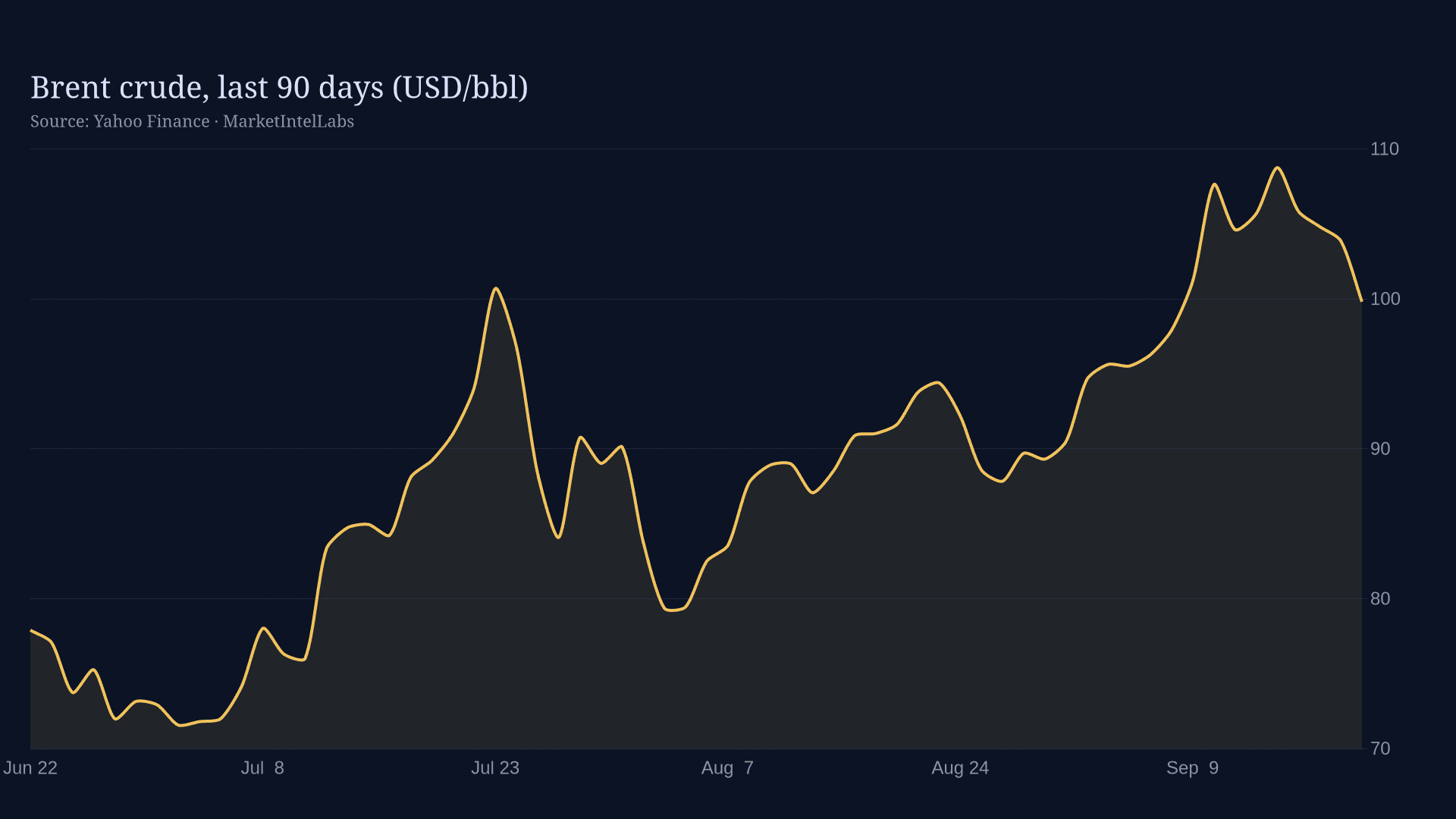
Crude is giving back the war premium, but don't mistake that for a loosening market. Brent eased to roughly $98.19 a barrel Monday, down about 2% from Friday, as traders priced in a faster return of Middle East barrels and softer demand forecasts. WTI slipped to the mid-$94s. The catch is on the refined-product side, which hasn't budged: the ULSD crack spread is holding near a record $106 a barrel against roughly $30 a year earlier. This is a two-tier market, and the bottleneck is refining, not the barrel in the ground. See our crude oil coverage for the supply-side read.
The crude leg is running on supply. Ukraine's overnight strike into Sunday on the Gazprom Neft Moscow refinery in Kapotnya, which Mayor Sobyanin called the year's largest drone barrage, adds to a Russian refining system already running roughly a third below last year after June strikes knocked the plant's primary units out until 2027. Kyiv said a key oil facility and logistics site were hit; Russian officials confirmed damage.
Yet crude only slipped, and that is the tell. Saudi Arabia has exports back toward ~4 mb/d in September after a ~2.4 mb/d August low, the East-West pipeline is expected back toward ~50% capacity within days, and record US output near 13.95 mb/d keeps Atlantic Basin supply flowing. The IEA cut its 2026 growth outlook and OPEC trimmed its forecast a fifth straight month. EIA data showed a softer-than-expected crude draw of 0.64 mb versus a 1.6 mb expectation, with gasoline and distillate builds.
That is why the crack is where the action is. Diesel is the tight barrel. Russian seaborne diesel and gasoil loadings have collapsed to roughly 150 kb/d against a ~790 kb/d five-year average, an outright export ban is in force, and the IEA says it is not clear where the missing refined barrels come from. EU diesel prices are up 38% year over year, and Hormuz transits still sit near 8 per day versus an 85/day baseline. This is a market to sell the crude curve and respect the product crack.
The bear case is real, and it runs through diplomacy. President Trump said he is open to meeting Iran's president at the UN General Assembly this week, and reports of Omani facilitation on temporary Hormuz shipping arrangements could knock the transport premium out hard. If the East-West line returns and US output holds, crude has further to fall even while cracks stay rich. JPMorgan has, for the first time since the war began, dropped its baseline oil view, a sign of two-sided tail risk.
Watch this week. A Trump-Iran meeting or a Hormuz arrangement is the trigger for a sharper crude drawdown, while another confirmed Russian refinery hit extends the diesel squeeze. The money is in the spread between what crude clears at and what diesel actually clears at, not in guessing the crude level alone.
This content is for informational purposes only and does not constitute financial advice. Past performance is not indicative of future results. Consult a qualified financial advisor before making investment decisions.
Related reading: Russian seaborne diesel loadings are down 81%. The record crack is where the war premium lives.; Ukraine's drones knocked out nearly a third of Russia's refining. Diesel just hit a record because of it.; Crude Cedes the Hormuz Spike as Pipeline Clock Ticks Down.
Get daily intelligence delivered
Create a free account for the Daily Brief every weekday and The Week Ahead every Sunday. No card required.