PPI vs CPI: Producer Prices Outpace Consumer Inflation


The September inflation picture has a split personality, and the split is the story. What producers charge is now accelerating much faster than what consumers pay, and that spreading gap is the number worth watching. Producer prices rose 1.3% on the month and 6.3% from a year earlier, the largest monthly advance since March 2022, according to the Bureau of Labor Statistics. Headline consumer inflation re-accelerated to 3.7% year over year. Six months ago the two gauges were moving in the same range; they now sit nearly three percentage points apart, with the producer side leading. That unusual configuration has a track record, and the record points toward higher consumer inflation ahead, not disinflation.
The producer-consumer gap and why it leads
The divergence is visible in the year-over-year tables. Consumer prices accelerated to 3.7% in September from 3.4% in August, driven heavily by energy: gasoline rose 9.1% on the month and accounted for more than half of the overall monthly all-items increase. Core consumer inflation, stripping out food and energy, ran a much cooler 2.6% year over year, ticking up from 2.4%.
Related reading: Retail Sales Rose 0.8% in September as Jobless Claims Stay Near 200,000.
On the producer side, the move is broader. PPI final demand rose 1.3% in September, the biggest one-month gain since March 2022, taking the 12-month rate to 6.3%, the largest increase since December 2022. Energy contributed the biggest lift, +10.8% overall and gasoline up 20.3% on the month, but the core was hardly quiet: producer prices excluding foods, energy and trade services still advanced 0.5% on the month and 5.0% from a year earlier. Trade-service margins rose 1.4% on the month, with machinery and vehicle wholesaling up 3.9%. That is not a pump-only story. Money is being pushed downstream through the distribution chain.
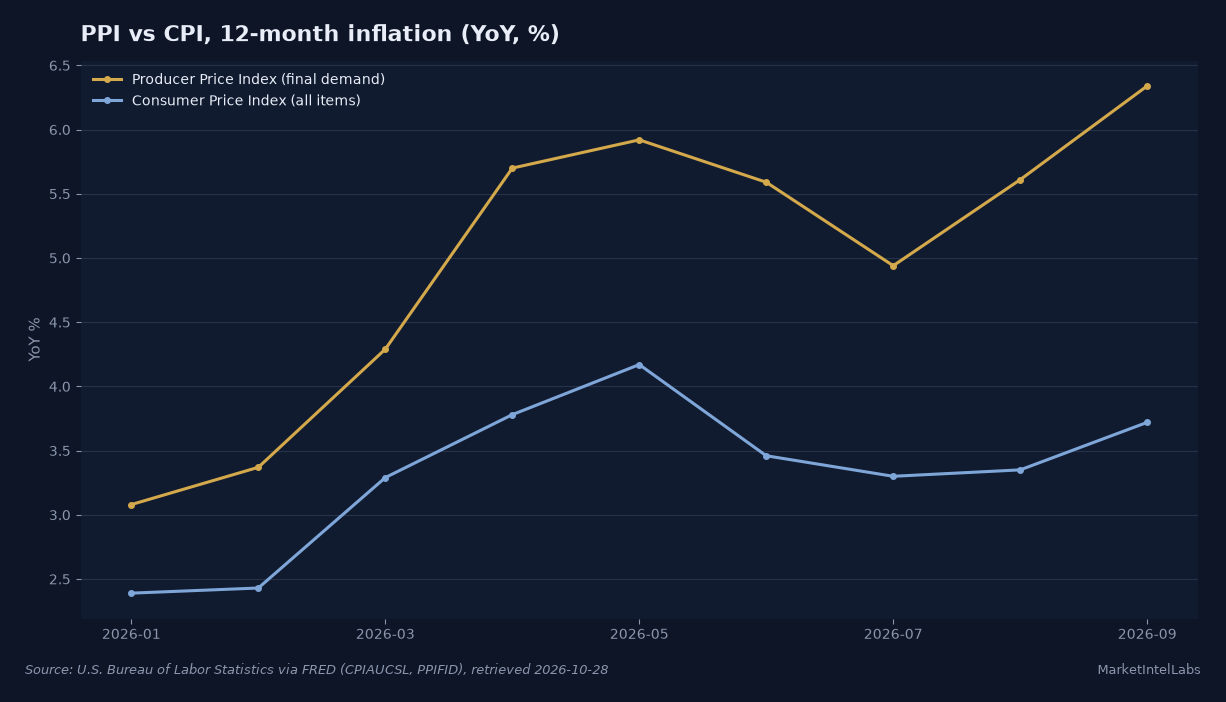
Why the gap leads. PPI is a wholesale measure, CPI is the retail readout, and the two do not always move together. When producer prices run persistently above consumer prices, the usual read is that margin compression upstream has not yet worked its way to the shelf, and that pressure tends to transmit with a lag. The September prints are exactly the shape of that transmission beginning to land. Back-to-back producer prints at this magnitude, the largest monthly run since the 2022 spike ended, have historically preceded consumer inflation re-acceleration rather than disinflation.
For the broader framework, see our Fed policy coverage.
Related reading: Fed rate path odds: Kalshi's December ladder prices a 25 bps hike at 79 percent after consumer confidence hits 91.7.
The pass-through case is strengthened by what is not yet showing up. Wage growth has cooled to 3.0% year over year, its slowest since May 2021, and the labor market has softened at the margin: payrolls added 29,000 in September against a roughly 84,000 forecast, with net downward revisions of about 60,000 across July and August, and the three-month average sits at 51,000. Slower wages are the classic anchor against a wage-price spiral. But they do not stop a cost-push pass-through if input prices, wholesale margins and transport are all moving up, which is what the producer data now show. Money supply growth has also firmed to 5.7% year over year in September, a gently re-inflating liquidity backdrop that removes a deflationary tailwind.
The bear case: a genuine second wave
The clearest argument for a real second inflation wave rests on breadth. If energy alone explained the producer surge, the Fed and markets could discount it as transitory and mean-reverting. The core producer print at 5.0% year over year, the monthly gain in trade margins, and the 3.9% jump in machinery and vehicle wholesaling all say otherwise: pricing power is showing up beyond the pump. Consumer core inflation is near its cycle low at 2.6% but has begun ticking up, the classic late-stage handoff from a producer-driven cost shock to the consumer reading. On this view the Federal Reserve's 25 basis point hike in September to a 3.75% to 4.00% range was validation of a firming process, not the end of it, and markets have leaned the same way: roughly 88% of the probability mass on today's decision prices a hold, but a December hike is now priced near 82%, with the implied end-2026 mid-rate near 4.39%. If producer breadth shows up in the PCE measure that the Fed actually targets, that December probability is likely to firm further, and bonds, gold and the broader real-rate complex reprice with it.
Related reading: September CPI Explained: August Inflation Was 3.4% Before the October 14 Release.
The bull case: base effects fade
The softer reading is that the spike is a mechanics problem, not a regime change. Gasoline jumped 9.1% in September partly on unusually low year-ago comparables, and that arithmetic cuts both ways. If crude and pump prices mean-revert from here, both the CPI and PPI headline prints could decelerate sharply, and the crowded December-hike consensus, already near 82% after a survey of all 100 surveyed economists projected it, would be jarred. A soft advance GDP print this week, near or below 2.0%, alongside a benign PCE reading, would give the Fed room to lean on a hold and fade December expectations. That path would steepen the curve and lift duration and metals back toward recent highs. The hawkish path is where the pricing sits today; the genuine risk to that trade is that it is already consensus.
The policy read. Today's decision from the Federal Reserve is widely expected to hold the target range at 3.75% to 4.00% as markets price it, but the December lean is the live risk. The re-inflating prints since September's hike validate the earlier tightening and have firmed the case for one more move. The two competing narratives, a genuine second wave versus an energy-led overshoot, are not yet distinguishable in a single month, and much will be settled by the prints that follow.
Related reading: September CPI Inflation at 3.7% As Payrolls Add Just 29K.
The first test comes tomorrow morning with the advance estimate of third quarter GDP and September PCE data. If the breadth visible in PPI, the core and trade-margin pass-through, shows up in the PCE core the Fed targets, the December probability re-marks toward near-certainty and the real-rate complex reprices. A soft GDP print or a benign PCE is the counter-signal that fades the hike and lifts bonds and metals. The producer to consumer gap is the thread connecting both outcomes: it either normalizes as those pressures transmit to consumers, which is the bear case, or it closes as input costs roll over, which is the bull case. The data over the next two release cycles will say which.
This content is for informational purposes only and does not constitute financial advice. This analysis is not a recommendation, and past performance is not indicative of future results. Consult a qualified financial advisor before making investment decisions.
Get daily intelligence delivered
Create a free account for the Daily Brief every weekday and The Week Ahead every Sunday. No card required.