Oil conflict premium unwinds: WTI slips to $86.99, Brent to $93.91 in four sessions

Crude just gave back a big chunk of its war premium, and it did it with the headlines still screaming. WTI was trading near $86.99 on Thursday morning and Brent near $93.91, both around 4-session lows, after unwinding about 16.5 percent (WTI) and about 20 percent (Brent) of the spike printed on October 30, when WTI hit a 30-day high of $104.12 and Brent touched $117.64. The selloff in crude is the week's quiet misdirection: demand worries and a risk-off tone are overriding supply headlines that, on the surface, should have been bullish for every barrel in the ground.
The math is clean. WTI printed $104.12 on October 30 and was trading near $86.99 on Thursday, a round trip of roughly 16.5% over four sessions. Brent did the same from $117.64 to $93.91, a little past 20%. The one-month trading ranges tell the same story: WTI spanned $86.7 to $104.1, Brent $93.4 to $117.6. The premium that Russia and Gulf escalation built into the curve in the back half of October is now draining out of the front end at speed. The heaviest selling hit on November 4, when WTI fell about 8.3% and Brent about 8.6%; Thursday's follow-through is quieter, WTI down roughly 1.3% and Brent about 0.8% at the morning fix, which is typical of the back half of a premium flush.
Related reading: Diesel Holds a 4.5% Bid as Crude Gives Back Its War Premium.
What makes the move worth respecting is that the catalysts people were told to fear have not gone away. Ukraine's campaign against Russian oil infrastructure is still running. An overnight November 4-5 drone attack hit the Ryazan refinery, and Ukrainian outlets reported at least six hits and a large fire. Russia's Ryazan governor, Pavel Malkov, confirmed a massive overnight drone attack with fires at industrial facilities, though he did not confirm damage specifically to the oil refinery, so the outage extent is not yet quantified. That is a strike in the "claimed," not "confirmed," bucket until a second source verifies the damage, but as a headline it should have kept a bid under crude. It did not.
The other live wire is the Gulf. The US struck Iran's Qeshm Island on November 4, and Tehran has rejected a ceasefire floated in Doha. A strike on Iranian territory, with Iran refusing to stand down, is exactly the kind of escalation that historically puts a durable premium into oil. Yesterday that would have been a two-dollar story. Today the move is narrower, with WTI around 1.3% lower on the session, but the point holds: a conflict headline that used to be a two-dollar story is barely moving the tape. When a geopolitically bullish headline stops moving the market, the tape is telling you something louder than the headline does.
For the broader framework, see our crude oil coverage.
Related reading: Oil Prices Plunge 9% on Democratic Sweep and Iran Peace Hopes; WTI Falls to $87.74.
The unwind itself has mechanics worth spelling out. The run from roughly $87 to $104 into October 30 was a pure risk event: conflict premium layered on top of a normalization in refining stress and a market that had already priced tight products. A big part of that premium was built on borrowed positioning that was long and crowding into the same trade. Premiums built that quickly unwind that quickly when the marginal buyer steps back. The Democratic sweep in Tuesday's midterms, read as fiscal-loose and policy-uncertain, flipped the macro tone: equities sold off, the VIX sat near 22.8, and the "risk-on de-regulation" trade that had supported commodities along with stocks gave way to a risk-off bid that pulled everything down together.
The bear case on fresh longs is straightforward and it is the one the structure favors right now. The commodity desks read WTI as short-term bearish on this unwind, with Brent support at 93.4 and then 90, against resistance at 94.9 and then 101. If headlines failed to lift crude with Qeshm and Ryazan both live, the market is telling you the conflict premium still in the price is trading on the assumption of de-escalation or demand destruction. Adding fresh length into that tape means fighting the flow of the last four sessions, and the risk/reward is poor until the sellers exhaust themselves at a real support level.
Related reading: Brent price near $115 as Hormuz conflict premium holds: Brent-WTI spread stays near $13.7.
The bull case is not dead, and it deserves a straight read. This is a headline-driven market with a wide range, and a premium that can unwind 20% in a week can snap back just as fast. The squeeze scenario is real: a lot of the oil crowd is short that premium. If the Gulf or the Black Sea actually takes barrels offline, or if a refinery or export disruption is confirmed and quantified, the unwind reverses quickly and the shorts are the ones paying. A confirmed hit on Ryazan's capacity, or a heightening in the Gulf after Qeshm, would be the trigger. Anyone holding the short side of the conflict premium into live escalation should respect that the position is only comfortable while the market believes the worst is priced in.
There is also a demand side to weigh. The macro backdrop is hot rather than soft: roughly 5% Treasury yields, third-quarter GDP around 3.4%, and a deficit near $2 trillion are the kind of numbers that keep the Fed leaning hawkish and keep a headwind under risk assets and, through them, under crude. If the post-election fiscal narrative fades and the dollar firms again, oil gets another leg of pressure that has nothing to do with Ryazan or Qeshm. That is the balanced map: a geopolitical bid still live underneath, a macro-heavy seller in charge on top.
Related reading: Russian refinery strike hits Yaroslavl's YANOS for a third time: governor confirms fire as crude holds its supply risk.
For positioning, the honest read is position-sized and both-sided, and the conflict-premium unwind argues for caution rather than conviction on fresh longs. The desk signal across the oil complex is bearish for the short term: WTI bearish at this level, Brent bearish, both driven by demand and risk-off overriding still-live headlines. Respect that until either a support level holds under real selling or a confirmed supply disruption gives the bulls a fundamental reason to step in. Fifty-fifty crude is not a trade; it is a coin flip with headline risk on both sides of the coin.
What to watch next is narrower than the headlines make it seem. On the upside, confirmation of an actual outage, meaning a dated tonnage figure from a named tracker for Ryazan or a Gulf escalation that moves through Hormuz, not just the Strait chatter. On the downside, Brent closing under the 93.4 shelf, which opens the 90 handle and would make the unwind a trend rather than a retracement. The range is wide and every session is headline-driven, so the premium can do a lot in a hurry. The four-session drop is the market's way of saying it has already punted on the conflict's tail risk for now.
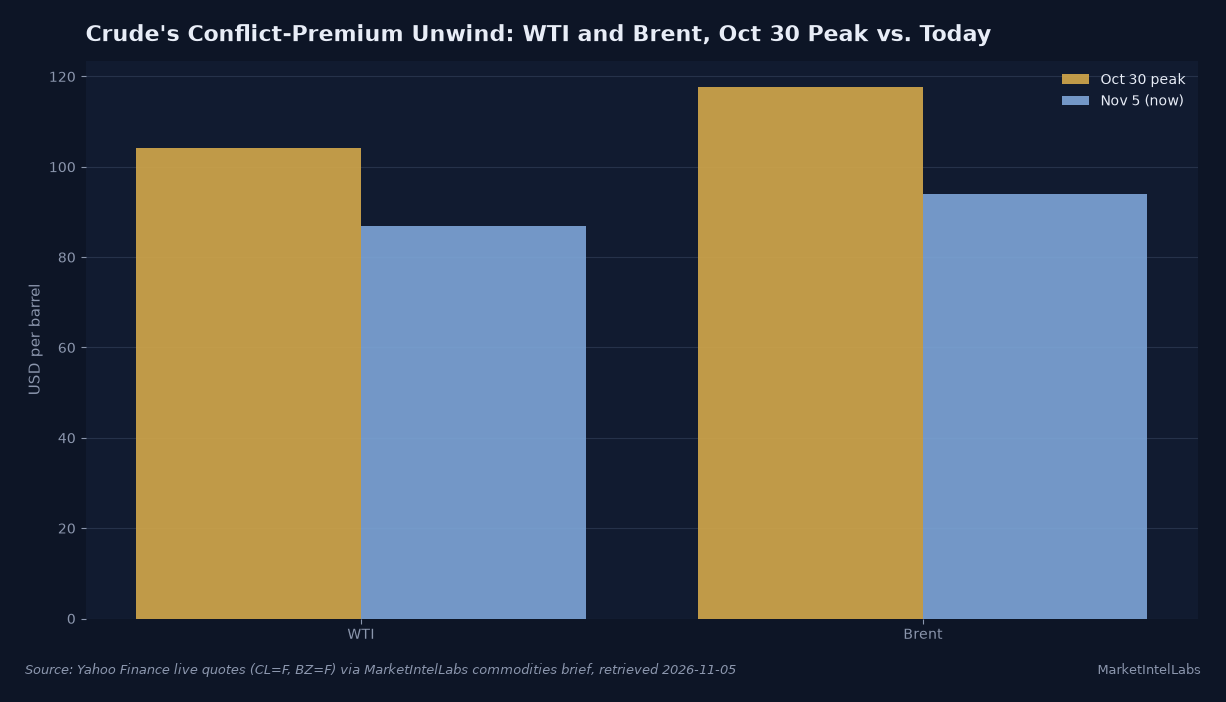
The financial read on oil this week is that the market is paying down the conflict bet even as the conflicts grind on. Traders can argue the headline risk either way, and both directions have a real case. But for anyone tempted to buy the dip on the back of the Ryazan and Qeshm news alone, the last four sessions are the cautionary diagram: premium can come out of crude long before the underlying risk does.
This content is for informational purposes only and does not constitute financial advice. Past performance is not indicative of future results. Consult a qualified financial advisor before making investment decisions.
Get daily intelligence delivered
Create a free account for the Daily Brief every weekday and The Week Ahead every Sunday. No card required.