NASA moon base contracts worth $10 billion send space stocks higher

NASA announced a suite of awards and mission updates on Nov. 7 to expand its Moon Base program, and the market spent the next three sessions pricing the winners. The centerpiece is a combination the agency is calling CLPS 2, a 10-year, multiple-award, indefinite-delivery/indefinite-quantity lunar delivery contract with a combined maximum value of $10 billion. Eight companies can compete under it for future missions: Blue Origin, Firefly Aerospace, Intuitive Machines, ispace-U.S., Lockheed Martin Space, Northrop Grumman Space Systems, SpaceX and Voyager Technologies. NASA also lifted the ceiling of the original CLPS 1.0 contract from $2.6 billion to $4.2 billion to carry initial Moon Base objectives.
Related reading: NASA Moon Base $10B Framework, $1.3B Transport Orders Land.
What investors should keep straight first is the difference between the $10 billion ceiling and actual money committed. The headline number is a master-contract cap, not a spending commitment. The tied-down figures in the Nov. 7 release are smaller and specific: about $1.3 billion in six task orders under the VADR launch-services contract went to Arrow Science and Technology, Blue Origin and Impulse Space to integrate and transport Moon Base cargo, with missions set to ride Blue Origin's New Glenn, Relativity Space's Terran R and SpaceX's Falcon 9. NASA separately selected SpaceX to carry out a cislunar communications demonstration aboard a Starship launch in 2028, and it awarded Blue Origin a $94 million base contract, with an option worth an additional $140 million, to deliver the rover described below using its Mark 1 lander.
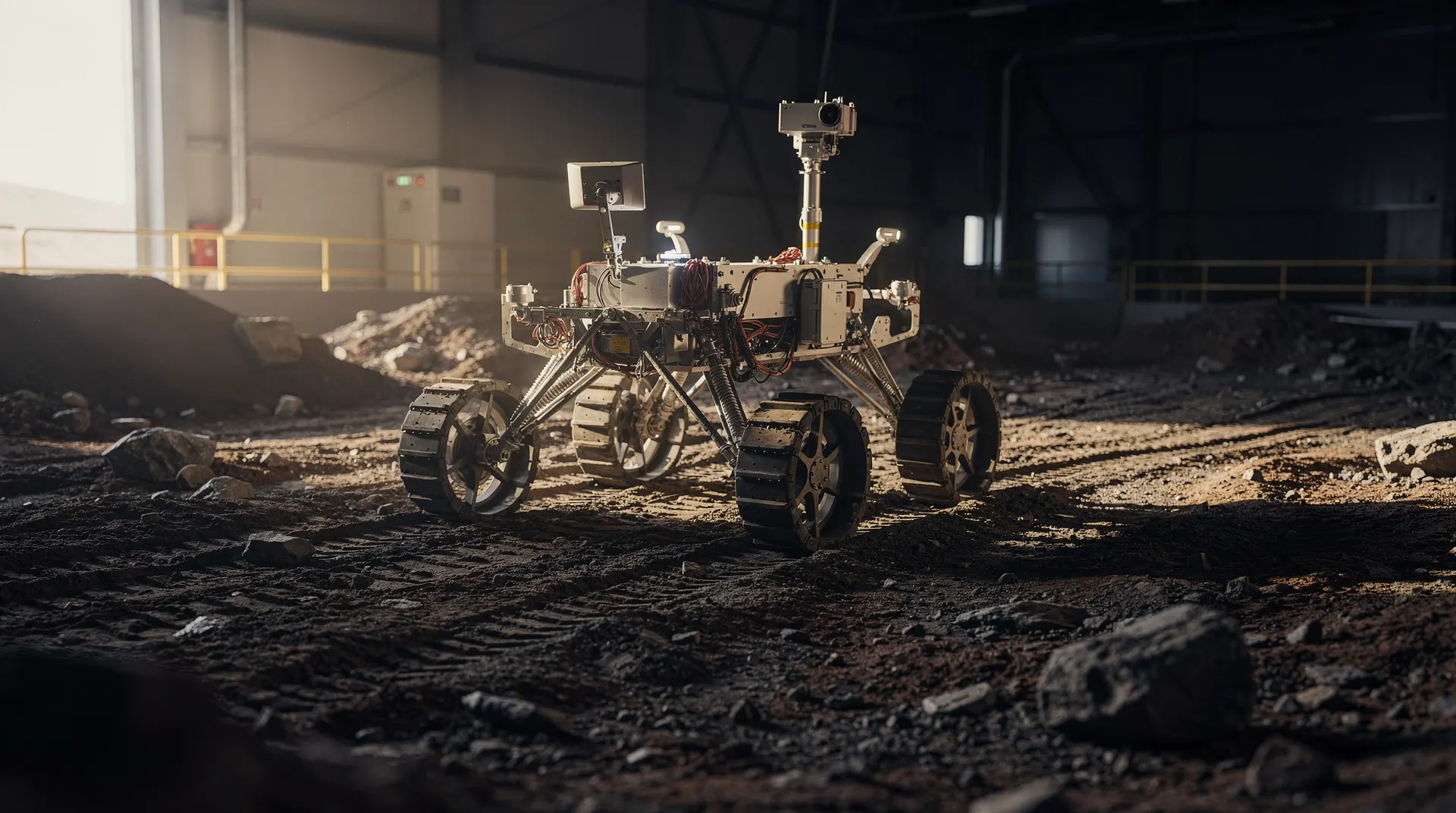
The flagship piece of technology is PROMISE, the Polar Rover for Observation, Mapping, and In-Situ Exploration. It is a six-wheeled, nuclear-powered rover that NASA's Jet Propulsion Laboratory will build from spare components and engineering test models of the Curiosity and Perseverance Mars rovers, a reuse strategy intended to cut cost and shorten the schedule. It will land at the Moon's South Pole, drill roughly one meter into the regolith to characterize ice and other resources, and test a next-generation radiation-tolerant computing system. NASA is targeting a late-2028 launch and an 18-month mission.
Related reading: NASA Ka-band relay awards: $1.07 billion across Viasat, SES and Astranis.
The market read the news as a buying event, and the freshest completed session, Wednesday's close, showed a broad space rally. Rocket Lab closed at $66.15, up about 26% on the session, and Intuitive Machines, a named CLPS 2 awardee, climbed about 23% to $12.18. Redwire, which won a miniCAST power-generation component under the same release, rose about 9%; Lockheed Martin and Northrop Grumman, both named on the contractor list, gained roughly 2.5% and 4.9% respectively. The rally ran well beyond the named list: BlackSky jumped more than 40%, Planet Labs about 13%, and the ARK Space Exploration ETF gained nearly 5%.
One nuance matters for the names that moved. Rocket Lab surged despite not appearing anywhere in NASA's contractor list, which makes its move a read-across of the sector theme rather than a direct award. The directly exposed public winners are the companies NASA named: Intuitive Machines, Redwire, Lockheed and Northrop. When our Nov. 9 look at the award framework published, the listed lunar names had actually closed lower, with Redwire down about 14%, before the complex reversed hard into Wednesday. That swing is the market deciding the framework now carries enough funded, dated work to model.
Related reading: CesiumAstro's $730M Series D funds a 737-satellite constellation at a $4.5B valuation.
For emerging-tech investors the useful change is the arrival of milestones. NASA's integrated lunar power solicitation is expected around early 2027, a NextSTEP-3B directed call aims to close data gaps for South Pole operations, and PROMISE plus the SpaceX cislunar demonstration give 2028 concrete dates. The story shifts from a ceiling on paper to a schedule with named contractors and launch slots, the difference between a framework announcement and revenue visibility investors can actually build into a model.
Related reading: Northwood Space raises $375M Series C at a $2B valuation to expand the satellite ground network.
This content is for informational purposes only and does not constitute financial advice. Past performance is not indicative of future results. Consult a qualified financial advisor before making investment decisions.
Get daily intelligence delivered
Create a free account for the Daily Brief every weekday and The Week Ahead every Sunday. No card required.