Jobs Week: Wage Growth Slows to 3.0%, Slowest Since 2021


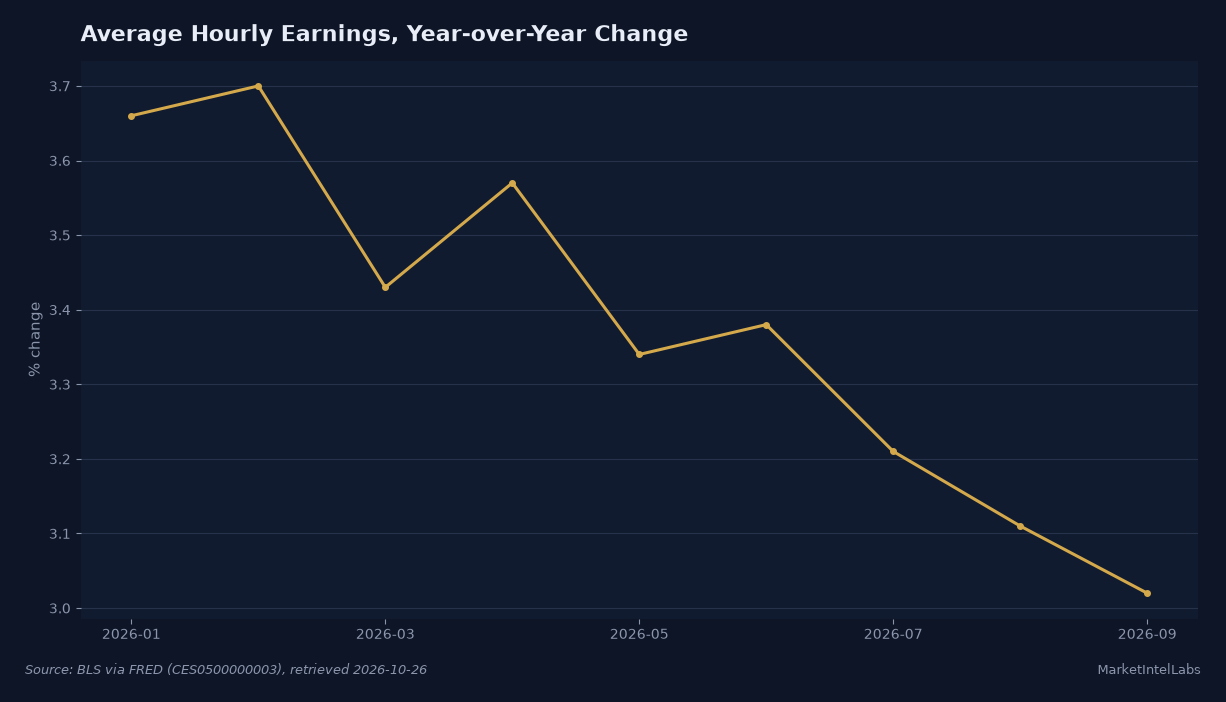
Wage growth has cooled to its slowest annual pace since May 2021, the clearest sign yet that the labor market has settled into a slower, gentler gear after more than four years of post-pandemic inflation. Average hourly earnings rose 3.0 percent in September from a year earlier, according to the Bureau of Labor Statistics, down from 3.1 percent the month before and from 3.7 percent back in February. It is the number that defined this week for anyone watching the temperature of the jobs market.
The wage slowdown arrives with little help from hiring itself. Employers added just 29,000 workers in September, well short of the roughly 84,000 economists expected, and the prior two months were revised lower. July was cut to a loss of 10,000 from a reported gain of 47,000, and August was trimmed to 133,000 from 142,000. The unemployment rate held at 4.2 percent, unchanged for the month.
Related reading: September Jobs Report: Payrolls 29,000, Unemployment 4.2%.
New claims for unemployment benefits, for their part, keep printing low. Initial jobless claims fell 6,000 to 194,000 for the week ending October 17, the lowest reading since mid-July, and the four-week average eased to 197,750. The backlog tells a softer story. Continuing claims, the count of people still receiving benefits, rose 25,000 to 1.728 million, the highest since late August. The split is familiar in a cooling market: layoffs are rare, but the people who do lose work are taking longer to find the next job.
The longer spells show up in the composition of the unemployed. More than a quarter of the people counted as out of work in September had been jobless for 27 weeks or more, according to the BLS household survey, a share that has drifted up through the year and left long-term unemployment near 1.9 million. That is the difference between a soft landing, where displaced workers get reabsorbed quickly, and a stickier version, where the path back into a job stretches out.
For the broader framework, see our Fed policy coverage.
Related reading: Hourly Pay Is Slipping Below Inflation Again, and Friday's Jobs Report Tests the Wage Line.
Both flows still sit well below where they were a year ago, which is why this week's prints do not signal a market in trouble. New filings of 194,000 compare with 231,000 for the same week in 2025, and the insured unemployment rate held at 1.1 percent. The rising backlog, though, is the clue that rehiring has slowed: the count of people collecting benefits for more than a week climbed from 1.701 million a month ago to 1.728 million now, the least encouraging direction on the labor side of the ledger.
For the Federal Reserve, which wraps up its two-day meeting on October 28, the report card is close to benign on paper. Wages cool, job creation remains positive, and layoffs stay minimal. That combination is what a central bank calls a soft landing, and it argues for holding the policy rate where it is. The complication is outside the labor market. The jump in oil prices toward $115 a barrel has pushed headline inflation back up, and energy costs have a way of reaching wage negotiations even when the jobs data itself looks balanced.
Related reading: September Jobs Report Lands Friday With Real Wages Already Shrinking.
Friday brings the report that matters most to the wage question. The Employment Cost Index for the third quarter lands on October 30, and it is the Fed's preferred pay gauge because it measures total compensation, including benefits, rather than hourly earnings alone. ECI has run hotter than simple wage growth for much of this cycle, because benefits have been the stickier line item. If the third-quarter ECI also cools, the case for holding rates steady through year-end firms up. If it stays sticky, the wage picture is less benign than the headline suggests.
None of this argues for alarm, but it argues for reading the labor market carefully rather than trusting a single print. Layoffs sit near cycle lows and new filings near three-month lows; by any long-term standard that is still a tight market. Yet the September payrolls surprise, the steady round of downward revisions, and the creeping continuing-claims backlog all point the same direction: the market is loosening, slowly, from a very tight starting point. For workers that means wage gains near the slowest in five years. For the Fed, it means the labor side of the dual mandate is no longer the source of upward pressure it was in 2022 and 2023.
Related reading: Claims Hit 196,000 in the Payrolls Survey Week. Hiring Is the Freeze..
The question for the final stretch of the year is whether the loosening stays gentle, or whether the energy shock turns a slow cooling into something faster. The week ahead has two chances to answer it. Thursday's initial claims reading for the week ending October 24 will confirm whether the fall in new filings sticks, and Friday's ECI will settle the wage question. Both arrive as markets sort out what comes after this week's Fed meeting, so the reaction will be about the path ahead, not the decision behind us.
This content is for informational purposes only and does not constitute financial advice. Past performance is not indicative of future results. Consult a qualified financial advisor before making investment decisions.
Get daily intelligence delivered
Create a free account for the Daily Brief every weekday and The Week Ahead every Sunday. No card required.