September Jobs Report: Payrolls 29,000, Unemployment 4.2%


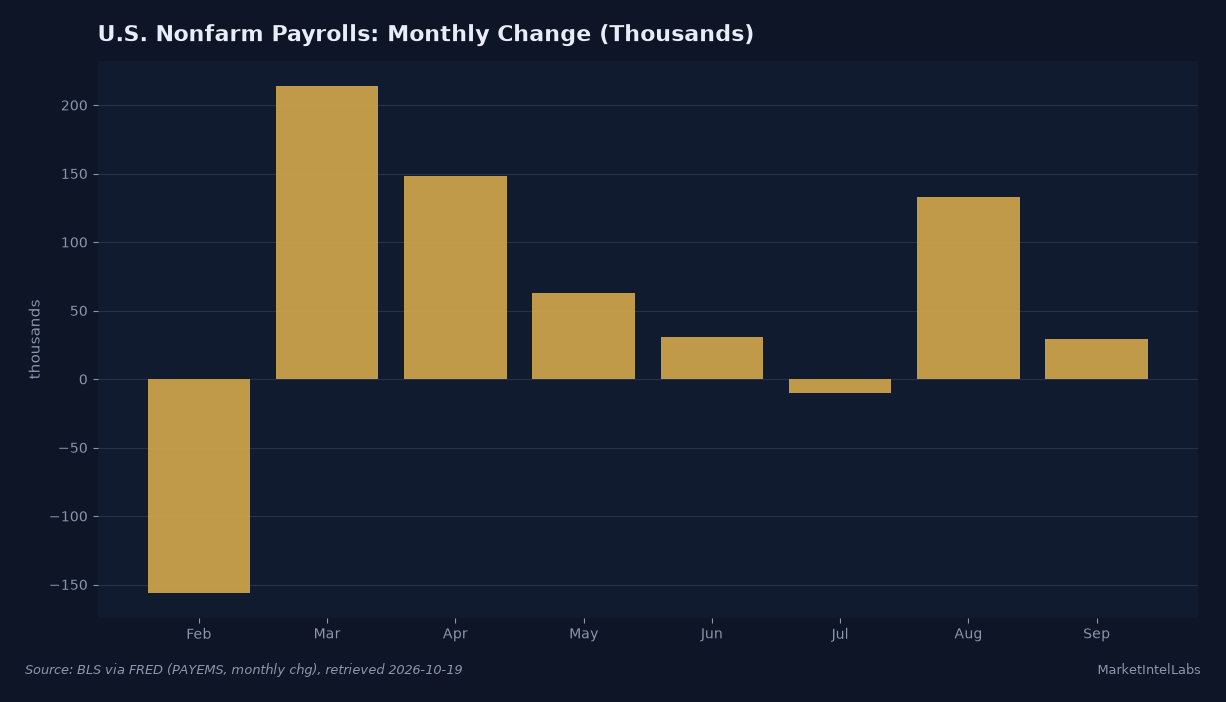
The week of October 19 put a plain number in front of the U.S. labor market: September payrolls added 29,000 jobs, the smallest monthly gain in recent data, and the unemployment rate edged up to 4.2% from 4.1% in August. With revisions to earlier months baked in, the three-month average now stands at about 51,000 net new jobs a month, a pace well below the 100,000-plus runs that marked much of the past two years.
A year earlier, the September 2025 report showed 76,000 jobs added, so this September ran at roughly two-fifths of the year-ago pace. The slowdown is broad rather than concentrated in one distressed sector: hiring eased in the private service industries that carried most of the expansion, while government payrolls provided a steadier offset. Health care and construction still added jobs, but at a slower clip than in early 2026.
Related reading: September CPI Inflation at 3.7% As Payrolls Add Just 29K.
The unemployment rate is the second signal worth reading together with the payroll count. At 4.2%, it is up 0.1 point from August and down from 4.4% a year ago, roughly in line with where it sat for most of 2025..
A labor market that cools this gradually, through a slower pace of hiring rather than outright layoffs, usually shows up first in the jobless rate and in weekly claims. Initial claims have held near 199,000 for the past month, a low, stable reading that argues against any sharp deterioration in the next few weeks.
For the broader framework, see our Fed policy coverage.
Related reading: September Jobs Report: Payrolls Add 29,000 After a 60,000 Revision.
Wages round out the picture. Average hourly earnings reached $37.81 in September, up 3.0% year over year. That is a solid nominal gain, but it trails the 3.7% headline inflation rate reported for the same period, which means real earnings are still being squeezed at the margin. For households that is the difference between borrowing power holding steady and slowly eroding, and it is the reason the jobs report does more than describe hiring.
The other side of the market, job openings, continues to point downward at a measured pace. The August JOLTS report showed openings easing to 7.08 million from 7.34 million in July, while quits held around 3.07 million. Openings have drifted lower for over a year without collapsing, and quits staying near 3 million suggests workers remain confident enough to leave a job, just not eagerly. That is the signature of a market tightening gently, not souring.
Related reading: September Jobs Report Lands Friday With Real Wages Already Shrinking.
Sector detail shows where the hiring still is and where it has thinned out. Government employers continued to add, and health care and construction both stayed in positive territory, consistent with a service-heavy expansion grinding along at a slower gear..
The notable change was the private services wedge: restaurants, retail and business services, which together drove most of 2025 and early 2026, contributed less in September as discretionary demand softened. Manufacturing added little, a familiar pattern for a sector still shadowed by elevated borrowing costs and weak global demand.
Related reading: September payrolls added 29,000 as revisions erased 60,000.
The household survey, which produces the unemployment rate, told a slightly softer story than the payroll count alone. While payrolls measure jobs held on a particular reference week, the household side captures more self-employment and small-business work, and its signal this month leaned toward a looser market..
The two surveys disagree from time to time, and this is one of those months, so the honest read is that the labor market is cooling but not collapsing. The participation rate held close to recent levels, which means the rise in unemployment mostly reflects slower hiring rather than a surge of people newly looking for work.
What does this do to the Federal Reserve? The set-up is genuinely two-sided. A payroll gain of 29,000 weakens the argument that the economy is running hot enough to keep policy as restrictive as it is, and the drifting unemployment rate reinforces that read..
At the same time, the strong September CPI release has pushed market pricing toward a hike at the October 27-28 meeting, and wage growth at 3.0% against 3.7% inflation gives the hawks room to argue that real incomes are still falling. The data the committee weighs are pointing in opposite directions.
The calendar keeps the signal fresh. Weekly claims publish Thursday, and the October employment report lands Friday, November 6, followed by September JOLTS data later in the month. Between now and the FOMC decision, those are the three releases that will move the question: whether a 29,000 month is an aberration or the start of a trend.
The takeaway for the quarter is that the labor market is cooling without cracking. Hiring is running just fast enough to absorb new entrants, the unemployment rate is drifting up off a low base, and wage gains are being overtaken by higher prices. That combination keeps the Fed’s next decision genuinely open, and it makes every claims release over the next two weeks a number worth watching on its own.
Get daily intelligence delivered
Create a free account for the Daily Brief every weekday and The Week Ahead every Sunday. No card required.