Google's $17 billion Wyoming data center pairs 702 MW of Bloom fuel cells with carbon capture

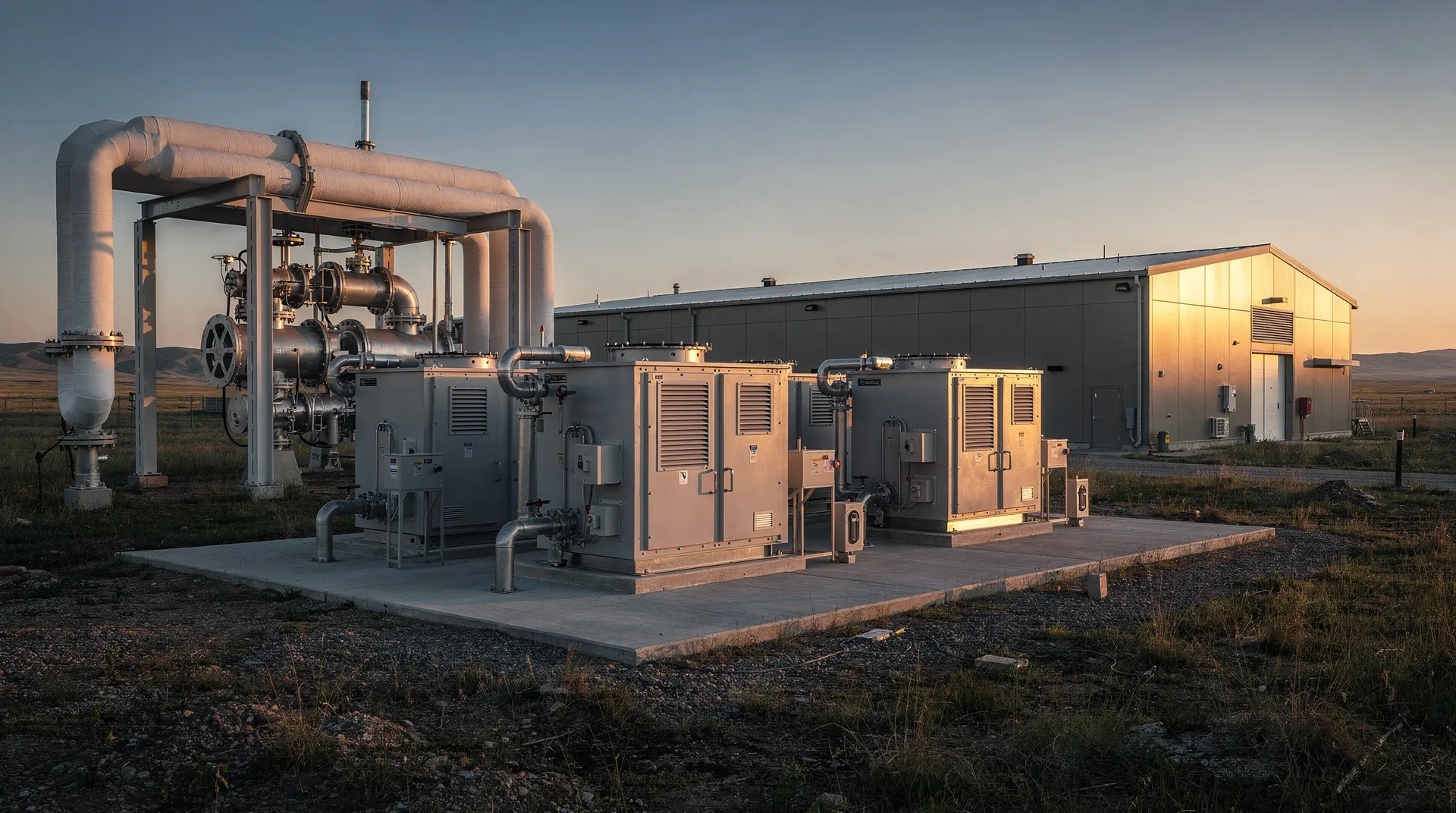
Alphabet's Google announced Thursday that it will build its first data center in Wyoming, a $17 billion investment that anchors an unusual answer to the AI data center's hardest constraint: the power supply itself. Google will run the facility in part on a planned 702-megawatt fuel-cell development equipped with carbon capture and storage, with the fuel cells supplied by Bloom Energy. The company disclosed the project on its infrastructure blog on November 5, 2026.
The size clears the bar for what qualifies as a major AI infrastructure move. $17 billion is a single-state commitment by a tier-one hyperscaler, and the 702 MW fuel-cell capacity is roughly half a gigawatt of contracted generation attached to one campus. Google said the fuel-cell development is a first-of-its-kind commercial-scale project of that size, and that the CCS technology will capture and geologically store most of its carbon emissions at Tallgrass Energy's nearby Eastern Wyoming Sequestration Hub. That brings Google's total contracted CCS capacity to nearly one gigawatt.
Related reading: Google Locks In 702 MW of Fuel-Cell Power From AEP for Its AI Data Centers.
Here is the chain that matters for this beat. Google is the spender. Bloom Energy is the supplier, making the fuel cells that convert natural gas into electricity through an electrochemical reaction rather than combustion. American Electric Power, a listed utility, is contracted to deliver the power package, and Tallgrass Energy and Black Hills Energy are operating generator capacity on the site. Related Digital is the real-estate partner. Google said the project is air-cooled to avoid drawing down local water, and that it expects the campus to generate hundreds of millions of dollars in property taxes for Laramie County and the local school district over its life.
What the market priced checks against what the document says. The Google blog and the Reuters report on November 5 describe the same $17 billion figure and the same 702 MW fuel-cell plan. But the market reaction on the same day was not a simple AI-capex bid. Bloom Energy shares slumped more than 14% on November 5, according to Reuters, on the worry that restrictions could hit the industry. That move had more to do with the political climate around data centers than with the Google contract itself, which is a positive for Bloom's order book.
For the broader framework, see our crude oil coverage.
Related reading: Google Malaysia data center investment hits $15 billion for 2027 and 2028.
The political read is the second half of this story and it is a priced risk, not a commentary. Investors are reassessing the pace of the AI infrastructure buildout. Of 41 data center-related ballot measures voted on this week, all but one went against data centers, according to Ballotpedia. Reuters reported that candidates opposed to data-center expansion won in key Texas and Georgia races during the midterm elections, adding to concerns that political resistance could complicate the industry's rapid growth. The implications are institutional: local permitting, power procurement and the cost of capital for developers all feed into whether announced capacity actually gets built.
The third signal came from another hyperscaler the same day. Reuters reported that Microsoft declined to expand a Texas data-center agreement with AI cloud provider Nscale, and that Bloomberg News reported Microsoft planned to tighten oversight of data-center projects from neocloud providers Nebius, IREN and Nscale. Taken together, Google's Wyoming commitment and Microsoft's tightening both suggest the frontier of hyperscaler policy is now being set campus by campus, and that investors are watching each one.
Related reading: Bloom Energy NTT DATA 900 MW Onsite Power Deal for AI Data Centers.
The bulls and the bears both have a defensible case here. The bull case is arithmetic: hyperscaler capex is still expanding, Google committed $17 billion to one campus on what it argues is a responsible build, and AI capacity is the scarce asset. The bear case is the ballot box and the boardroom together: local resistance puts permitting and power at risk, and hyperscalers appear to be renegotiating the terms of neocloud deals that were once assumed to be locked in. The next calendar inputs are the earnings and capex disclosures from the hyperscalers in the coming quarter, and any further state or federal action on data-center power and land use that would put hard numbers on the risk.
For now the takeaway is precise. A tier-one hyperscaler committed $17 billion to new AI infrastructure on November 5, with 702 MW of Bloom fuel cells, carbon capture at a nearly one-gigawatt scale, and a roster of listed partners in AEP, Tallgrass, Black Hills and Related Digital. The same day, the market sold Bloom Energy on the politics, not on the contract. Both facts matter for anyone trying to price the AI buildout: the money is still being committed, and the constraints on that money are growing.
Related reading: WEC Energy capital plan jumps to $47.5 billion on Microsoft and Oracle data center demand.
This content is for informational purposes only and does not constitute financial advice. Past performance is not indicative of future results. Consult a qualified financial advisor before making investment decisions.
Get daily intelligence delivered
Create a free account for the Daily Brief every weekday and The Week Ahead every Sunday. No card required.