Event Contracts Explained: Why December Fed Odds Are Not a Forecast


Event contracts turn a precise question into a price, not a promise about the future. As of 10:02 UTC on November 23, Kalshi's December Federal Reserve decision contracts indicated 89.5% for a quarter-point increase, 7.5% for no change, 2.5% for an increase greater than a quarter point and 0.5% for each of two cut categories. The next decision is scheduled for December 9, according to Kalshi's December meeting page. These figures describe what participants were willing to quote at that moment. They do not say the Fed has voted, and they do not guarantee that any one outcome will happen. Understanding the distinction starts with the contract's question and its settlement rule.
There is already a market story here. Our report on December Fed repricing after the October CPI release follows the economic news and the rate-market reaction. This feature answers a different question: what exactly do event-contract odds measure, why can they change quickly, and how should a reader compare them with a futures-based estimate without mistaking either for the decision itself? The contracts are most useful when read as dated evidence about expectations, with the exact question attached. A bare percentage detached from its resolution terms is less informative than it looks.
Related reading: Fed December decision odds: prediction markets price a 77.5% move on Dec 8-9.
How event-contract prices become probabilities
Kalshi's explanation of how its prices are determined describes a contract that links a Yes price in cents to a market-implied probability. Its example of a 70-cent Yes price corresponds to a 70% market estimate of that defined event, with the No side correspondingly priced around 30 cents in the basic example. The venue matches opposing orders rather than appointing an economist to publish a forecast. For the December Fed contracts, we read the exchange's market data at 10:02 UTC and report indicative Yes midpoints, not an executable all-in price. Midpoint, available size, spread and fees are different facts. A displayed 89.5% does not mean a reader could transact at exactly 89.5 cents.
Consider the wording. A contract on a quarter-point hike is not the same question as a contract on any hike; a contract on the target range is not the same as one on the effective overnight rate. Kalshi's December page lists separate outcomes for a 25-basis-point increase, a larger increase, an unchanged rate and cuts. A basis point is one hundredth of a percentage point, so 25 basis points denotes a quarter-point move. The five indicative midpoints in this snapshot add to slightly more than 100%. That is a feature of looking at separately quoted markets with discrete ticks and spreads, not evidence that more than one mutually exclusive Fed decision can occur. We have not normalized them into an artificial probability distribution.
For the broader framework, see our Fed policy coverage.
Kalshi's Yes-versus-No explanation says the two sides of an individual contract are economically connected: its simplified account describes a combined dollar for the opposing claims. That relationship belongs to one precisely specified contract. It does not erase the spread between the best bid and the best ask on an order book, nor does it prove five separately traded contracts have perfectly synchronized quotes. A useful reading discipline is to say what the contract asks, when the observation was taken and whether the figure is a last trade, a bid, an ask or a midpoint. A chart that suppresses those details could make a noisy quote look like an official probability.
Market depth also matters. A small order can move a thin book more than it would move a deep one. The Kalshi public data snapshot for this December event reported approximately 174,400 contracts of 24-hour volume for the quarter-point-hike outcome, compared with about 28,000 for the greater-than-quarter-point-hike outcome. Those are contract counts, not dollar volume and not a guarantee of depth at the displayed midpoint. The relative activity helps explain why a dramatic percentage change in a small side market may deserve less interpretive weight than movement in a much busier outcome. Volume is context for a price, not a measure of whether the price is correct.
Other venues complicate the picture in useful ways. Polymarket's resolution guide says a winning share receives $1 and a losing share becomes worthless when a market resolves, and describes a proposed outcome followed by a challenge period and, if challenged, a dispute process. That is a different settlement mechanism from simply reading a government press release off a screen. Resolution terms specify which document, time window and interpretation count. Two contracts can appear to discuss the same headline but settle on different definitions. Readers comparing venue percentages should check that the questions, deadlines and underlying evidence match before calling a difference a disagreement about the economy.
The December snapshot, and what the chart cannot show
The original chart below plots the five Kalshi Yes midpoints for the December 2026 Fed decision, drawn from the exchange's public market data retrieved on November 23 at 10:02 UTC. Its largest bar is the 25-basis-point hike at 89.5%; hold is 7.5%, a hike greater than 25 basis points is 2.5%, and the two cut outcomes are 0.5% each. The chart depicts a cross-section at one time, not a history or an executable offer. Because these are distinct quotes, their unadjusted sum can depart from 100%. The useful signal is which defined outcome was dominant at the observation time, not precision to the last tenth of a point.
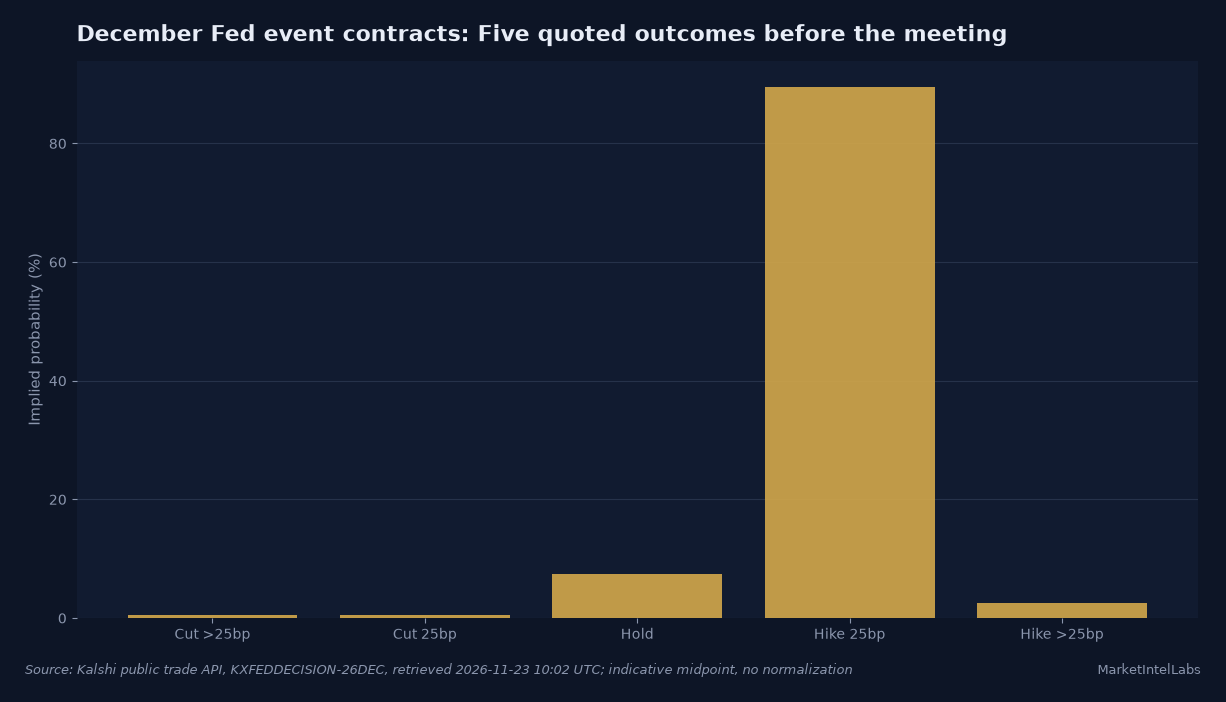
To read the chart properly, picture the alternative interpretations of a Fed press conference. If the committee were to leave the range unchanged, the hold outcome would have matched the announced action, even if officials' language sounded restrictive. If it raised the range by 25 basis points, the quarter-point-hike outcome would be the relevant one; a speech before the meeting would not settle that contract. The Kalshi event page identifies the December decision as the object of the market and gives the announcement date as December 9. Only the actual decision and the venue's written rules settle the market. A quote on November 23 is a provisional consensus about that later event.
The Fed's October 28 FOMC statement supplies the starting point. The committee maintained the federal funds target range at 3.75% to 4.00%, said inflation remained elevated and described economic activity as expanding at a strong pace. It recorded a 10-to-2 vote, with Lisa Cook and Beth Hammack preferring a quarter-point increase at that meeting. These are the committee's published words and votes, not evidence that December is predetermined. A December hike would be a change from that published target range; a hold would preserve it, assuming no intervening action. The distinction between a current policy setting and a market's expectation of a future decision is the center of the story.
Our account of the October FOMC minutes provides additional background on why investors are scrutinizing the next meeting. A reader can extract more from the Fed's direct statement, the scheduled release calendar and the contract's precise terms than from a naked percentage alone. The disagreement at the October vote shows that officials did not all favor the same action then; it does not give us a usable vote count for December. New inflation and activity data may change how markets assess the committee, while the Fed itself can evaluate information not captured by any single contract.
Why FedWatch is a different lens
The comparison people usually reach for is CME FedWatch. CME Group's methodology explains that its tool calculates probabilities from 30-Day Federal Funds futures prices. Those contracts incorporate expectations for the average daily effective federal funds rate during their month; the model then infers probabilities for target-rate levels around scheduled meetings. CME says the calculation assumes policy changes in 25-basis-point increments and an effective rate response proportionate to the move. Its published method warns that estimated probabilities can vary when assumptions fail. A FedWatch percentage and a Kalshi Yes midpoint are therefore outputs from different instruments and different methods, even when both refer to the same committee meeting.
One difference is what is priced directly. The event contract names an outcome and the price of a claim on it. A futures contract prices an average overnight rate across a calendar month, which CME's methodology translates into possible meeting outcomes using a probability tree. Calendar days before and after the meeting, the relationship between the effective rate and the target range, and the assumed increment all enter that translation. The event contract has its own complications: how the outcome is defined, whether a market is liquid and what a buyer would actually pay. Neither construction has a special channel into the Fed's internal deliberations.
That makes a comparison valuable without making it a contest. If futures-derived probabilities and a directly quoted event contract diverge, first compare timestamps, definitions and conventions. Is one measure about a 25-basis-point hike only while another combines all possible hikes? Did one observation arrive after an economic release and the other before it? Are you comparing a midpoint with a model output that uses futures settlement assumptions? A discrepancy that survives those checks is an interesting description of different market expectations. It is not a self-executing opportunity, proof that one venue is mistaken, or a prediction that must resolve a particular way.
The Commodity Futures Trading Commission's November 2020 order designated KalshiEX as a contract market, a fact that matters when locating the venue within the U.S. derivatives framework. That designation does not certify the accuracy of any forecast. Regulators evaluate the market and its obligations; participants determine quotes, and subsequent events determine settlement. Likewise, a CFTC designation does not turn a market price into an endorsed probability for a reader's portfolio. Institutional status and predictive performance are separate questions. The same separation applies when looking at a futures exchange: the existence of a regulated contract tells you where trading happens, not whether its current implied path will happen.
The next dated tests of the market's view
The Bureau of Economic Analysis schedules its October 2026 personal income and outlays release for November 25 at 8:30 a.m. Eastern. That release contains the personal consumption expenditures price data investors use to assess inflation. As of this article's November 23 observation, the October release had not happened. Any assertion about its final reading would be a forecast, not a reported print. BEA also schedules the second estimate of third-quarter GDP for November 25 at the same hour. A reaction in event odds afterward could reflect both releases or other simultaneous information; a change in a chart does not by itself identify its cause.
Kalshi's December event page schedules the decision announcement for December 9. Before then, traders can revise odds as official data arrive and officials speak. Afterward, the resolution terms, rather than a commentator's reading of the press conference, govern the contract. There is a practical difference between following the odds as a barometer of expectations and using them as an oracle. A barometer can respond to fresh observations, but it does not cause the weather. The market's signal becomes more informative when tracked alongside the date of each new primary release, rather than interpreted as a stable percentage that lives outside time.
It helps to keep three clocks separate. The first is the publication time of a document such as the BEA release. The second is the timestamp of the price quote; an event contract can move between those observations. The third is the settlement time specified in the contract's rules, which can follow the official announcement. Polymarket's published resolution explanation illustrates why the third clock can be especially important: a proposed resolution can be challenged. The price before resolution is the market's expectation about an outcome; the result after resolution is the venue's application of the rules to evidence. Mixing those moments creates false claims about what traders knew.
There is also uncertainty beyond the headline decision. Even if a contract's modal outcome were to occur, its price might have changed sharply between now and settlement. A 25-basis-point move tells us little by itself about the committee's subsequent path, the statement's language or the degree to which markets had anticipated it. CME's futures-based probability tree summarizes a rate-path assumption, but a short-dated Kalshi decision contract isolates a particular outcome. Readers interested in the economic consequences should distinguish an announced target-range change from expectations about later meetings. Our analysis of the yield and dollar response to December repricing addresses that separate transmission question.
What would change this picture? A BEA inflation reading that significantly changes the perceived persistence of inflation could shift the contract prices, but its exact value is not yet known. A Fed statement indicating a change in the balance of growth and inflation concerns could matter too; any such statement has to be read when it exists. A large move concentrated in a low-volume outcome, with wider quoted spreads, would deserve more caution than a sustained change across liquid contracts and the futures market. These are tests for interpreting new information, not claims that a particular reading or price change is coming.
The strongest case for watching event contracts is that they force vague commentary into falsifiable questions. Was there a hike? Was it exactly 25 basis points? Did the market price that outcome confidently beforehand? The strongest case for restraint is that the answer is conditional on contract text, liquidity and time. On November 23 the dominant December quote was 89.5% for a quarter-point hike; on December 9, the Fed's decision and the contract's settlement criteria will provide the answer. In between, the odds are best treated as a continuously revisable record of what traders expected, not as a substitute for the official release.
Frequently Asked Questions
What is an event contract?
An event contract is a traded claim whose settlement depends on a defined outcome. Kalshi explains that the Yes and No sides of its basic binary market correspond to opposite results, with the quoted Yes price often presented as a market-implied probability. The precise question and resolution rules matter more than the topic label.
Does an 89.5% Fed hike price mean the Fed will hike?
No. Kalshi's December quarter-point-hike contract indicated an 89.5% Yes midpoint at 10:02 UTC on November 23, 2026. That is a dated market quote for a specific outcome, not a Fed announcement or a guaranteed forecast. The actual December decision was still pending.
Why do event-contract odds differ from CME FedWatch?
Kalshi's contract directly quotes a defined event outcome, while CME Group says FedWatch derives target-rate probabilities from 30-Day Federal Funds futures prices under specified assumptions about meeting dates and rate increments. Different timestamps, question definitions, spreads and models can produce different reported percentages without either being an official Fed prediction.
When is the next inflation release before the December Fed decision?
The Bureau of Economic Analysis schedules October 2026 personal income and outlays, including PCE inflation data, for November 25 at 8:30 a.m. Eastern. Its reading was not available at the time of the November 23 market snapshot. The December Fed decision is scheduled for December 9, according to Kalshi's event page.
Can five Fed outcome prices add up to more than 100%?
Yes, if a reader adds indicative prices or midpoints from separately quoted outcome contracts without adjusting for spreads, ticks and different depths. The five Kalshi December outcome midpoints retrieved on November 23 were not normalized into a probability distribution. Adding those displayed figures is not the same as observing one frictionless set of jointly executable prices.
This content is for informational purposes only and does not constitute financial advice. Past performance is not indicative of future results. Consult a qualified financial advisor before making investment decisions.
Get daily intelligence delivered
Create a free account for the Daily Brief every weekday and The Week Ahead every Sunday. No card required.