December Fed Rate Hike Is Nearly Priced In: What Odds Mean


Markets have moved the December Federal Reserve decision from likely to nearly certain. CME FedWatch now prices a 25 basis point rate hike at the December 8-9 FOMC at roughly 94% to 97%, a jump that followed the October personal consumption expenditures report, which came in hot on the core gauge the Fed watches most closely.
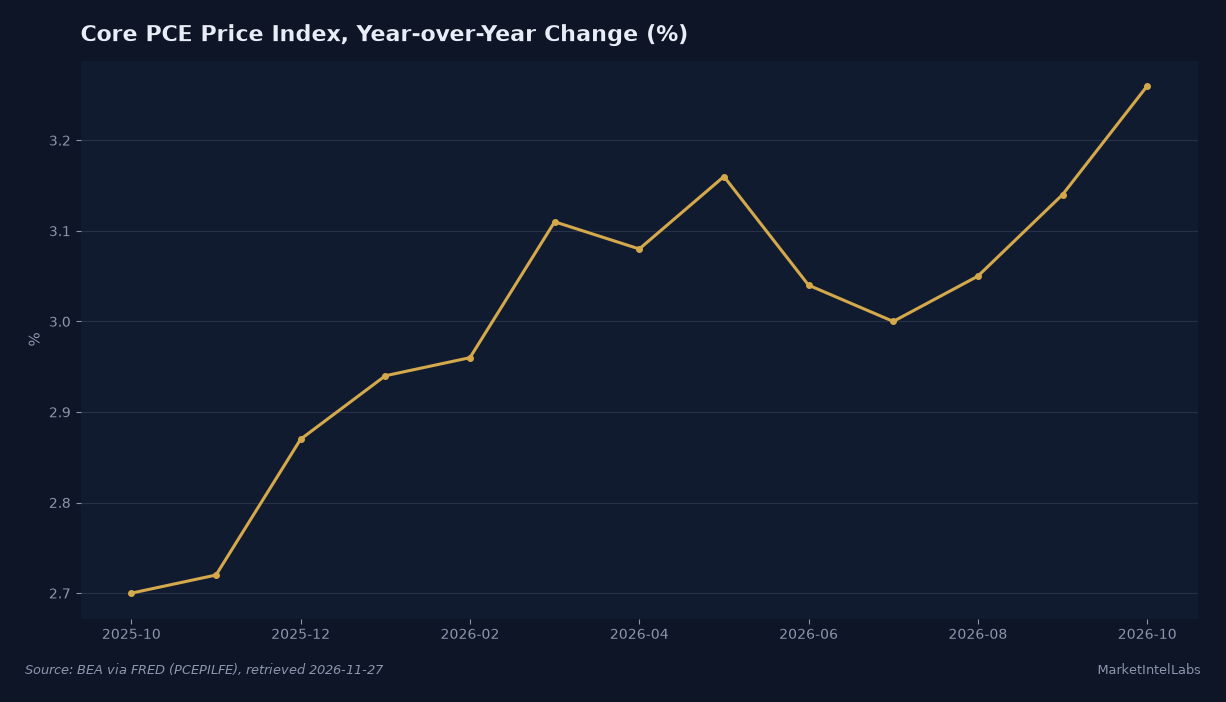
The core print is where the inflation tension lives. Core PCE, which strips out food and energy, rose 3.3% year over year in October, according to BEA data released November 25, a tenth above the 3.2% consensus and up from 3.1% in September. Headline PCE was 3.8% year over year, broadly in line with its forecast. Both rose 0.3% month over month. Core inflation is now re-accelerating against the Fed's guidance rather than easing toward the 2% target, and that is the pattern that has traders pricing the first quarter-point hike in months.
Related reading: CME FedWatch December 2026 rate hike probability: what October CPI means for December.
The rate path is a short history with a sharp turn. After holding rates in a 3.50% to 3.75% range through most of the year, the Fed hiked 25 basis points on September 16, its first move in three years, bringing the target range to 3.75% to 4.00%. The October 28 meeting produced a hold by a 10 to 2 vote, with Governors Cook and Hammack dissenting, and the minutes published November 18 showed almost all participants expect further hikes, with a couple flagging a move larger than 25 basis points as possible in December. The September dot plot median already put the end-2026 federal funds rate at 4.1%, which after the current range implies at least one more hike and leaves room for more.
What is genuinely new since those minutes is the repricing around the PCE print. FedWatch's December hike odds sat near 97% to 98% before the report and settled around 94% to 97% afterward, with the probability of a larger 50 bp move running between 3% and 10%. Markets now price roughly 62 basis points of hikes across the next three meetings, a path that implies the December move plus real odds of a follow-up, and the January meeting draws a near-60% chance of a hike. In other words, the market is no longer asking whether the Fed tightens next month; it is asking how far the tightening goes.
For the broader framework, see our Fed policy coverage.
Related reading: October PCE: does a 3.3% core print seal the case for a December Fed rate hike.
The fixed-income reaction held the real story of the day. Ten-year Treasury yields fell roughly 3 to 6 basis points to around 4.85% to 4.87% even after a hot core print, as a safe-haven bid and growth concerns capped the long end while the front end priced more tightening. That is a bull steeper: the curve is simultaneously building in a near-certain December hike at the short end and questioning how much further growth can carry at the long end. The two-year yield did the front-end work, while anxiety about the pace of the economy held the ten-year in check.
Growth is not giving the Fed an excuse to pause. Real GDP was revised up to a 4.3% annualized pace for the third quarter, according to the BEA, well above the 3.5% consensus and the fastest in three years. Hot core inflation alongside accelerating growth removes the argument that the Fed can hold and wait, which is the core reason the December hike is now priced as nearly certain rather than merely probable.
Related reading: Fed December Rate Hike Odds Near 76% on Kalshi as October Pausing.
The size debate is the open question. Governor Waller has said a 50 basis point move stays on the table if there is no clearer signal by January, while New York Fed President Williams has counseled against dramatic action and Treasury Secretary Bessent has warned about the risk of overtightening. The Fed enters its communications blackout on November 28 through December 10, so officials will not guide markets between now and the decision. The two days after the blackout matter more than the days before it.
What happens next is a string of catalysts rather than one event. The December 9 decision at 2pm ET lands with a fresh Summary of Economic Projections and dot plot, followed by the press conference at 2:30pm, so the rate is only half the story the committee sets. The January signal in the dots, a post-meeting CPI report, and how year-end money markets hold through the holiday lull will all test whether the market's 62 bp of priced tightening is right, too much, or not enough. The September dot median already points to a 4.1% end-2026 rate, so the direction of travel is clear even if the December size is not, and the next inflation prints will do most of the deciding.
Related reading: October CPI Runs Hot: Core Holds at +0.3% and the December Path Stays Priced In.
This content is for informational purposes only and does not constitute financial advice. Past performance is not indicative of future results. Consult a qualified financial advisor before making investment decisions.
Get daily intelligence delivered
Create a free account for the Daily Brief every weekday and The Week Ahead every Sunday. No card required.