Bitcoin ETF flows turn net negative for October as BTC reclaims $80,000 and IBIT outpaces Fidelity and ARK


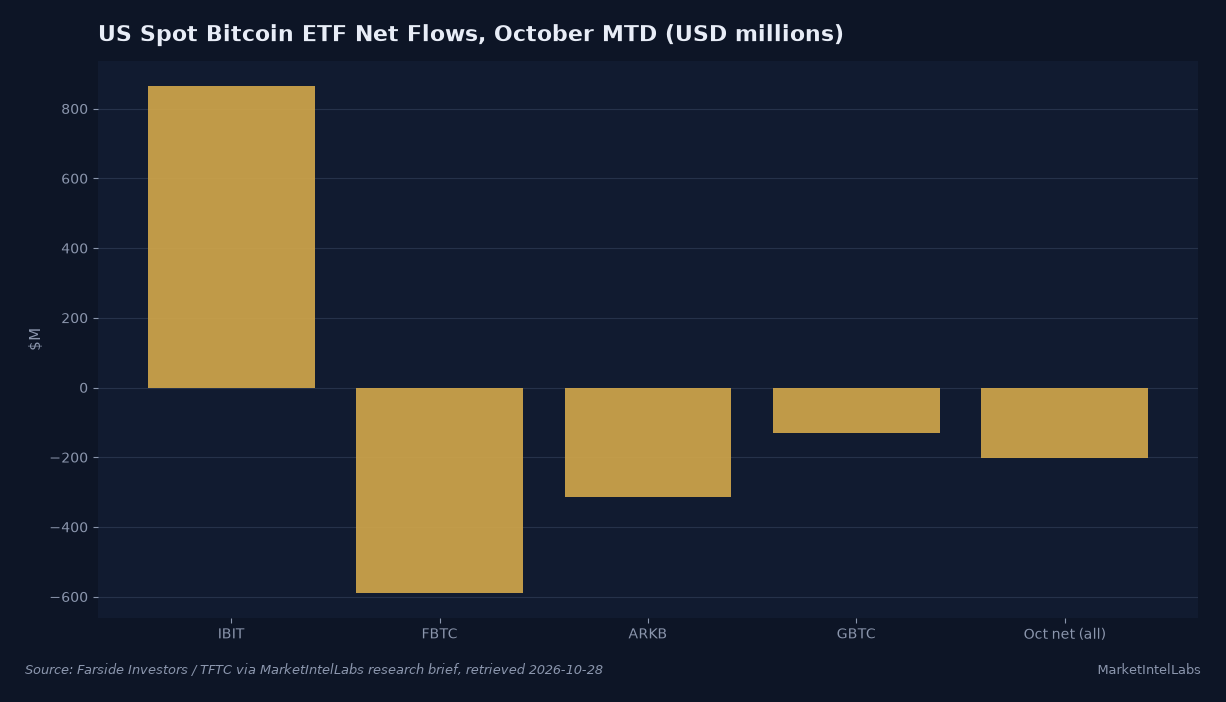
Bitcoin has climbed back above $80,000, but the flows underneath that reclaim are telling a more complicated story than the price alone. US spot bitcoin ETF flows are net negative for October, roughly minus $202 million across 18 trading days, and the picture inside that total is starkly bifurcated: BlackRock's IBIT keeps absorbing money while Fidelity, ARK and Grayscale bleed. The move is landing on the eve of a Federal Reserve decision the market treats as a near-sure hold, and that is where the real risk to crypto sits.
The reclaim is real but recent. Bitcoin crossed back above $80,000 in this morning's print after dropping under that line on October 26, when roughly $117 million of crypto long positions were liquidated in 24 hours. That flush fits the week's frame: a scheduled Federal Reserve decision on October 28, and traders de-risking into it. Bitcoin is trading as a rate-sensitive asset right now, not as a store-of-value outlier, and the price charts confirm it; the token slipped with risk appetite and recovered with it.
Related reading: Bitcoin ETF flows explained: IBIT holdings rose in October.
So the price has a bid. The question is whether the institutional flows back it. Per the Farside daily fund table, October's 18 trading days have run 10 inflow sessions against 8 outflows, leaving the month net negative near $202 million.
The single worst session was October 22 at roughly $635 million out. That is the headline number, and it is the reason this month reads as a distribution month after the strong inflows of September.
But the aggregate hides the real signal. While the month is net negative, BlackRock's IBIT has collected about $865 million of net inflows, and three of the legacy and incumbent issuers have done most of the bleeding: Fidelity's FBTC down about $589 million, ARK's ARKB down $315 million, and Grayscale's GBTC down $131 million.
That is not a uniform exit from bitcoin exposure. It is money moving inside the ETF wrapper, consolidating into the deepest liquidity and the lowest-cost incumbent. In that sense the institutional dollar is still there; it is just narrower and pickier than September's broad bid.
One data caveat is worth flagging. CryptoBriefing's October 26 headline reported roughly $443 million of net outflows, a figure that does not reconcile with Farside's daily table, which shows net inflows of about $110 million on October 26 and $24.5 million on October 27. The discrepancy is unresolved at the time of writing, so this piece follows the per-fund daily table and does not assert either number as definitive. Where flow data conflict, wait for the official daily reconciliation rather than trade the first headline.
None of this happens in a macro vacuum. The FOMC decision lands today at 18:00 UTC, and markets price the outcome at roughly 95 to 96% hold on Kalshi's KXFEDDECISION-26OCT contract, with CME FedWatch running slightly lower around 88 to 93%. The hold itself is not the risk. The December signal is.
Kalshi prices about a 74% chance of a 25 basis point hike by the December meeting, and CME futures imply roughly 0.9 hikes into December, an 82% chance the rate is higher by December 9. That is the line that caps bitcoin, and it is why a dovish hold would lift the complex while a hawkish hold, even with rates unchanged today, would keep the lid on.
On-chain conditions back the read that this is liquidity risk, not a broken bid. Total USD-pegged stablecoin supply sits near $303 billion, elevated and consistent with substantial dry powder waiting on the sidelines. Bitcoin dominance near 59.6% against ether's roughly 10.5% tells the same story from the other side: capital is rotating defensively into the largest, lowest-beta asset ahead of the decision rather than reaching for ether or solana speculation. Across the desks, the majors track the rate path; solana at about $101.74 is the most resilient of the three into the Fed, but as the highest beta it also swings hardest on the outcome.
For balance, the bull case rests on that $303 billion of dry powder and the IBIT absorption: if the Fed sounds dovish about December even while holding today, the deferred-hike timing could release sidelined capital into a coin that has already reclaimed its psychological level. The bear case is the mirror: a hold that keeps December tightening priced, or worse, guidance that pushes the hike cycle forward, and ETF flows staying net negative into year-end would eat the support under $80,000. Key references to watch are support at $80,000 and resistance near $84,500, with the decision at 18:00 UTC as the trigger.
The practical takeaway for a retail investor is to watch the axis, not the number. Bitcoin is recovering above $80,000 while its institutional flows are net negative and diverging by issuer, and it is doing so on the eve of a Fed decision the market reads as a hold with a hawkish December. That combination is a rate-and-liquidity trade, and the flows right now are leading less than they follow.
Watch the FOMC statement and the December pricing after 18:00 UTC, and watch whether the Farside table flips net positive again. Until the institutional bid broadens beyond IBIT, the reclaim is real but it is built on a narrow and picky base of support.
This content is for informational purposes only and does not constitute financial advice. Past performance is not indicative of future results. Consult a qualified financial advisor before making investment decisions.
Get daily intelligence delivered
Create a free account for the Daily Brief every weekday and The Week Ahead every Sunday. No card required.