Polymarket trims 2026 AI Millennium Prize solve odds to 58%


Polymarket traders cut the chance an AI lab announces another Millennium Prize solution this year to 58.0 percent by Monday 07:50 UTC, down 17.5 points in 24 hours, the sharpest single-day re-rating the market has shown since OpenAI claimed a solve in September. The move runs across the whole AI mathematics complex, and it reads as a market pulling risk on a story that had run hot.
The companion series on the same complex helps fix the direction. Polymarket's “Will AI solve the Riemann Hypothesis in 2026?” contract fell 12.0 points to 59.5 percent, and the “Riemann Hypothesis next” market, which asks which of the seven problems AI solves first, declined 8.0 points to 73.1 percent for the next-solve framing. Those three contracts moving together, down 8 to 18 points each, is a coherent re-rating rather than noise in a single market.
Related reading: Ethereum above $1,700 odds: Nov 23 market swings 41 points.
Where the lost probability went is the part of the 24 hour move worth reading. The 2028-dated contracts absorbed it: “no Millennium Prize Problem solved by AI by December 31, 2027” rose 4.4 points to 7.5 percent, and “AI solves the Riemann Hypothesis in 2026” lost ground while its 2028 horizon held steady. Probability did not leave the AI mathematics thesis; it moved later in time. That is a calendar shift, not a disbelief in AI mathematics, and it is the kind of signal a prediction market gives that a headline cannot.
The register here matters. These contracts resolve on announcements and awards that have no settled timeline. The Clay Mathematics Institute has awarded only one Prize, for the Poincaré conjecture in 2010, and it took years of verification after the proof circulated. No AI lab has a published verification pipeline for a million dollar problem, and the September OpenAI claim has not produced a Clay award. A market pricing a 2026 announcement at 58 percent is pricing a press statement, not a certified result, and the gap between the two is the widest and least visible part of this trade.
Related reading: October Hike Odds Jump 14 Points on the Barr Speech.
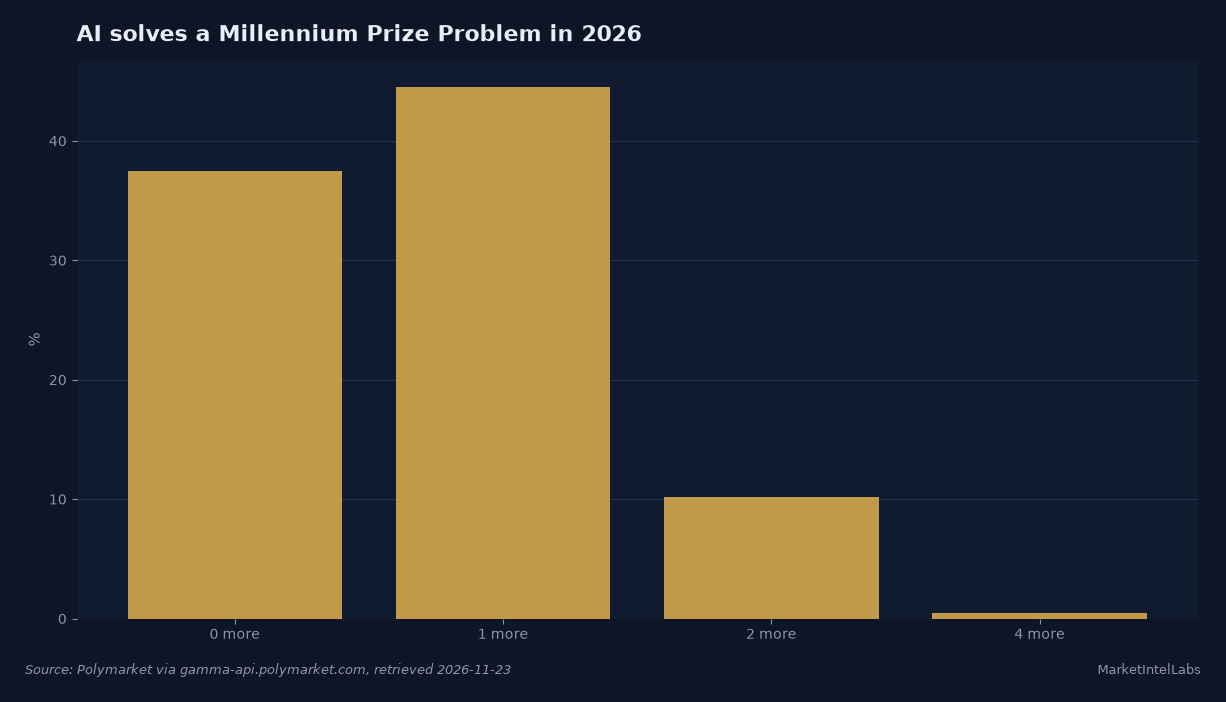
The flagship contract asks whether any AI lab announces another Millennium Prize solution before December 31, 2026. It traded near 75 percent a week ago, per the 24-hour move, and has now settled into the high 50s. A companion market, “Will AI solve 0 more Millennium Prize Problems in 2026?,” jumped 15.0 points to 37.5 percent yes, meaning the crowd now sees a 62.5 percent implied chance of at least one new solve this year against a four-in-ten chance the year closes with none.
These are thin, fast markets, and the size of the move is itself the story. Polymarket volume in the flagship contract reached $399,800 total over its life with $28,800 traded in the last 24 hours. The “0 more” contract traded $58,700 daily against $362,800 lifetime. A market this small can swing on a single large order, so the 15 to 20 point moves of the last day reflect positioning more than a changed scientific fact.
Related reading: Fed December 2026 hike odds: Polymarket prices 74.5% for a 25 bps move after jobless claims print at 194,000.
The catalyst context goes back to September 8, when Quanta Magazine reported OpenAI’s claim that it had solved one of the seven Millennium Prize Problems, the million dollar questions endowed by the Clay Mathematics Institute. That claim shot the “announce another by December 31” market into the mid 70s and pushed the “solve the Riemann Hypothesis in 2026” market near 70 percent. The retreat since has been steady, and the 24 hours to Monday morning mark the largest one-day leg.
Underlying the complex is a genuine open question about the prize structure. The Clay Institute awards the million dollar sum only after a solution is published and verified, a process that takes years for human work and has no published precedent for an AI-generated proof. What the market prices for 2026 is an announcement, not a verified award, and the “announce” framing is exactly why an OpenAI press event in September moved it so hard.
Related reading: Anthropic IPO valuation odds jump 48 points to 90.5%.
Cross-check the venue against itself before reading anything into it. The “0 more” contract and the “announce by December 31” contract imply different denominators, one counting solves and the other counting announcements, so the two should not sum to 100. The market that shattered on Monday was the spread between them: equal probabilities across the near contract collapsed into a wide gap, with the “no solve this year” side absorbing 15 points.
The next dated input is the calendar. The complex prices a December 31, 2026 resolution, so the odds will firm as the year end approaches. The most likely near-term catalyst is another lab announcement, any of which the market reads as an instant repricing. On the other side, the two 2028-dated contracts, “Riemann Hypothesis next” and “no solve by December 31, 2027,” have been the destination for the probability those near contracts lost.
For a reader watching the AI mathematics story, the honest read is that a single lab announcement or one conference demo can move these odds more than the actual mathematics does. The September claim set a high-water mark that the market has been drifting away from all quarter. Monday’s drop is that drift accelerating, not a change in the seven problems themselves, all of which remain open and unsolved on the Clay Institute’s own list.
This content is for informational purposes only and does not constitute financial advice.
Get daily intelligence delivered
Create a free account for the Daily Brief every weekday and The Week Ahead every Sunday. No card required.