The Yield Curve's Quiet Warning: Treasury Yields Rise and the Spread Narrows

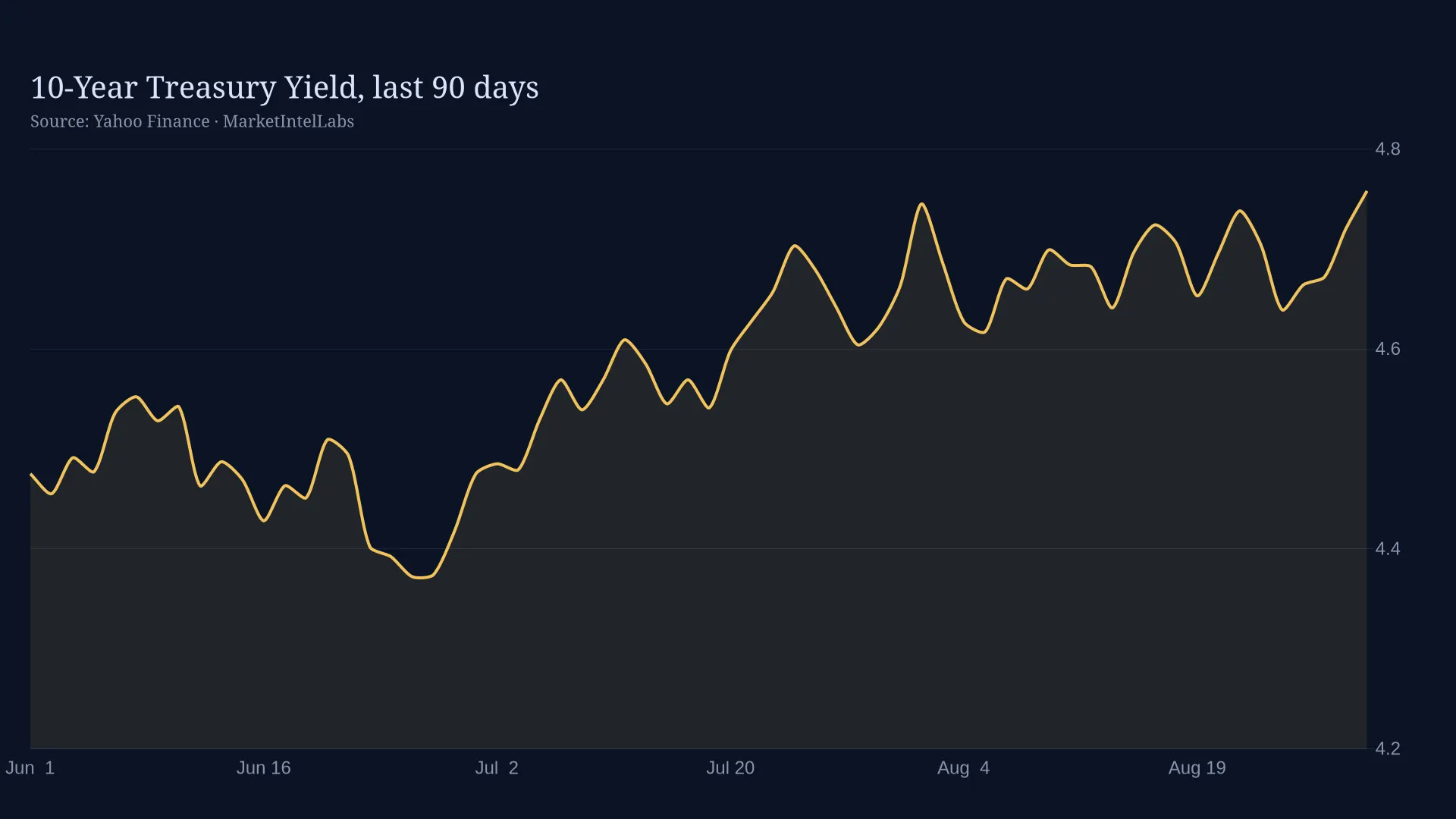
The yield curve is flattening again. Two-year Treasury yields jumped 3.33% to 4.34% while 10-year yields rose 1.28% to 4.73% (according to Treasury market data) over the past day, narrowing the spread between them to 39 basis points. That move is not just technical noise. It reflects a market recalibrating expectations for Federal Reserve policy and the path of growth.
This flattening matters because it tells us something about the market's collective view of the future. A positive but narrowing spread suggests growth expectations remain intact, though the pace is moderating. The last time the curve inverted was in 2022 to 2023, and it correctly signaled the 2024 recession. Today's 39-basis-point spread is nowhere near inversion, but the direction of travel bears watching.
Related Research:
The Federal Reserve's balance sheet tells the other half of the story. Assets declined 0.22% in the week ending August 26, 2026, marking a subtle but persistent drain on liquidity. This quantitative tightening proceeds on autopilot, removing roughly $15 billion in reserves each week. The effect compounds over time. Less liquidity means fewer dollars chasing risk assets, which puts pressure on valuations even if the underlying fundamentals remain solid.
Rising real yields are already showing up in asset prices. The across-the-board selloff in Treasuries, evidenced by TLT's 0.43% decline, suggests the market is pricing in either stronger growth or less accommodative monetary policy ahead. Gold dropped 0.11%, a modest move that reflects the competing forces of contained inflation reducing gold's appeal as an inflation hedge and ongoing geopolitical uncertainty supporting safe-haven demand. Silver eked out a 0.18% gain, likely benefiting from industrial demand that partially offsets monetary headwinds.
Equities are caught in the crosscurrent. SPY's 0.30% decline reflects the pressure that higher real yields place on equity valuations, particularly for long-duration assets. Yet QQQ's 0.05% gain shows technology stocks holding relatively firm, suggesting investors see pockets of resilience even in a rising rate environment. That divergence is telling. Growth stocks tend to suffer more when rates rise, but today's market is differentiating rather than selling indiscriminately.
The inflation backdrop remains supportive of a soft landing narrative. CPI increased just 0.07% month-over-month in July 2026 (according to Bureau of Labor Statistics data), well below the Fed's 2% annualized target. Unemployment held steady at 4.1%, a level that historically correlates with sustainable consumption. M2 money supply expanded 0.44% in July (per Federal Reserve data). That moderate liquidity injection offsets some of the Fed's balance sheet contraction. The data collectively supports the view that the Fed can remain on hold through year-end without triggering a recession.
But the risks are asymmetric. The bullish soft landing thesis rests on inflation remaining contained while growth stays positive. Should inflation reaccelerate, an energy price spike or supply chain disruption could do it, the Fed would face pressure to tighten more aggressively. Alternatively, a sharper deterioration in the labor market could trigger a recession before the curve fully inverts. Continued quantitative tightening also poses a risk if it drains more liquidity than the system can absorb, forcing a repricing of risk assets across the board.
The next few weeks will be critical. Watch the 10-year to 2-year spread. If it continues narrowing toward zero, the recession signal strengthens. Watch the Fed's balance sheet. The pace of contraction could accelerate if the central bank decides to step up quantitative tightening. And watch cross-asset correlations. Rising real yields that simultaneously pressure equities, gold, and bonds would signal a broader repricing of risk.
The data today is not flashing red. The soft landing remains intact. But the yield curve's flattening is a reminder that the path forward is narrowing. Markets are pricing in a benign outcome, but the margin for error is shrinking. That is not a reason to panic, but it is a reason to pay attention.
Disclaimer: This content is for informational purposes only and does not constitute financial advice. Past performance is not indicative of future results. Consult a qualified financial advisor before making investment decisions.
Get daily intelligence delivered
Create a free account for the Daily Brief every weekday and The Week Ahead every Sunday. No card required.