The Weekend Brief: A Hiking Fed Meets a Soft Labor Market and a 5% Ten-Year

On the afternoon of September 16 the Federal Reserve raised the target range on its benchmark rate by 25 basis points, to 3.75 to 4.00 percent, on a unanimous 12 to 0 vote (Federal Reserve, \u201cFederal Reserve issues FOMC statement,\u201d September 16, 2026). It was the first hike since 2023, and the statement that delivered it was written to say the obvious thing: this is not one and done. Chair Kevin Warsh told the press conference that the economy \u201cappears to be strengthening\u201d but inflation remains too high, and the Summary of Economic Projections published alongside the decision puts the median funds rate at 4.1 percent at the end of both 2026 and 2027, up from 3.8 percent for 2026 in June (Federal Reserve, Summary of Economic Projections, September 16, 2026).
The market took the message in one gulp. Fed funds futures repriced to roughly 3.7 hikes of 25 basis points over the next twelve months (Yardeni QuickTakes), and the prediction-market ladder scrambled a 48-hour repricing: Kalshi priced an October hike at 44.5 percent and a December hike at 83.5 percent, with a 6-point gap to Polymarket on the October meeting (MarketIntelLabs, prediction-markets desk, September 18, 2026). By that measure the market hears \u201cat least one more\u201d as the base case, and a real question as to whether the Fed gets two.
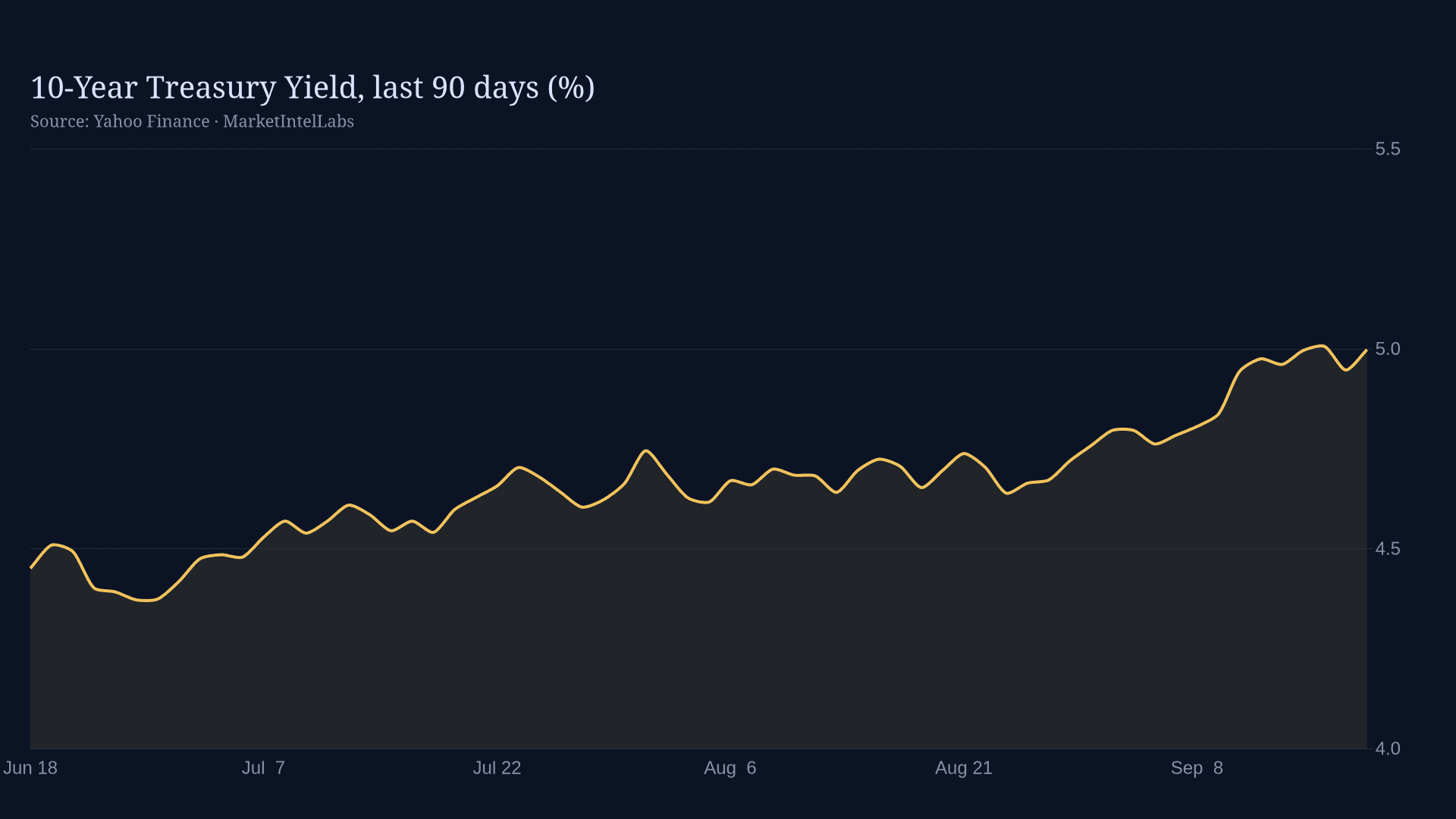
This is the structural story of the year, and it deserves more than a daily-brief headline. The Fed has not hiked since 2023. The labor market it is hiking into is sending two different signals at once. The bond market is repricing the long end to a 19-year high even as the central bank tightens the short end. The mechanics of that long-end repricing are spelled out in our look at the 5% ten-year. And gold, the asset that historically dies when real yields rise, is holding bids above $4,340 against exactly the kind of rates that used to break it (Kitco, \u201cGold price rebounds above $4,340,\u201d September 17, 2026). None of those four things fits the textbook the market has been reading since 2008. Figuring out what they add up to is the question this essay takes, and the answer matters for every portfolio that assumes the Fed will break the economy to fix inflation or that gold and Treasuries still hedge each other.
Why the Fed had no choice
The hike itself was, by the standards of a surprise, no surprise at all. August core CPI printed 0.3 percent month over month against a 0.2 percent consensus, which was enough to push the headline rate toward 3.4 percent year over year and to repricing the September meeting to an 87 to 90 percent hike probability before the decision (MarketIntelLabs macro week-in-review, September 18, 2026; Kiplinger, \u201cAugust CPI Numbers Are In\u201d). A central bank whose declared goal is 2 percent does not sit still at 3.5 percent with the inflation print accelerating. Warsh was explicit that the standard for holding had not been met, and the projections carried the whip hand: twelve of the eighteen participants project at least one more hike before the year is out (MarketIntelLabs, \u201cThe Fed\u2019s 4.1% Dot Puts AI\u2019s Cheap-Money Math to the Test\u201d).
The question is not whether this Fed was going to hike. It was what the hike says about the next eighteen months, and there the dot plot is unsparing. Holding the median funds rate at 4.1 percent at the end of 2026 and 2027 is a statement that the money financing the largest capital expenditure program in corporate history will stay expensive well past the next election cycle. It is a regime shift away from the holding posture that defined 2024 and 2025, and the market has started to believe it. When the 10-year Treasury sits at 5.00 percent, as Fed data showed it on September 15, the long end is doing the Fed\u2019s tightening for it while the short end does more (MarketIntelLabs, \u201cThe Fed Hikes Into a 5% 10-Year\u201d).
The labor market the Fed is hiking into
Here is where the picture stops being tidy. The labor market is not weak, on the claims side of the ledger. Continuing claims for the week ending September 5 fell 39,000 to 1.730 million, the lowest level of insured unemployment since January 2024, and the insured unemployment rate fell to 1.1 percent, its first decline since late April (U.S. Department of Labor, continuing claims release, September 17, 2026; MarketIntelLabs, \u201cContinuing Claims Just Hit Their Lowest Since January 2024\u201d). Initial claims dropped 10,000 to 196,000 for the week ending September 12, the lowest since July, with the four-week average at 203,250, roughly 43 percent below the post-1967 long-run average (Bloomberg Law, \u201cUS Jobless Claims Fall to 196,000 During Holiday Week,\u201d September 17, 2026). We broke down the split between firming claims and soft payrolls in our piece on the labor market the Fed is hiking into.
But the survey side of the ledger tells a different story. August payrolls rose a soft 162,000, and July was revised from a reported 23,000 decline to a 21,000 gain, a swing of 44,000 jobs in a single retroactive month (U.S. Bureau of Labor Statistics, Employment Situation, August 2026). The unemployment rate has sat at 4.1 percent for two straight months. Real hourly earnings slipped below a year ago in August, and worker pay is now running behind a 3.4 percent inflation rate (MarketIntelLabs, \u201cReal Wages Fall Behind\u201d). The divergence is the entire story: by the claims measures the labor market never cooled, by the payroll surveys it cooled through midyear and may still be cooling, and the two have pointed in opposite directions all year.
To a hiking central bank that split is gold. Claims at multi-year lows mean the Fed can tighten without the political heat of a rising unemployment line, at least for now. Firming claims were exactly the argument the market used in the spring to demand cuts; that argument is gone. What remains is a hiring market that is frozen at the input end, with openings and quits still weak, even as the firing end has gone quiet (MarketIntelLabs, jobs-labor desk). The Fed reads that as an economy that can absorb a hike without cracking, and the summary projections read as genuine confidence rather than wishful anchoring. The bear reads the same print as a labor market whose headline stability is masking a hiring slowdown that has not yet shown up in claims, because workers hang on to jobs they would once have quit.
The bond market and the gold that would not break
The strangest part of the week was the simultaneous reputation of the two assets that are supposed to move in opposite directions. A 10-year Treasury at a 19-year high is the bond market saying the government\u2019s funding needs are big and the Federal Reserve is no longer the friend of the long end. Gold above $4,340 against those yields is the same information expressed in the opposite index. Their agreement, stripped to the bone, is that investors no longer trust the real rate to sit where the real economy, the debt outlook, or the inflation path would put it (MarketIntelLabs macro week-in-review; BullionVault, \u201cGold Rebounds as US Inflation Data Cools Record-High Real Rates\u201d, September 2026).
Gold\u2019s behavior is the note that should worry the doctrinaire. Silver reclaimed $65 and outran gold 1.46 percent on the week with the gold to silver ratio compressing toward 66.8, and both metals bounced hard in the two sessions after the hike as oil cooled (GoldSilver.com, September 17, 2026; MarketIntelLabs commodities desk). On paper that is a contradiction. Higher policy rates lift real yields, which is historically the exact pressure that takes gold down. The market has an answer, and it is not a technical one: central banks are still buying, sovereign accumulation is treating the metal as a reserve asset rather than a rates derivative, and the de-dollarization premia that embedded themselves through 2025 and 2026 do not care about the next 25 basis points. On why sovereign demand kept the metals bid, see Fed's First Hike Since 2023: Gold Holds, Yields Peak (Discovery Alert, \u201cGold & Silver Price Analysis\u201d, September 2026).
The bull case for gold has always been that it is a hedge against the failure of the fiscal and monetary regime, and a hiking Fed in a 5 percent long-end world is not evidence of regime health. The bear case, which the past decade keeps proving wrong in real terms, is that a run to $4,400 and beyond is an overshoot that a genuine negative real yield, deeply negative real rates the historical correlation says should accompany that price, will eventually repay. Both positions rest on the same raw fact: gold near $4,400 against real rates that the pre-2022 relationship would say justify roughly a 5 percentage point lower 30-year rate (BullionVault). That gap is either the strongest hedge signal in the market or the most crowded trade. It is not both, and the Fed\u2019s two more hikes the futures strip implies are the mechanism that will force the answer.
For equities the verdict is a defensive tape in disguise. SPY closed the week flat, down 0.22 percent, while QQQ managed 0.29 percent and Treasury longs, in the cleanest win of the week, gained 1.13 percent (Yahoo Finance, September 11–17, 2026). A flat equity tape alongside a rallying long bond and a bid in gold is not a risk-on signature; it is a market that got its tightening and is trying to decide whether the amplitude of the move was the whole story or the beginning of one. Small caps underperformed hardest, and breadth has thinned behind an index that keeps printing new names while most of its constituents go nowhere.
What actually changes
The wrong way to read this week is as a single rate decision. The right way is as the first full-percentage-point validation of a fiscal-and-inflation regime that had been denied for three years. When the Fed held through 2024 and 2025, the market could pretend the inflation scare was over and that rates would normalize down. The September 16 decision names the regime: inflation is still too high to tolerate at 3.5 percent, the labor market is strong enough to let the Fed lean against it, and the long end is now doing the work the funds rate refuses to finish. Every asset class prices against that. The dollar gets a fresh bid as global rate differentials widen. Gold survives it on sovereign demand. Equities trade on whether the AI and capex cycle can fund itself when money is no longer free, a question the Oracle balance sheet, $30 billion of new AI contracts against negative $5 billion of free cash flow and a $20 billion equity raise, is now asking in public (MarketIntelLabs, \u201cThe Fed\u2019s 4.1% Dot Puts AI\u2019s Cheap-Money Math to the Test\u201d).
The case for calm is real and should be stated fairly. The Fed is getting ahead of an accelerating inflation print rather than chasing a failed one, the economy is absorbing the move without a visible labor crack, and a 0.3 percent core print, irritating as it is, is not 1970. Hiking into resilience, not into collapse, is the soft-landing definition the committee has been converging on, and the dot plot\u2019s fixity is a signal that they intend to hold, not to pile on endlessly. Twelve dots for one more hike and a median that flattens at 4.1 percent is not a tightening cycle that is out of control; it is a cycle that wants to be finished.
The bear case deserves the same honesty. A Fed hiking into a labor market whose payroll surveys are soft and whose revisions are volatile is a Fed that may be reading only the half of the story that flatters it. The revenue side of the economy is cooling even as the layoff side holds, and that is the configuration, historically, in which the tightening overshoots: the cracks do not show in claims until they are already in payrolls, and they show in payrolls with a lag. A 10-year at 5 percent alongside an inverted curve is the exact pairing that preceded every recession of the last forty years, and the reason it has not yet produced one is that the long end moved late. Financial-stability risk rides along. Every week the front end stays at 4 percent and the back end at 5 percent, the holders of long-duration assets, the banks matched short, the pensions, the carry trades, pay the finance cost. That cost does not show in a claims print, and it compounds on a schedule the payroll numbers cannot see.
The honest answer is that both cases are live and the data in October decides them. August PCE lands at the end of the month, September CPI on October 14, and the FOMC returns on October 27 to 28. If PCE and CPI confirm the 0.3 percent core and the Fed hikes again while claims keep falling, that is the firmest no-landing signal in years and risk assets, especially the carry trades and gold\u2019s dry powder, get a reprieve on rate certainty. If payrolls soften, the October 2 number comes in light, and claims finally start to edge up, then the Fed is hiking into exactly the labor crack it is telling itself does not exist, and the 5 percent long end will be repriced in a hurry. Watch the claims trend more than the payroll headline; it is the earlier signal, and it is the one the Fed watches too.
AI & technology
The week\u2019s AI story was about the cost side of the buildout, not the demand side, and the Fed\u2019s hike is what made the timing notable. Intel chief executive Lip-Bu Tan told the AI Infrastructure Forum in Santa Clara on September 15 that memory prices have risen five to seven times and that projects are being delayed because buyers cannot secure enough of it (MarketIntelLabs, \u201cMemory Is Now the Most Expensive Part of an AI Server\u201d). TrendForce forecasts server DRAM contract prices up 13 to 18 percent quarter over quarter in the third quarter and roughly 270 percent for 2026 as a whole, and projects DRAM and NAND combined to reach 68 percent of cloud providers\u2019 total capital spending in 2027, up from 47 percent in 2026. Google said at SEMICON Taiwan that high-performance memory now accounts for more than 75 percent of an AI server\u2019s hardware bill of materials. The market paid for that math: Micron closed up 5.5 percent in Thursday\u2019s session at $977.50, with SK hynix and Intel rallying as investors priced in a memory shortage that is now structural.
The finance lens is what matters here. A tight money environment and a memory supercycle are running at each other. The Fed\u2019s dot plot says the funds rate stays at 4.1 percent through end-2027, and every hyperscaler capex dollar raised at that rate is now more expensive just as the memory line of the buildout is taking a bigger share of the bill. Oracle\u2019s fiscal quarter is the template: $30 billion of new AI cloud contracts booked, but negative $5 billion in free cash flow and a $20 billion equity raise to fund it. TSMC\u2019s August revenue still hit a record NT$514.81 billion, up 53.3 percent year over year, which says the demand leg is intact (MarketIntelLabs, \u201cTSMC August Revenue Hits Record\u201d). But a buildout financed at 4.1 percent with memory prices up fivefold is a buildout whose unit economics now depend on the AI workload generating returns faster than the financing and component costs compound. Micron\u2019s September 30 results are the first hard test of whether the pricing holds and therefore whether the capex can be self-funded.
Security & sanctions
The week had a real sanctions event with market transmission, and it was the quiet kind that moves a bond more than a headline. Treasury\u2019s Office of Foreign Assets Control issued Venezuela-related General License 5Z on September 16, pushing the date on which holders of Petroleos de Venezuela\u2019s 2020 8.5 percent bond can act on the Citgo collateral behind it to November 5, the seventh extension of a 2018 authorization that has never once taken effect (OFAC, General License 5Z, September 16, 2026). In the same release OFAC deleted two Russia-linked names, a Swiss national tied to Tamyna AG and a Turkish machine-tool exporter, from its Specially Designated Nationals list with no explanation. The market transmission is direct: a sanctions program that indefinitely defers a bondholder\u2019s ability to reach pledged collateral keeps that debt trading at a sanctions discount, and every unexplained delisting applies the reverse pressure. None of it moved the index, and all of it changes the price at which that paper clears.
Jobs & sectors
The jobs number that mattered this week was not the one on the front page. Continuing claims at 1.730 million, the lowest since January 2024, with initial claims at 196,000 and the four-week average a full 43 percent below its long-run norm, are a labor market that is nearly free of layoffs (U.S. Department of Labor, September 17, 2026). That is the number the Fed\u2019s hawks are reading. The softer read comes from the surveys: August payrolls up just 162,000, July revised from a 23,000 decline to a 21,000 gain, the unemployment rate pinned at 4.1 percent, and real hourly earnings falling behind 3.4 percent inflation (U.S. Bureau of Labor Statistics, Employment Situation, August 2026). Sectors tell the split too: housing is rationing on a 6.95 percent mortgage rate and builder confidence at 32, freight and container lines are climbing on rates even as global volumes flag, and the forecast job-cutting pipeline stayed quiet with August announced cuts at 52,881, the lowest August in four years (MarketIntelLabs, housing and supply-chain desks).
For the Fed path this split is decisive. A claims series that is firming at the same time payroll surveys soften points to an economy that has stopped firing people and stopped hiring them in equal measure, the frozen middle. That configuration narrows the case for cuts at the same time it argues against the need for aggressive further tightening. It is why the futures strip lands near two and a half to three more hikes rather than one, and why the October jobs print, now riding on the September payrolls report due October 2, is the single most important data point of the autumn for what the Fed actually does.
From the Investigative Desk
This weekend\u2019s investigation follows the eleventh extension of a licensing chain that has been running for nearly a year and has still never authorized the deal it exists to permit. On September 18 OFAC issued General License 131J, extending to an October 22 expiry the narrow authorization that lets American companies negotiate the sale of Lukoil International GmbH, the Swiss-registered international arm of the sanctioned Russian oil major (OFAC, General License 131J, September 18, 2026). Every version of the license, from the original GL 131 through 131I, has permitted talk, paperwork, due diligence, and wind-down, and none has authorized an actual closing; the fine print still withholds the one sentence that would let money move. The desk\u2019s investigation reads the clause that carries the entire legal weight of the document, the contingent-contract language that forces any buyer to come back for separate OFAC sign-off, and walks through what an eleventh no-way-forward extension tells you about how Washington actually deploys its sanctions architecture. Read it here: OFAC Reopens the Lukoil Sale Window for an Eleventh Time.
The week ahead in one paragraph
The data calendar is the quietest of September, and that emptiness is the story. No tier-one print lands in the week of September 21 to 25; the market gets Fed-speaker tone, with Vice Chair Philip Jefferson Tuesday and Governor Michael Barr Wednesday, a tape-leading Costco report Thursday afternoon, and a five-day window in which the market must decide whether last week\u2019s hawkish shock and a 5 percent 10-year are the new base case or a week that overcorrected. The first hard test is August PCE at the end of September, then September CPI on October 14, payrolls on October 2, and the October 27 to 28 FOMC decision. Monday\u2019s Week Ahead article carries the full tactical setup; the headline here is that a quiet calendar is not a calm one, because the asymmetry in this market sits with the surprise that breaks the quiet first.
This content is for informational purposes only and does not constitute financial advice. Past performance is not indicative of future results. Consult a qualified financial advisor before making investment decisions.
Get daily intelligence delivered
Create a free account for the Daily Brief every weekday and The Week Ahead every Sunday. No card required.