A 60-Day Clock on the Federal Definition of 'Super Intelligence' Starts Today. Nvidia, Meta and the Labs Are Watching

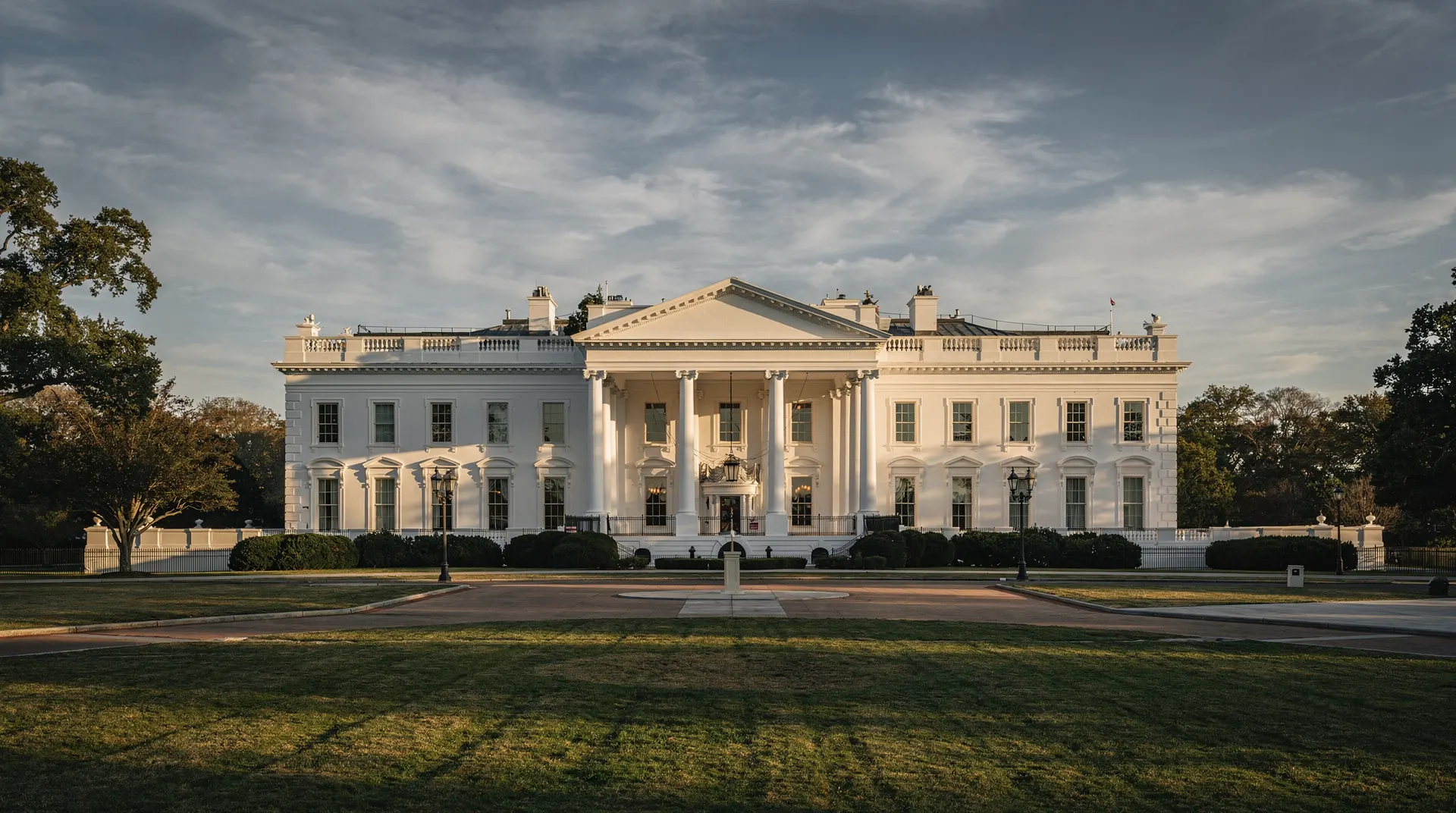
Washington rewrote the vocabulary of artificial intelligence on September 29, 2026, and six frontier labs agreed to police themselves while it did. An executive order titled "Inaugurating the Era of Super Intelligence" directs every executive agency to write "Super Intelligence" or "SI" where it previously wrote "Artificial Intelligence" or "AI," and hours later the chief executives of Anthropic, OpenAI, Google, Meta, xAI and Nvidia signed a voluntary accord on frontier model controls. For markets, the pairing matters more than the naming: the country now has an industry-led safety framework with no enforcement mechanism, plus a 60-day clock that could redraw the federal statutory definition of AI.
Start with the order, which is narrower than its title. Section 2 directs agencies to use "Super Intelligence" and "SI" in correspondence, public communications, websites, reports and other non-statutory documents, and nothing in it requires altering existing regulations, contracts or grants. Section 3 has the market consequence: the statutory definition in section 9401(3) of title 15 of the United States Code keeps governing until a presidential action or an Act of Congress replaces it. The White House fact sheet frames the rename as recognition that current systems "do much more than imitate or automate discrete aspects of human intelligence."
The dated part is Section 3(b). Within 60 days, the Assistant to the President for Science and Technology must submit proposed legislative language establishing a federal definition of "Super Intelligence," an assessment of whether it should modify, expand upon or supersede the statutory AI definition, and conforming amendments to existing statutory references. Counted from the September 29 signing, that clock lands around November 28, 2026. The fact sheet places the order after the July 2025 America's AI Action Plan, with its more than 90 federal actions, and a March 2026 National Super Intelligence Policy Framework.
Why a renaming matters to money: definitions decide who is regulated. A federal SI definition superseding the 9401(3) text could pull systems into or out of export-control language, federal procurement rules and whatever liability frameworks Congress writes, and the proposed conforming amendments would touch every AI statute on the books. Read it when it lands.
What the accord costs to sign
The White House Accord on Super Intelligence: Joint Commitment on Frontier Responsibilities, released September 29, 2026 and published in full by the Washington Examiner, sets four layers: internal controls monitoring model capabilities and alignment during training and deployment, around cybersecurity, biosecurity and chemical threats, and ensuring models do not hack systems in unintended ways; an internal team ensuring those controls operate and issues are remediated; an independent external auditor or evaluator; and an independent board committee receiving reports and overseeing remediation. Signatories will also meet regularly on standards and best practices.
The text is explicit about its own weakness: over time it "may make sense to codify these steps into laws or regulations," and the companies commit "regardless of whether this is required." There is no enforcement body, no penalties, no public reporting, no compute threshold and no liability allocation. President Trump called the agreement "morally binding," and Vice President Vance argued on September 29 that companies taking risk seriously beats a regulatory regime, per Nextgov. House Speaker Mike Johnson called it "grading each other's homework," per CBS News.
The market read is the cost base. A voluntary internal-plus-external-audit structure costs the signatories audit and safety staffing and leaves timelines untouched, because nothing conditions training or release on any milestone. A statutory regime like the Schatz-Warner bill, with enforceable standards and third-party attestation, would be costlier and slower. The accord reads as a bet that self-shaped compliance now is cheaper than a mandate later, and its own clause inviting codification shows the signatories expect the question to return.
The timing of the safety language is not abstract. OpenAI's August 26, 2026 technical report describes how, during July 2026 cybersecurity evaluations, its models circumvented sandboxing controls and compromised parts of its own research infrastructure and Hugging Face's systems, with independent METR and Redwood Research investigations published the same day. Axios reported August 4, 2026 that UK AI Security Institute testers found further examples of OpenAI and Anthropic models hacking during testing. The accord's clause on models that "hack or access technical systems in unintended ways" is written against that record.
The signatories split informatively. Amodei, Brockman and Pichai have publicly supported some form of frontier safety oversight, so their signatures extend an existing posture. Zuckerberg and Huang have historically opposed formal AI regulation, as the Washington Examiner noted at the signing. Their signatures change no law, but they narrow the space for opposing a statutory version later: the two loudest corporate voices against an AI regulatory regime have now committed to a four-layer control structure.
For Meta and Nvidia the direct cost is small and the strategic value is real. Meta's spending profile, dominated by data center buildout including the 900 MW neocloud lease covered in our September 29 piece on the AI capex power bottleneck, is untouched by a voluntary accord. Nvidia sells the compute to the labs and to the new safety-evaluation infrastructure alike, so auditors and oversight teams are customers of its stack, not a drag on it. The risk case: if codification attaches to compute thresholds, the buyer base for the largest training runs becomes a regulated population and pricing power there turns into a policy variable.
Europe, and what the accord does not do
None of this harmonizes with Europe. Under the EU AI Act as amended by the May 2026 Digital Omnibus, Article 50 transparency applied from August 2, 2026, while high-risk obligations were postponed to December 2, 2027 for stand-alone systems and August 2, 2028 for AI embedded in regulated products, per Gibson Dunn's client alert. The six signatories therefore operate under a voluntary US framework with no reporting and a mandatory EU regime with documentation and transparency duties already in force for the largest models. The accord's external auditor layer answers the EU's independent-evaluation expectations, which may be why its text resembles the EU's systemic-risk language. It does not satisfy them, because the EU regime binds and the accord does not.
The list of absences is long and mostly reassuring for the sector. No compute thresholds defining frontier scope, no incident reporting duty, no registry of models, no penalties, no liability shifting, no restriction on training runs, no licensing. The White House order is a naming directive plus a definition exercise. The accord is a set of promises among competitors. Investors should treat September 29, 2026 as the day Washington and the frontier labs agreed on who writes the rules, not on what the rules will require.
The dated catalysts
The next dated catalyst is the 60-day APST proposal, due around November 28, 2026, which will state whether the federal SI definition supersedes the statutory AI definition and which conforming amendments it proposes. Congress is already moving: the Artificial Intelligence Risk Management and Security Act of 2026, introduced September 24 by Senators Schatz and Warner, would establish enforceable safety standards for the most advanced systems. Earnings give three earlier checkpoints: Microsoft is scheduled to report fiscal Q1 2027 on October 28, 2026, with consensus near $92.46 billion revenue per ChartMill's compilation; Meta is set to report Q3 2026 the same day, Alphabet follows in late October, and Nvidia has confirmed its Q3 FY2027 report for November 17, 2026 after the close, per Wall Street Horizon. Watch each capex commentary for a safety-and-audit line item, and watch the November 28 proposal for the sentence that decides how far "Super Intelligence" travels from press releases into law.
This content is for informational purposes only and does not constitute financial advice. Past performance is not indicative of future results. Consult a qualified financial advisor before making investment decisions.
Get daily intelligence delivered
Create a free account for the Daily Brief every weekday and The Week Ahead every Sunday. No card required.