Goldman Puts 2027 AI Capex at $1.4 Trillion, and $400 Billion of It Will Be Borrowed

Goldman Sachs raised its forecast for US hyperscaler AI capital spending to $1.4 trillion in 2027, up from its prior estimate of about $1.1 trillion, in a note published September 25. The figure sits well above the roughly $920 billion Wall Street consensus the bank cited, and it comes with a financing detail that matters more than the headline: Goldman expects roughly $400 billion of that 2027 spend to be funded through investment-grade bond issuance. The AI buildout is no longer paid for entirely out of chip-company cash flows, and the week of September 21 gave investors three separate data points on what that means for the companies doing the building.
TSMC just printed the cleanest demand signal in the chain
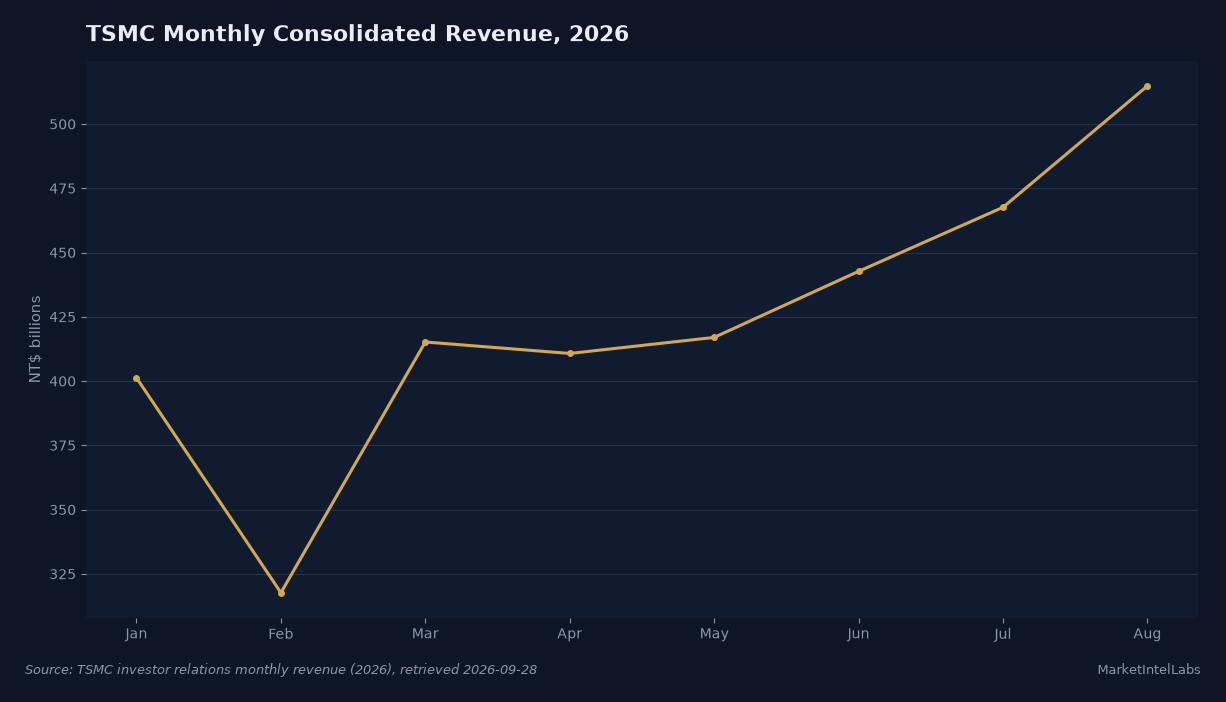
The leading indicator on my beat is TSMC's monthly revenue release, and August's print, published September 10, was a record in every direction: NT$514.8 billion in consolidated revenue, up 53.3% year over year and 10.1% above July. That is the fourth consecutive monthly record for the foundry, and the year-to-date total of NT$3.39 trillion runs 39.3% above the same eight months of 2025. Company commentary reported alongside the figure said demand still exceeds what TSMC can supply, which is the sentence that matters: a supplier at full utilization with a stated backlog can reprice, and it did.
On September 24, supply-chain reporting via Digitimes indicated TSMC has set wafer-out price increases of 3 to 6% for January 2027, with high-performance-computing and AI orders carrying surcharges that can push the effective increase far higher; Nikkei had reported in July that advanced-node customers faced base increases of 5 to 10% with AI orders up to 25%. Read those together and the chain is telling you something specific: willingness to pay was never the constraint; wafers are. UBS raised its end-2027 global CoWoS advanced-packaging capacity forecast to about 270,000 wafers per month in a September 22 note, 69% above its end-2026 estimate, and still projected demand of roughly 2.63 million wafers for 2027. Capacity is being added at speed, and the people adding it do not think it will be enough.
The spender and the supplier are no longer the same balance sheet
Goldman's $400 billion bond-issuance estimate is the number I would underline. For two decades the hyperscalers funded infrastructure out of operating cash flow, a posture Korean banks have begun stepping into, which imposed a natural discipline: spend too much and your own CFO pulls the budget. Debt breaks that link. Oracle's remaining performance obligations hit $664 billion in its September 10 report after more than $30 billion of new AI cloud contracts, but its long-term debt now stands above $117 billion, roughly 43% of total capitalization per company filings. CoreWeave, the model for AI-native neoclouds, has layered multiple debt facilities this year. When the marginal dollar of AI capex is borrowed, the marginal project needs a return, not just a narrative.
The week supplied a stress test. On September 24, Bloomberg reported Oracle issued a force majeure notice to a Blue Owl unit developing Project Jupiter, a Stargate data center campus in New Mexico, citing potential delays; Reuters attributed the delay to power. Oracle shares fell more than 4% that day and the read-through hit the usual names, with Nvidia off 1.5% and Microsoft down 2.5%. One campus with local opposition and a power delay is not a trend, but the transmission mechanism is exactly the one to watch: contracts signed in 2024 and 2025 now meet 2026 permitting boards, interconnection queues and substation lead times, and the force majeure clause is where the gap shows up first.
The power constraint is measurable. ERCOT's data center interconnection queue has swollen to roughly 390 GW of large-load requests as of late September, against Goldman's May estimate that US data center power demand reaches about 66 GW by 2027. The queue is where hopes go to wait. Every Stargate site that cannot get energized on schedule converts a 2027 revenue line into a 2028 or 2029 one, which is precisely the risk a bond-funded buildout cannot easily absorb, because coupon payments do not wait for energization.
What the market priced versus what the filings say
Equity markets spent the week adding to the bet rather than questioning it. AMD crossed a $1 trillion market capitalization on September 21 after its 6 GW multi-year accelerator commitment from OpenAI, and closed near $630 by September 25, up more than 120% on the year. Nvidia closed September 25 at $224.58, within roughly 5% of its all-time high, with Bernstein reaffirming outperform ratings on both Nvidia and Broadcom on September 22 while flagging supply capacity as the binding constraint rather than demand. On the private side, OpenAI is reportedly canvassing a round at a valuation of $1.2 to $1.5 trillion ahead of a possible IPO, per the Financial Times and Forbes on September 16. None of these prices embeds a delayed campus.
The bear case rests on arithmetic rather than a demand collapse. Torsten Slok of Apollo Global Management has argued the entire trade rests on the five major hyperscalers roughly tripling combined operating cash flow from about $600 billion toward $2 trillion to service the spending. Against that, Goldman's own decomposition of the $7.6 trillion cumulative buildout it projects through 2031 allocates only $358 billion to power infrastructure, the input the New Mexico episode suggests is scarcest. Money is flowing fastest to the layer with the least bottleneck relief.
Next comes a dated test. Micron reports fiscal fourth-quarter results on September 30 after the close, with company guidance of $10.0 billion in quarterly revenue plus or minus $100 million and roughly $31 EPS at the guide midpoint; LSEG consensus compiled by Pip Theory sits at $10.9 billion and $31.49, and the quarter is a 14-week period, so the next guide will look optically smaller than the underlying trend. Memory is the second most memory-intensive input after logic, and Micron's guide is the cleanest read on whether AI demand is pulling pricing through the DRAM and HBM stack the way TSMC's prints show it pulling wafers. TSMC's September monthly revenue follows in the first half of October. If September shows a fifth straight record, the supply-constraint thesis holds through the Micron print; if it flattens, the bond-financed capex numbers start meeting their first real demand test.
The week's implication, in one sentence: the capex ceiling keeps rising and the financing has shifted from cash flow to credit, so the binding risk now sits with power delivery and permitting rather than with customer willingness to pay for AI, and the next four weeks of prints, Micron on September 30 and TSMC mid-October, will show which of those two constraints bites first.
This content is for informational purposes only and does not constitute financial advice. Past performance is not indicative of future results. Consult a qualified financial advisor before making investment decisions.
Get daily intelligence delivered
Create a free account for the Daily Brief every weekday and The Week Ahead every Sunday. No card required.