Tokenized Stocks: Why 67 Issuers Objected as New Venues Emerge


A tokenized stock is a claim on a share recorded or transferred using a blockchain, not a new class of stock that escapes securities law. The question in November is who controls that claim: the listed company, the market intermediary or the operator of a new trading venue. A November 20 OKXICE public notice lists 67 issuers that objected to its proposed third-party tokenized trading, even as the venture with NYSE parent Intercontinental Exchange advertised a November 23 start for eligible U.S. customers. An objection is a restriction on that venue's offering of a company's shares, not a vote against every form of tokenization.
There are at least three paths competing here. Nasdaq's approved exchange rule keeps a tokenized order in the existing order book and relies on a Depository Trust Company pilot. NYSE has filed a comparable exchange rule and separately proposed a round-the-clock venue.
OKXICE's notice instead describes permissioned automated market maker pools under the Securities and Exchange Commission's September exemption. Treating those plans as a single switch to 24-hour stock trading misses the legal and trading differences that matter most to shareholders.
For the broader framework, see our bitcoin coverage.
Related reading: Is the Stock Market Open on Veterans Day 2026? Stocks Trade, Settlement Pauses.
The first distinction is ownership. In a January 28 staff statement, the SEC's Division of Corporation Finance separated securities tokenized by issuers from securities tokenized by unaffiliated third parties and warned that the rights attached to a token depend on its structure. A token may record the security directly, or it may represent a claim through an intermediary. The words on the screen can look the same while the person responsible for delivering dividends, proxy votes and corporate-action adjustments is quite different.
How a stock becomes a token
Consider a conventional listed share. Its trade passes through a broker and an exchange, then the clearing and custody system records an entitlement. Blockchain can replace or supplement a piece of that recordkeeping, but the investor still needs to know whether the token is the share, an entitlement to the share or a contractual promise from someone holding it. The SEC staff statement says the applicable federal securities laws do not change merely because a security takes token form.
Related reading: Anthropic Stock Debuts on Nasdaq as ANT After Record $83 IPO.
Nasdaq's March 18 SEC approval offers the conservative model. Its rule lets eligible shares trade in tokenized form on the Nasdaq Market Center, in the same order book and at the same execution priority as traditional shares, during the DTC pilot. The order says a tokenized share must be fungible with its conventional counterpart, use the same CUSIP and ticker and carry the same rights.
The exchange's order book remains the place where prices are formed. The token changes how ownership may be represented and processed after execution, rather than creating a separate market price by design.
Related reading: Italy Regulator Fines Meta $887 Million Over Android Data Access.
NYSE's April filing, published by the SEC as an immediately effective proposed rule change, describes a similar approach to trading securities in tokenized form during the DTC pilot. That is not the same project as the platform NYSE announced on January 19. In that announcement, NYSE said it was developing a new digital venue with 24-hour trading, fractional share capability and immediate settlement funded by stablecoins, expressly subject to regulatory approvals. A filed rule for exchange trading and an announced future venue should not be conflated with a launched 24-hour NYSE equity market.
The DTC pilot matters because the existing custody network is where investors and issuers already reconcile beneficial ownership. If the token and ordinary share can be exchanged on equal terms inside that network, a separate token price has less room to drift. If a token trades in a distinct liquidity pool outside ordinary market hours, there may be no immediate order-book arbitrage at the same depth.
Neither design makes a share's underlying business more valuable. It changes market access, settlement mechanics and the number of intermediaries responsible for proving a holder's rights.
On September 17, the SEC issued a temporary conditional exemption for tokenized securities venues, or TSVs, that use permissioned automated market maker pools. The regulator's press release says the venue receives relief from the Exchange Act definition of an exchange if it meets conditions, and certain pool liquidity providers receive conditional dealer relief. The order says that relief expires five years after publication. It is an interim exception, not the same thing as an SEC license for a particular new exchange.
An automated pool does not match every new buyer to a new seller at a posted price in the way an exchange order book does. A participant exchanges a token against pool liquidity under coded rules, so the price can depend on the pool's inventory and outside arbitrage. The SEC order also calls for auditable public smart contracts on a public blockchain, verified access for permissioned participants and trading halts that follow a halt in the underlying stock. Limits on symbols and volume are part of the exemption, an acknowledgment that an experimental venue should not immediately replace the national market.
The difference is tangible for a retail holder. A 24-hour interface may accept an order on Sunday, but the listed company's primary exchange is not necessarily open to set a concurrent reference price. Liquidity can be thinner and the quoted spread wider when the main market is closed.
An investor seeing a token's last price should ask whether it is an exchange execution, a pool swap or a displayed valuation. Immediate on-chain settlement can reduce a specific type of counterparty exposure; it cannot guarantee a fair price or remove wallet, custody and code risks.
The objection list shows the boundary
OKXICE is a joint venture between OKX and Intercontinental Exchange, the company that owns NYSE, according to OKX's launch announcement. Its planned venue is not NYSE itself. OKX says eligible U.S. customers who complete identity verification and onboarding can use an OKX wallet to access permissioned Uniswap v4 pools on X Layer.
It says Securitize supplies tokenization infrastructure, each token represents a security entitlement backed one-to-one by an underlying U.S. share, and holders receive the applicable economic and shareholder rights. Those are the operator's stated arrangements, not proof that every advertised asset has traded.
The November 20 OKXICE public notice says the venue and its affiliates do not themselves issue the tokenized stocks that would trade there. It also records 67 notices of issuer objection. Those names include issuers across technology, finance, consumer businesses and industrials.
We counted the listed issuer entries in eight successive dated public notices: one on October 4, nine on October 15, 16 on October 19, 22 on October 23, 50 on October 30, 56 on November 2, 67 on November 5 and 67 on November 20. These are snapshots of the venue's disclosed objections, not estimates of the total number of companies opposed to tokenization.
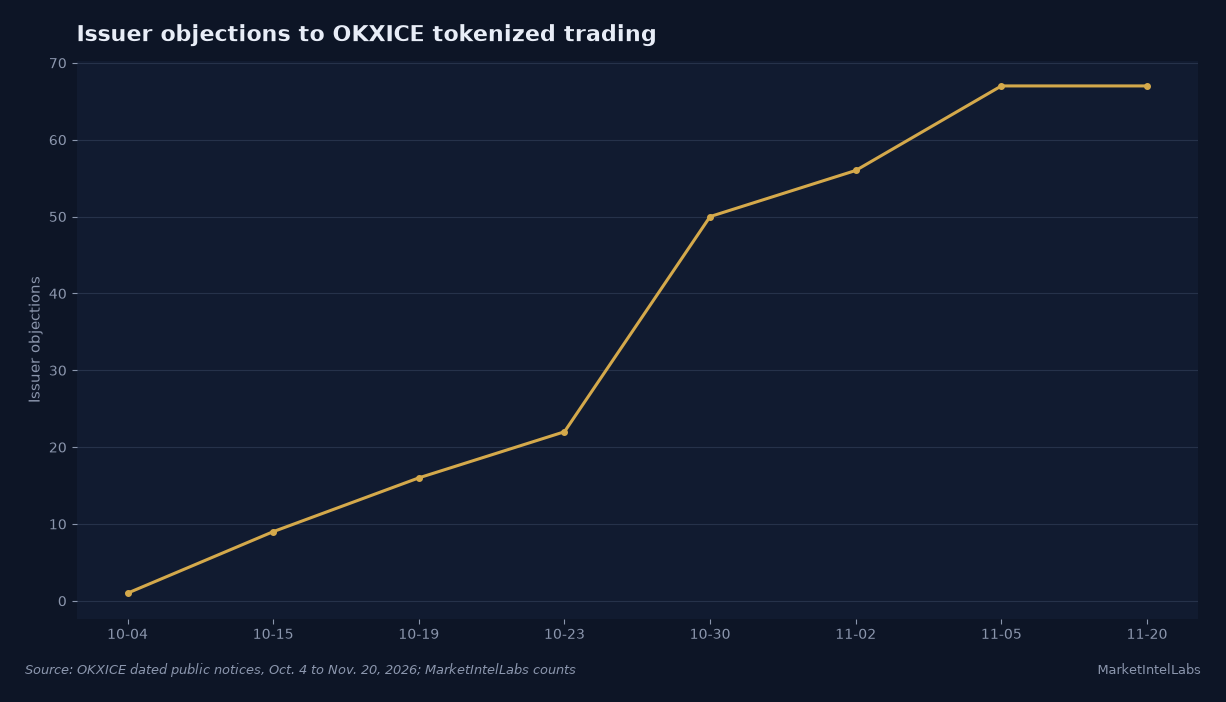
Its steepest recorded jump came between the October 23 and October 30 notices, when the count moved from 22 to 50. That does not establish when each issuer privately decided to object, only when the names appeared in the available snapshots. It also says nothing by itself about price performance for the companies listed.
This is a market-structure participation signal. It is not a stock-selection screen.
Under the SEC's September order, before a venue offers tokenized stock created by an unaffiliated third party, it must notify the issuer and give it the opportunity to object. The SEC press release lists that issuer notice as an explicit condition. An objection therefore addresses the proposed third-party venue and its handling of a company's securities. It does not prevent a company from working on its own tokenization plan or make its existing shares untradeable on Nasdaq or NYSE.
That distinction explains an apparent contradiction in the day's headlines. OKX says its November 23 launch is expected to include more than 70 assets, including 59 Direxion funds and securities from several named issuers. Its most recent public notice simultaneously lists 67 other issuers' objections.
The 70-plus figure is the operator's expected inventory, while the 67 figure is a count of named objections to that operator's third-party offering. They are not opposing forecasts of the same total, and neither establishes how many instruments actually traded by the time of writing.
Issuer consent has practical value. A company needs to know who receives shareholder communications, who can exercise a vote and whether distributions reach the beneficial owner. A token transfer on a chain records movement of a digital asset.
It does not, without a legally enforceable chain of title and accurate intermediary records, answer every corporate-law and securities-law question. OKXICE describes backing and shareholder rights for its planned tokens; investors should distinguish that description from independent verification of each issuer relationship.
Nasdaq backs the technology, questions the exemption
Nasdaq is not rejecting tokenized shares. Its own SEC-approved rule makes that plain. But in a November 16 comment letter to the SEC, Nasdaq argued that issuer participation in the separate TSV exemption should move toward affirmative consent instead of a short period to object.
The letter also raised questions about corporate-action processing, shareholder visibility, pricing and the transparency of pools whose transaction information may appear later than data on the consolidated tape. That is an objection to a particular framework, not evidence the SEC has rescinded its order.
Nasdaq's public explanation focuses on three linked investor questions: whether a token gives a shareholder the same rights, whether a price reflects the wider market and whether the issuer can see the ownership information needed to administer the security. Its comment letter says the exemption's post-trade information may be published within 10 minutes, unlike real-time consolidated-market reporting. As an incumbent exchange with a competing tokenized-order model, Nasdaq has an interest in preserving the order-book framework. Its incentives do not erase the substance of the transparency concern.
The other side is also real. A conventional exchange schedule leaves a weekend investor unable to trade a U.S. share even when company or macro news changes expectations. Automated pools can create a price outside regular hours and let a smaller investor transact in fractions.
NYSE says its planned platform seeks continuous access and immediate settlement. OKX says its venture would use permissioned wallets and share-backed entitlements, not a free-floating token with no stated claim on stock. These designs could broaden access if legal rights and pool liquidity work as advertised.
But a better user interface is not a substitute for investor protection. The SEC's conditional order requires verified rights and privileges comparable to ordinary stock, issuer notice when a third party creates tokens, public smart contracts and synchronized trading halts. Those are not incidental footnotes.
They are the conditions that turn a blockchain record from a possible source of ambiguity into something closer to a security an investor can analyze. The concentration of objections in OKXICE's own notices shows why issuers demand a say in the details.
For an equities investor, the relative winners are not self-evident. An exchange may capture new transaction volumes yet spend to maintain both conventional and on-chain operations. A fund manager may value fractional, round-the-clock distribution, while a company may resist an unaffiliated token that complicates its shareholder register.
Banks, transfer agents and custodians can lose one fee stream and gain another as the reconciliation work changes. No direct revenue or earnings benefit for the listed exchanges follows mechanically from a tokenization announcement.
Market breadth is an important check on the claim that this is already an equity-market revolution. OKXICE's objection list spans multiple sectors, but it is not market-wide trading data; the list of expected launch assets is not a consolidated volume report. No sourced evidence here measures tokenized shares as a fraction of all U.S. equity volume or shows changes in advance-decline breadth attributable to token trading. Until a venue reports repeatable volume, spread and settlement data alongside ordinary shares, the case is about infrastructure choices rather than a change in the index's underlying breadth.
What comes next
November 23 is a stated opening date in OKX's announcement, not a verified trading-volume milestone. The next evidence would be a dated venue operating notice, a verified list of instruments admitted and public transactions showing actual prices and size. A side-by-side comparison with ordinary market prices during overlapping hours would be more useful than a claim about how many tokens could someday list. If issuer objections grow in the next dated notice, that narrows the usable pool of third-party offerings even if demand from buyers is strong.
For Nasdaq, watch whether orders in the approved tokenized format actually enter its common book during the DTC pilot, and whether clearing records show the promised fungibility. For NYSE, separate any implementation of its filed pilot rule from a regulatory approval and operational start for the digital venue announced in January. For OKXICE, ask whether the venue's planned assets satisfy the SEC exemption's issuer-notice and rights tests. The SEC is also soliciting comments as it considers longer-term rules; Nasdaq's November 16 letter is part of that live debate, not a final regulatory ruling.
The strongest case for tokenization is a share that stays a share while its transfer becomes faster and easier to audit. The weakest is a separate digital claim that looks like an ordinary stock quote but leaves holders uncertain about voting, custody or execution quality. The 67 objections do not settle the future of tokenized markets. They identify precisely where the experiment meets the legal rights of companies whose securities someone else wants to put on a chain.
Frequently Asked Questions
What is a tokenized stock?
A tokenized stock is a security or an entitlement linked to a share whose ownership or transfer is represented with blockchain technology. The SEC says the precise rights depend on whether the issuer or a third party creates the token and on the legal structure behind it. The technology alone does not change the application of securities law.
Is a tokenized stock the same as owning a share?
It can carry equivalent rights, but it is not safe to assume every token does. Nasdaq's approved rule requires the tokenized share to share its conventional counterpart's ticker, CUSIP and rights. OKXICE describes a one-to-one share-backed entitlement for its planned venue. Investors still need to examine custody, voting, dividends and the party legally obliged to deliver those rights.
Why did companies object to tokenized stock trading?
The SEC's September exemption gives issuers a chance to object before an unaffiliated venue offers a third-party tokenized version of their shares. OKXICE's November 20 public notice lists 67 issuer objections. This does not establish that those issuers oppose all blockchain-based settlement or that the SEC has banned tokenized stocks.
Are NYSE and Nasdaq already trading stocks around the clock on a blockchain?
No such conclusion follows from the documents reviewed here. Nasdaq has SEC approval for an exchange rule allowing eligible tokenized orders in its existing book during the DTC pilot. NYSE filed a similar rule and announced a separate planned continuous-trading venue subject to approvals. OKXICE, a venture involving NYSE parent ICE, advertised a November 23 start under a different SEC exemption; an announced start is not a verified trading record.
What should investors watch after November 23?
Look for operating disclosures, admitted symbols and actual transactions from the venue, then compare spreads, volumes, rights and settlement outcomes with conventional shares. Also watch later issuer-objection notices and the SEC's response to comments about the temporary exemption. These facts will show whether the pilot creates an investable market with reliable prices rather than just a new way to display a claim.
This content is for informational purposes only and does not constitute financial advice. Past performance is not indicative of future results. Consult a qualified financial advisor before making investment decisions.
Get daily intelligence delivered
Create a free account for the Daily Brief every weekday and The Week Ahead every Sunday. No card required.