Strait of Hormuz tanker attack lifts oil price to $103 as crude heads for a fourth monthly gain

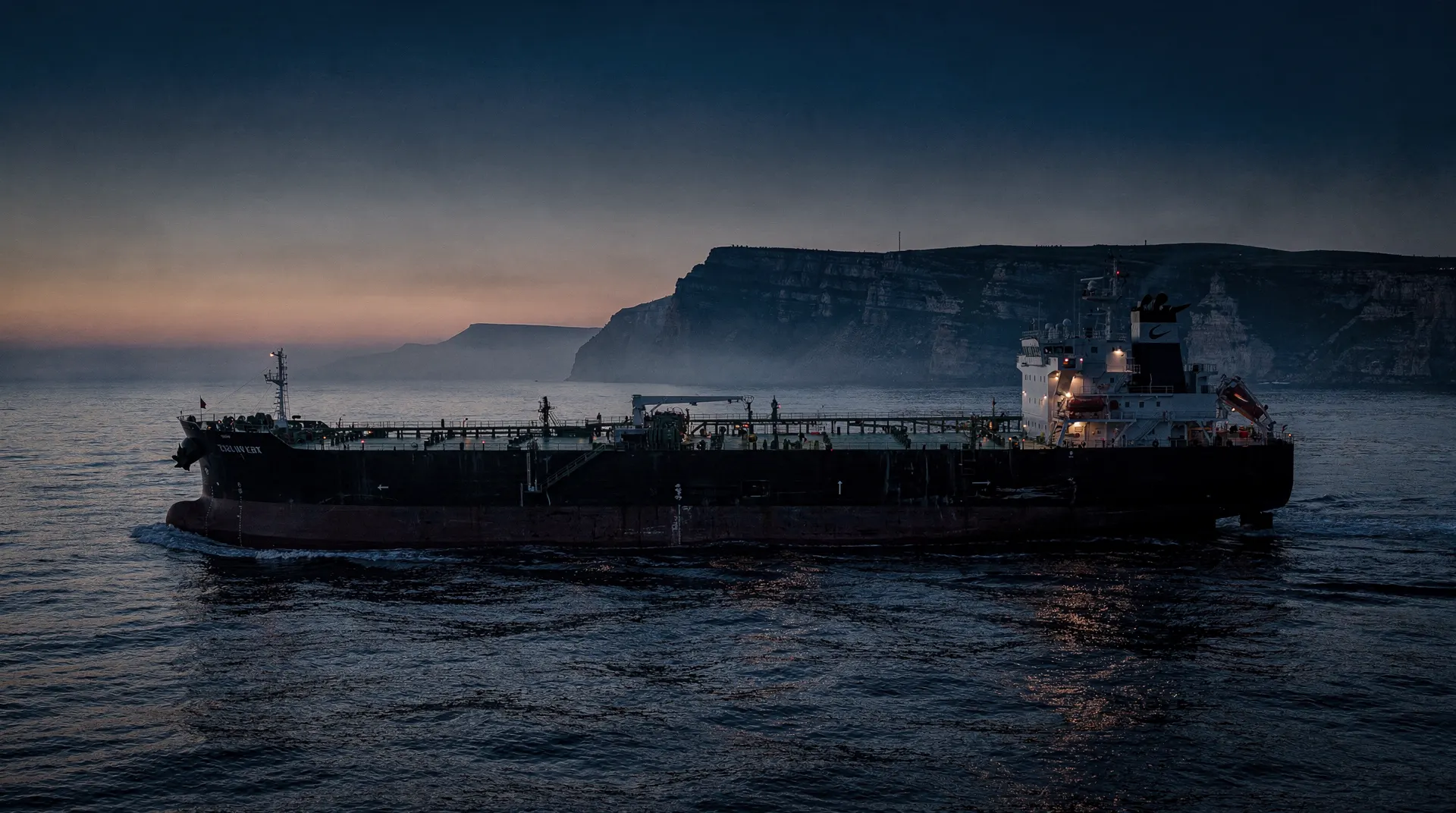
Oil is back to hunting a reason. WTI December crude was trading near $103.40 in Friday's session, up 1.37% and close to its one-month high, as a tanker in the Strait of Hormuz was hit by two explosive devices attached by a small boat about 25 nautical miles off Oman's Khasab, according to the UKMTO. No perpetrator has been named, the crew is safe and the vessel is sailing. The UKMTO notice landed alongside a claim of six Houthi attacks, and together they put crude's fourth consecutive monthly gain back on the table, re-pricing the same supply risk that has been pulling the geopolitical bid in and out of this tape for weeks.
The attack is the market transmission story more than the casualty story. When the UKMTO flagged a vessel hit off Khasab, the risk premium traders had watched fade after Ras Tanura snapped back into the market, and it pulled Brent's front month back toward $116.10 even as the last-day Brent contract quoted $112.39. The gap between those two measures is the curve doing what curves do when prompt supply is tight: roughly $4 of backwardation into the next month, which is exactly the signal you see when the market is paying up to get barrels now rather than later.
Related reading: WTI Oil Price Jumps to $110.48 Session High as Tankers Burn in Strait of Hormuz.
Here is the level to watch. WTI's one-month range is $88.28 to $103.66, so Friday's $103.40 is testing the top of a band crude has spent the month building. A break and close above the round $104 area in the sessions ahead would signal the premium is extending rather than pausing. A failure to hold against that ceiling, on the other hand, puts the $100 handle back in play as the first support, with the $96 to $97 zone behind it. The range is tight enough that the setup is really about which side of that ceiling the market decides the bid belongs on, and a close on either side of it sets the tone for the rest of the month.
The counter-case is the cleaner trade, and it is worth stating plainly. Ras Tanura is the template: the market carried a fat geopolitical premium, Saudi Arabia said there was no damage, and the unwind was about $4 within 48 hours. If Hormuz does not escalate beyond Friday's incident, and the Ukraine strike pause on Russian refining holds through the stated window, crude gives back a meaningful chunk of this bid. A $103 WTI is not trading on abundant supply; it is trading on the assumption that the next headline re-tightens the market. WTI at this level is hunting for a reason, and geopolitical headlines run both ways.
For the broader framework, see our crude oil coverage.
Related reading: Gold price rebounds to $4,158 as the dollar slips; crude pulls back as Hormuz risk meets freight relief.
The subplot that matters for product cracks is the refining side. The Wall Street Journal reported Tuesday that the pause in Ukrainian strikes on Russian refineries is expected to hold through the November 3 U.S. midterms, a report attributed to WSJ sources and not independently confirmed; our own strike tracker logs the Tambov pumping station on October 20 as the last confirmed strike. That easing is already showing up at the pump, where Moscow has relaxed gasoline-sales restrictions across 15 regions. Distillate is still extraordinarily wide, with heating oil near $4.61 a gallon implying a roughly $90 crude-equivalent crack over WTI, a residue of the deep refining outages from September. But the balance of that thread is loosening, and loosening refining stress subtracts from the bullish case even as Hormuz adds to it.
Metals offer the cross-asset read, and they are not cooperating with the risk bid. Gold broke back below $4,000 to a one-month low near $3,998 as a firm dollar and repricing toward roughly 80% odds of a December rate hike after the Fed held at 3.75% to 4.00% took the edge off the metals complex. The next support of consequence sits at that $3,925 52-week-low area, and silver has been trading to its own one-month low as the same firm-dollar bid does the work. If gold is slipping while oil is bid, that is the dollar and the rate path driving the tape, not a single risk-on surge; the two moves do not always confirm each other, and this time they are splitting.
Related reading: Oil prices hold $105 as unverified ceasefire meets fresh Hormuz risk.
What to watch next is de-escalation speed. The market has now seen the Hormuz premium build, get lightly drained by the Ras Tanura line, and get rebuilt in a day. Each repetition makes the market a little more sensitive to the next headline and a little quicker to fade it. The constructive read is that persistent backwardation and a fourth straight monthly gain are a bull structure with real supply tightness beneath it. The cautious read is that a crude market near $103 above a $100 floor is paying a war premium that can evaporate as fast as it appeared, and a re-risking phase would take the $96 to $97 zone back in short order. Assign the range, respect both sides, and let the ceiling at $104 and the Khasab aftermath decide which tape the rest of the week belongs to. Until that resolves, the setup is a two-way trade wearing a bullish outfit.
Related reading: Crude Holds the Hormuz Premium as Saudi Pipeline Stays Shut: WTI Near $103.
This content is for informational purposes only and does not constitute financial advice. Past performance is not indicative of future results. Consult a qualified financial advisor before making investment decisions.
Get daily intelligence delivered
Create a free account for the Daily Brief every weekday and The Week Ahead every Sunday. No card required.