SoftBank Earnings Explained: Why Did AI Power Costs Bite?

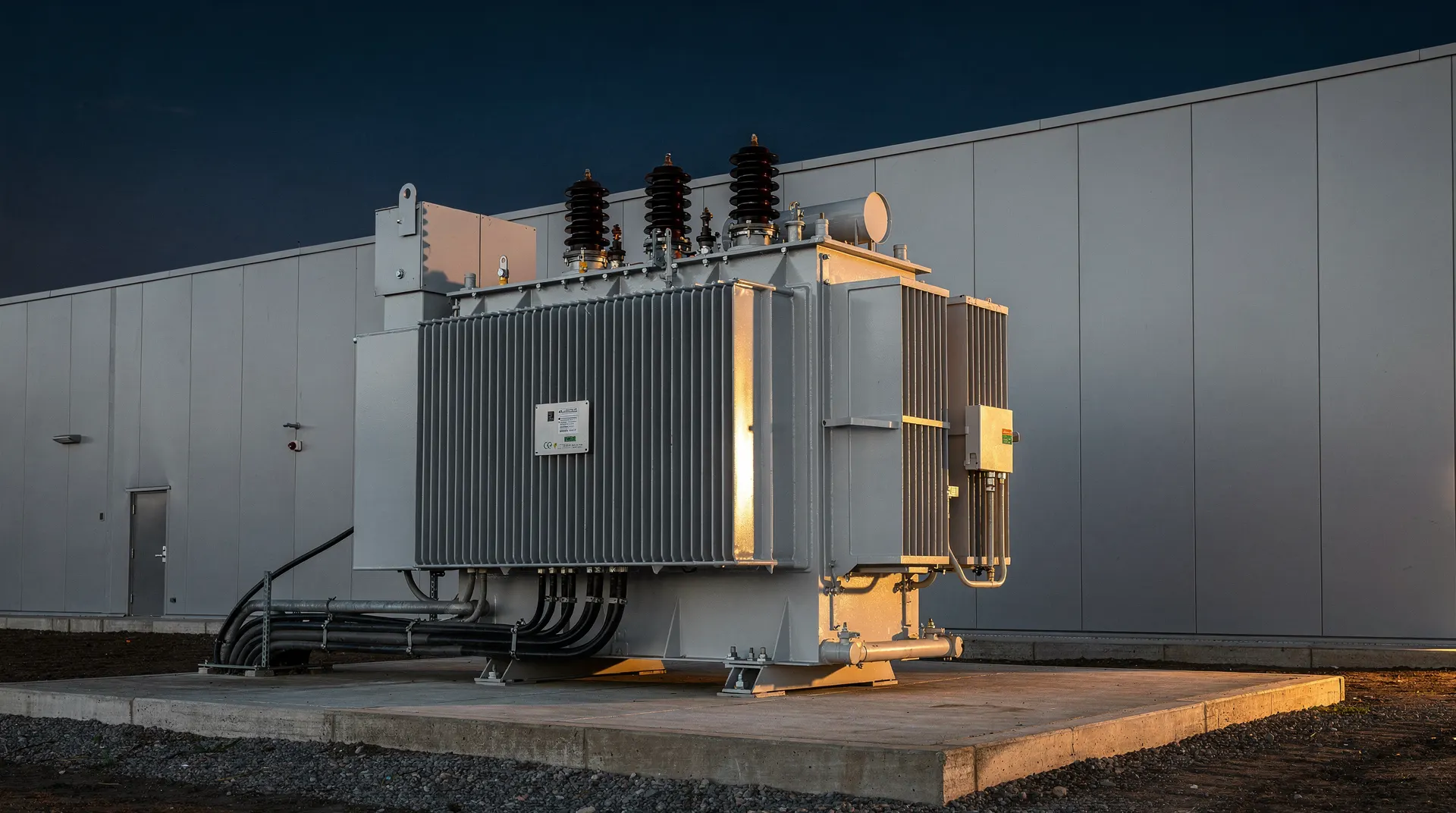
SoftBank earnings turned sharply negative in the quarter ended September 30, 2026. The company reported a ¥1,115.3 billion, roughly $7.0 billion, net loss attributable to owners of the parent, while a revision of U.S. AI data-center power-equipment plans produced a separate ¥597.2 billion, or $3.73 billion, charge over six months. The ¥7 billion number is the quarterly group loss, not the data-center charge. That distinction matters more than the shorthand headline: the cost of reserving electricity infrastructure can hit earnings before the computing campus starts collecting rent, according to the SoftBank Group interim financial report.
For the immediate account of the reported quarter, see our SoftBank earnings news analysis. This feature addresses the next question: why did a company trying to supply the AI boom absorb an equipment charge, an expensive financing cycle and volatile marks all at once? SoftBank occupies several links in the same chain: equity funding, data-center property and power equipment. This result measures costs across that chain; demand for AI computing is a separate question. It is an early test of whether the cash spent to make that computing possible can be matched by contracted revenue soon enough.
Related reading: Anthropic S-1 IPO filing: compute costs fall to 55% of revenue as operating loss narrows.
How the loss developed
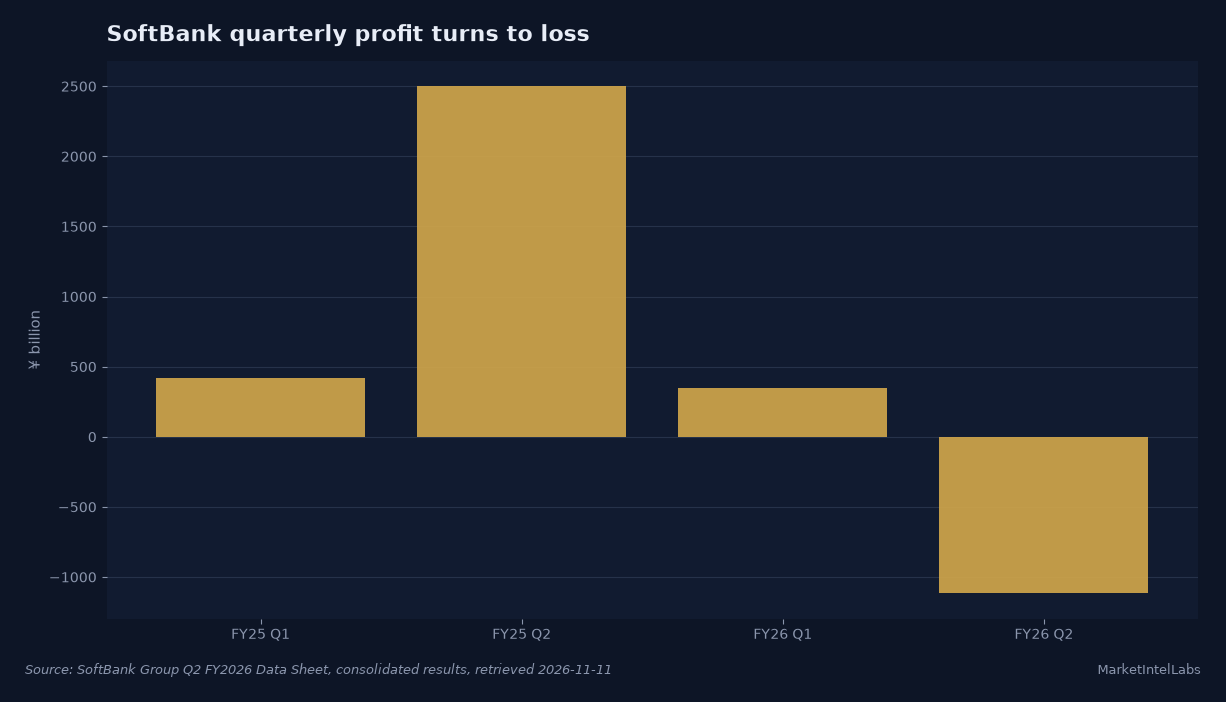
SoftBank’s Q2 FY2026 consolidated data sheet places the quarterly loss beside four very different prior quarters. Net income attributable to the parent was ¥421.8 billion in fiscal 2025 Q1, ¥2,502.2 billion in fiscal 2025 Q2, ¥347.3 billion in fiscal 2026 Q1 and a loss of ¥1,115.3 billion in fiscal 2026 Q2. The comparison is not a same-store measure of data-center profitability. This is a holding company whose consolidated earnings include changing investment valuations, financing, subsidiaries and derivatives. But the swing puts the procurement revision in context: it landed in a quarter that had little room for another setback.
The SoftBank Group earnings presentation identifies the ¥597.2 billion power-equipment loss and the ¥321.9 billion Intel-linked derivative loss in its explanation of the quarterly result. In the same presentation, SoftBank calls out a ¥270.1 billion Intel valuation loss in its quarterly investment chart. That figure does not mean its Intel shares fell over the entire April to September period. In the six-month interim report the Intel investment delivered a ¥1,062.8 billion gain as its valuation rose; the periods and accounting lines are different. Treating the quarterly Intel mark, the six-month gain and the derivative loss as the same exposure would give readers the wrong net picture.
Related reading: Google Locks In 702 MW of Fuel-Cell Power From AEP for Its AI Data Centers.
A subtler comparison sits in the six-month statement. SoftBank reported ¥1,725.8 billion in total investment gains for April through September, down from ¥3,926.7 billion a year earlier. Finance cost rose to ¥790.7 billion from ¥340.0 billion. Other gain became a ¥663.8 billion loss, including the power charge, according to its interim report. Investment gains can offset a lot, but not automatically compensate for cash financing and contracts that have become uneconomic. The earnings question is not whether SoftBank owns valuable assets. It is whether the value and liquidity of those assets arrive on the same schedule as its bills.
The original chart below reproduces the parent-attributable quarterly net-income figures from SoftBank’s data sheet. It intentionally shows both positive quarters and the negative September 2026 quarter on one yen-denominated axis. The bars are reported results, not forecasts or a claimed trend in AI demand.
Why chart the consolidated bottom line rather than make a stack of colorful AI spending estimates? Because a completed campus, its future rent and its power price are not yet disclosed here in a way that permits a verified project-return chart. SoftBank provides hard procurement payments and accounting charges; it does not provide a public, campus-by-campus schedule of megawatts delivered, rental receipts, fuel consumption and realized margin. Any line purporting to chart such returns from these disclosures would be an invention.
The power-equipment commitment and the accounting path
The center of the event is Silver Bands 7, or SB7. According to SoftBank’s interim financial report, this subsidiary entered manufacturing-capacity reservations, equipment purchase contracts and other arrangements to secure power for U.S. AI data-center projects, including the PORTS-Pike Technology Campus in Ohio. From the previous fiscal year through September 30, 2026, SB7 made ¥1,500.9 billion, or $9.48 billion, in cumulative procurement-related payments. These payments are not the loss: they describe money committed across a longer period, and some purchases may still have economic use.
When SB7 revised the equipment procurement strategy to reflect the evolving needs of existing and planned projects, non-refundable advances already paid to secure manufacturing capacity and equipment could not simply be recovered. SoftBank recognized ¥457.0 billion, about $2.85 billion, for those advances and a further ¥140.2 billion, about $0.88 billion, for contract modifications and settlements. Together they produced the ¥597.2 billion loss recognized in other gain or loss for the six months ended September 30. That is an accounting consequence of procurement decisions, not an electricity bill or a forecast of the total cost of a data center.
There is also a possible offset, but it should not be treated as earned cash. SoftBank says SB7 became entitled to rebates of up to $2.1 billion over the next ten years on future equipment purchases, subject to conditions. The company did not recognize the rebate rights as an asset at September 30 because their amount could not then be determined. A promised upper limit on future rebates is therefore not equivalent to a present reduction of the ¥3.73 billion reported charge. If future orders fail to qualify, the cash benefit could be smaller.
This is where the sequence of cash and earnings can confuse. A down payment for equipment initially exchanges cash for a right or asset. If a reservation is later abandoned and its payment is non-refundable, that item becomes an expense or loss. A contract settlement is another expense. Yet the cash may have left months earlier. Meanwhile equipment that remains useful can stay in the asset base and require further installation spending. The same company can report both investment in physical infrastructure and a write-off of part of the procurement strategy without claiming every planned AI campus has been canceled.
SoftBank’s interim report says ¥1,687.2 billion was paid during April through September for assets related to U.S. power generation and AI data centers, including ¥896.5 billion by SB7 for power equipment and ¥552.9 billion by Energy Global. The timing matters: capital can leave now while the price and volume of contracted compute capacity become visible later. For another approach to supplying power at a campus, our Google Wyoming data-center report describes a separate company’s fuel-cell plan. It is a comparison in the race to secure electricity, not evidence of SoftBank’s own project economics.
One should resist compressing every U.S. data-center power project into a single gas-turbine wager. The SB7 disclosure identifies power-generation-related equipment, manufacturing reservations and project requirements but does not provide a complete public tally of each technology, its installed capacity or operating fuel cost at every site. The economically relevant risk is broader than the type of generator: purchase commitments, changing engineering needs, the gap between purchase and operation, and the contract terms that decide who pays if the specification changes.
Why Intel and financing amplified the quarter
Intel is the accounting trap in the popular reading of this quarter. The interim report says SoftBank raised $7.35 billion in August through prepaid forward contracts backed by all its Intel shares. When Intel’s share price subsequently increased by quarter-end, the derivative contracts generated a ¥321.9 billion loss. That is not evidence that Intel stock declined through the measurement period. SoftBank separately recorded a large six-month gain on the shares themselves. A shareholder should read the asset and the contract together, including the mismatch in timing and valuation, rather than call one line a clean Intel bet.
A prepaid forward brings cash forward against shares whose future delivery or settlement is governed by contract. In ordinary language, it monetizes some value today while linking the eventual obligation to what the shares do later. Under fair-value accounting, a rising underlying share price can raise the reported value of an obligation even as the investment asset appreciates. The share gain can be reported in investment results; the related contract mark can appear in derivative loss. Presentation in different statement lines obscures the connection if only the headline loss is read.
The investor SoftBank Group accounting presentation separately displays the valuation and cash-flow treatment of its OpenAI and infrastructure commitments. SoftBank reported that its OpenAI follow-on investments totaled $30 billion after a final tranche in October 2026, with a cumulative investment cost of $64.6 billion and an ownership stake around 13% as presented in that deck. Those are investment commitments to an AI company, not revenue from renting power or data-center space. A higher private-company valuation can help reported asset values without depositing matching cash into a project bank account.
The interim report also details a ¥203.8 billion derivative loss associated with a rise in the fair value of warrants granted by Energy Global to OpenAI as incentives under data-center lease arrangements. As with the Intel collar, this line is a mark on a contractual obligation, not a direct operating cost per megawatt-hour. It reveals another way the financing of AI infrastructure can alter reported earnings before the associated physical sites reach steady operations. Investors should not add it to the procurement write-off and label the sum a single data-center loss.
The balance sheet is the bridge between those marks and real-world decisions. In April through September, group finance cost increased by ¥450.6 billion from a year earlier to ¥790.7 billion, according to the interim report. The holding-company section attributes higher interest expense to earlier Arm-share-backed lending, bridge loans and a larger bond balance, while also describing the treatment of costs when bridge loans were repaid early. A dollar borrowed to fund a stake or secure a campus creates a scheduled payment even when a valuation gain remains unrealized. That is why reported profit alone is a poor measure of how much freedom SoftBank has to keep expanding.
SoftBank’s investor finance presentation shows its September 30 adjusted standalone net debt at ¥11.30 trillion against an adjusted standalone equity value of holdings of ¥71.14 trillion, producing its stated 15.9% loan-to-value ratio. Management’s policy is to keep that ratio below 25% in normal circumstances, with a 35% upper limit even in extraordinary circumstances, and to maintain cash equal to at least two years of bond redemptions. These are management’s definitions and thresholds, not a universal stress-test result. Asset values in the denominator may change faster than a construction timetable, and a group-wide cash total is not automatically available at every subsidiary.
The best-case interpretation is that SoftBank has both financeable assets and counterparties willing to pay for scarce AI compute infrastructure. The unfavorable interpretation is that a wide discount between the value of stakes and the cash obtainable without sacrificing exposure can leave a company funding today’s construction with expensive debt or share-linked obligations. The September report is evidence that the procurement schedule already needed adjustment. It is not proof that long-run customer demand has evaporated, nor proof that all the initial reservation money will eventually earn a return.
What the next disclosures must resolve
Two dated markers are already public. The September 30, 2026 balance sheet is the baseline for the equipment-charge, cash and loan-to-value comparison, and SoftBank says it completed its $30 billion OpenAI follow-on program in October 2026. The interim report also says a $11.87 billion term loan raised in September 2026 is scheduled for full repayment by September 2028 under its terms. These dates matter differently: the first is a reporting cut-off, the second a completed cash commitment after that cut-off, and the third a contractual repayment horizon. None gives a confirmed start date for all the Ohio campus capacity.
At subsequent SoftBank earnings releases, the reader should look for the updated SB7 procurement balance, any further non-refundable advances or settlements, and whether conditional rebates actually become recognized or collected. The same disclosures should show how much of the capital spending at Energy Global and SB7 turns into operational assets. Those are testable fields in subsequent company filings, not a promise that the next release will include a complete project-level return calculation. A missing project-level disclosure should remain a missing number in the analysis.
The other test is whether signed leases and power arrangements support the spending. A project with fixed customer payments, bankable energy supply and equipment that arrives on schedule could eventually convert capital committed ahead of demand into recurring cash receipts. A delay in grid access, design change, higher financing rates or contractual dispute could stretch the interval between paying suppliers and receiving customer cash. One should ask who bears each delay in the lease and procurement contracts; the presently public material does not provide a complete contract-by-contract answer.
For the market, the decision is not only Masayoshi Son’s. SoftBank management sets project and funding priorities; equipment suppliers enforce the economic terms of reservations and modifications; customers decide what capacity to lease; lenders and bond buyers decide what capital costs. Those incentives do not move in lockstep. The quarterly loss tells us how costly one round of adjustments has become, while the follow-on financial statements will tell us whether the company can avoid repeating that expense as its capacity plans change.
Our reading is that the clearest near-term signal is procurement discipline, not the trajectory of chatbot usage. If cumulative advances stabilize while usable assets and contracted receipts grow, the September charge may mark an expensive reset. If new advances and financing costs keep rising without the matching delivery and cash flow, the economics of SoftBank’s AI infrastructure chain deteriorate even if the underlying technology market expands. Follow the cash spent on power equipment, the value of assets that can actually be financed, and the maturity schedule before treating a rebound in portfolio marks as a resolution.
Frequently Asked Questions
Why did SoftBank earnings show a $7 billion loss?
SoftBank recorded a ¥1,115.3 billion net loss attributable to owners in its September 2026 quarter, about $7 billion at the company’s stated translation. Its earnings presentation identifies a ¥597.2 billion loss tied to U.S. data-center power-equipment procurement and a ¥321.9 billion loss on Intel-backed derivative contracts among the drivers. Those items are not the whole consolidated income statement and should not be added together as if they are its exact quarterly net loss.
Was the entire $7 billion SoftBank loss a data-center write-off?
No. The power-equipment procurement loss was ¥597.2 billion, about $3.73 billion, recorded for the six months ended September 30. It includes ¥457.0 billion of non-refundable advances and ¥140.2 billion of modifications and settlements. The roughly $7 billion figure describes a quarterly group net loss attributable to owners, which includes other investment, financing and derivative entries.
Did falling Intel shares cause the SoftBank loss?
That is not what the six-month disclosure says. SoftBank reported a ¥1,062.8 billion investment gain on Intel shares over April through September and a ¥321.9 billion loss on prepaid forward contracts backed by those shares as the share price rose after the financing was arranged. The earnings presentation also shows a negative quarterly Intel valuation mark; those are different measurement windows and accounting lines, not a simple story of Intel shares falling throughout the half year.
What does the SoftBank data-center charge mean for AI spending?
It shows that reserving power equipment before a campus is complete can create a real loss if project requirements change and advances cannot be refunded. It does not by itself measure AI demand or the eventual economics of every SoftBank-backed campus. Subsequent disclosures on equipment purchases, rebates, operational assets, leases and financing costs will be more informative than a single impairment-style number.
This content is for informational purposes only and does not constitute financial advice. Past performance is not indicative of future results. Consult a qualified financial advisor before making investment decisions.
Get daily intelligence delivered
Create a free account for the Daily Brief every weekday and The Week Ahead every Sunday. No card required.