Electricity Prices Hold at 18.16 Cents as the Quiet Cost on Household Bills


The average U.S. residential electricity price reached 18.16 cents per kilowatt-hour in August, according to new Energy Information Administration data, up 3.4% from 17.57 cents a year earlier. For a household using roughly 900 kilowatt-hours a month, that gap works out to about $5 a month, or roughly $64 over a year, layered on top of every other line on the bill.
Electricity is the quiet climber on the household energy ledger this fall. Gasoline drew the headlines this week as pump prices settled near $4.28 a gallon, and diesel and heating oil have both pulled back from their autumn spikes. Power, by contrast, has refused to give ground.
Related reading: Electricity Prices Are Up 30% From Last Year.
The EIA's monthly retail-sales series put the U.S. residential average at 18.16 cents in August, only marginally below the 18.86-cent peak it touched in April. The federal Bureau of Labor Statistics' September print, released with the latest average-price data, held at 19.6 cents per kilowatt-hour, flat against August.
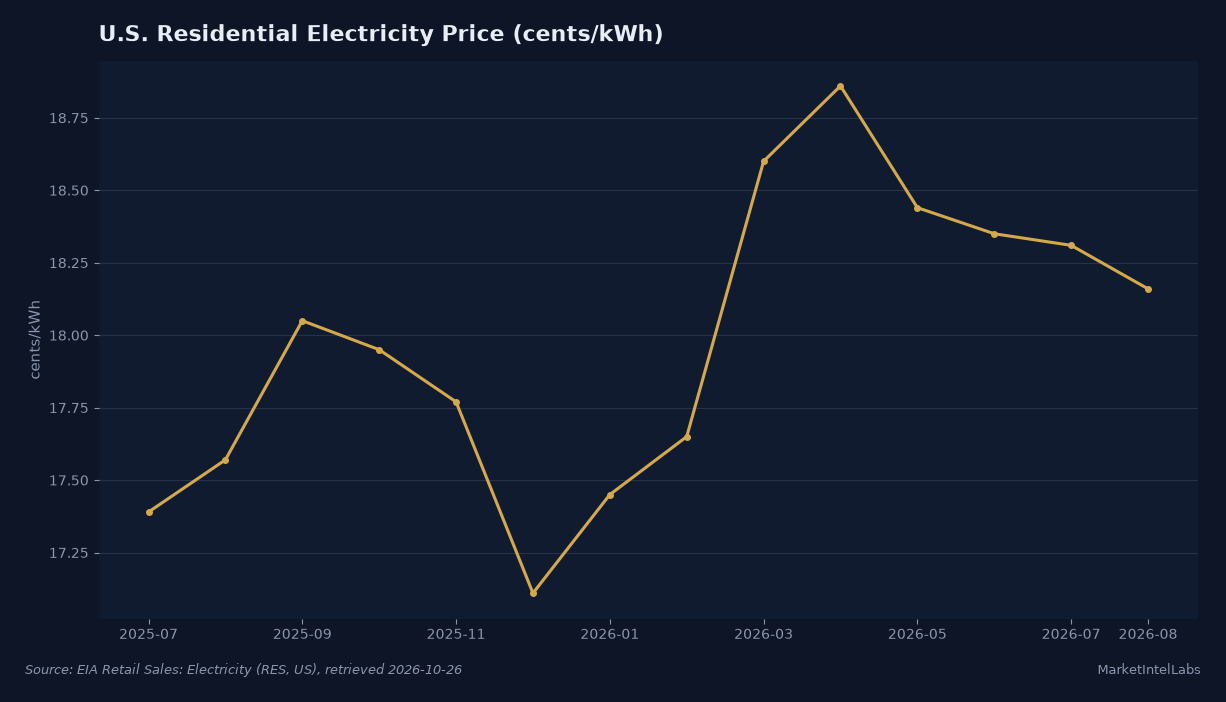
The two series measure slightly different things, which is why they do not match to the decimal. The EIA figure is the average price utilities collected from residential customers across the country. The BLS number is the price component baked into the consumer price index, collected from urban areas and weighted toward the rates most households actually pay. They track each other closely, and both tell the same story: the power line is stuck about 3% to 4% above where it stood a year ago, and it never fell the way fuel prices did.
For the broader framework, see our Fed policy coverage.
Related reading: Gas Sets a September Record at $4.33 and CPI Inherits It.
What is keeping it elevated? A few forces are stacking up. The 2024 and 2025 utility rate cases, the filings utilities make with state regulators to raise base rates, are still working their way into monthly bills. Those approvals happen on a lag, so cost increases from a year or two ago show up in the rates being collected now.
Transmission and distribution spending, much of it tied to hardening grids against storms and to data-center demand growth, has pushed up the delivery portion of the bill. On the generation side, natural gas remains the marginal fuel for much of the country's power, so while gas prices have eased from their late-summer spike, the cost of the fuel that sets the wholesale clearing price still feeds through to the retail rate.
Related reading: Gas prices near $4.28 a gallon heading into October PCE: what it means for the household bill.
The stubbornness shows up plainly in the EIA series. After the winter low, residential rates climbed steadily through the spring, cresting at 18.86 cents in April, then drifted down only gently through the cooling season to August's 18.16 cents. A year ago the same series stood at 17.57 cents, and in January of 2025 it was 15.92 cents. The trajectory is not a spike; it is a plateau that keeps resetting a notch higher.
For the household budget, the dollar math is the part that matters. At 18.16 cents per kilowatt-hour, a home using 900 kilowatt-hours in a month pays about $163 for electricity. At the 17.57 cents observed a year earlier, the same usage cost about $158.
Related reading: August CPI: Shelter and Energy Push Your Monthly Bills Higher.
The roughly $5 monthly increase is small next to the fuel swings households have absorbed this year, but it is constant, and it compounds across the year. It also does not respond to the price the market sets for crude, the way the pump does. When gasoline falls, drivers feel it at the station the same week; there is no equivalent relief valve on the power bill.
That makes electricity the most reliable energy cost for budget planners to pencil in, and the one least likely to surprise pleasantly. The BLS September print of 19.6 cents, the freshest available, shows no sign of a seasonal giveback yet. The typical pattern is for residential rates to ease into the fall as air-conditioning load drops, but this year the series has held near its high, and utilities are heading into the winter heating season with rate cases still pending in several states.
There is a counterargument worth naming. The year-over-year increase is real but modest, and the worst of the post-2021 energy inflation has passed. The monthly EIA figure was actually down from both June and July, and August marked the fourth straight month below the April peak.
Some of that reflects falling wholesale power costs as natural gas settled back, and analysts at the EIA expect residential rates to drift slightly lower through the fourth quarter if gas stays cheap. A household that saw a double-digit percentage jump in its bill during the 2021-2023 period is now facing a much gentler single-digit rise.
The risk to that benign view is the same named here all year: winter. If a cold start to the season, like the one forecasters have begun to flag for the Upper Midwest and Northeast, lifts natural gas demand and with it the wholesale price, the retail rate cases already in the pipeline will inherit that fuel cost within a couple of billing cycles. Electricity is the one household energy line that cannot be bought ahead or hedged by the end consumer, so it is the line most exposed to a sudden winter spike.
What comes next is on the calendar. The EIA will publish September's residential average in the weeks ahead, and the BLS October print arrives next month, both watched for the first sign of the autumn decline this year's plateau has not yet produced. The October PCE report, due Thursday, will show whether electricity's 3%-plus run is still pushing the overall inflation measure the way it did through the summer. For now the takeaway for households is simple: plan the power bill as if it is not coming down, because so far it has not.
This content is for informational purposes only and does not constitute financial advice. Past performance is not indicative of future results. Consult a qualified financial advisor before making investment decisions.
Get daily intelligence delivered
Create a free account for the Daily Brief every weekday and The Week Ahead every Sunday. No card required.