Gas prices near $4.28 a gallon heading into October PCE: what it means for the household bill

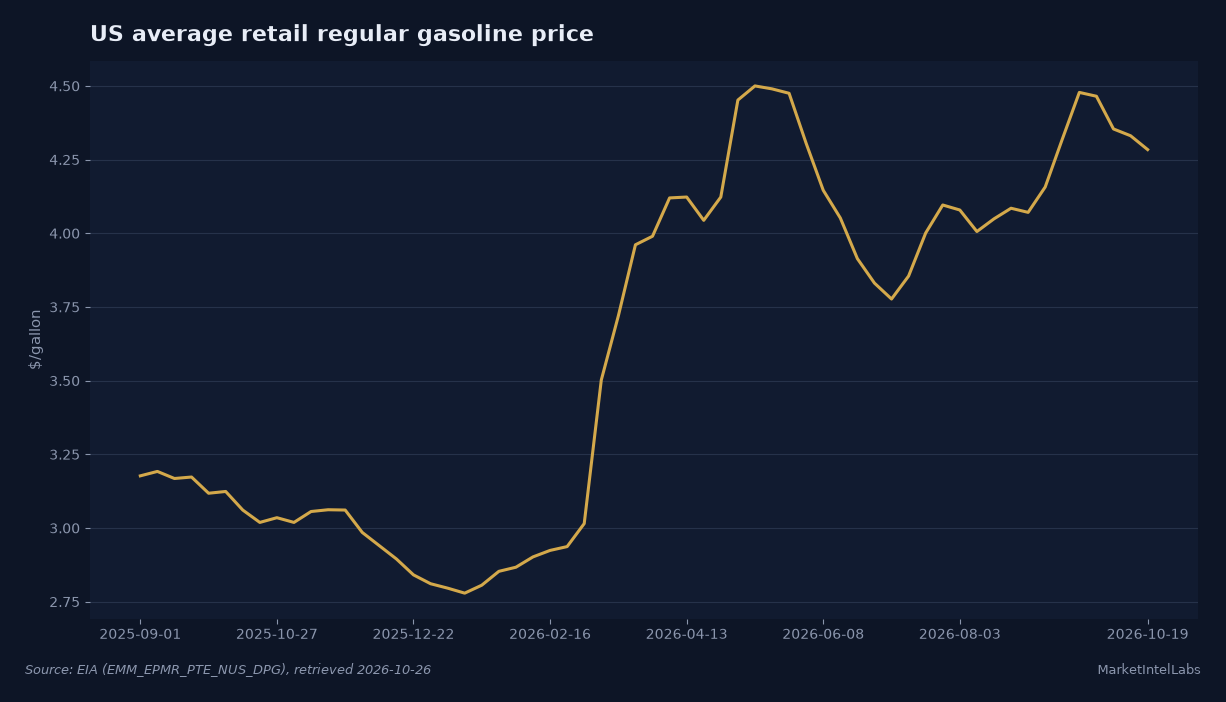
The number that defines the week of October 26 is $4.28, the national average price of a gallon of regular gasoline, and what it does to a household budget is larger than the per-gallon figure suggests. A standard 15-gallon fill now costs about $64. The same fill cost about $47 a year ago. That is roughly $17 more per tank, and for a household that fills once a week, it is close to an extra $70 a month before any other bill has been paid.
Gasoline is easing, but it is easing from a September peak, not back to anywhere near normal. The average stood at $4.284 for the week of October 19, according to EIA weekly data, down from the recent high of $4.478 the week of September 21. That is a pullback of roughly 4 percent from the top. It is still about 37 percent higher than the $3.12 a gallon at the same point in October 2025. The retreat matches a crude complex that has cooled from its five-month high, yet the base is high enough that the pump remains the most visible pressure point in the consumer price picture heading into this week's inflation data.
Related reading: September CPI Runs 3.7% as Energy and Shelter Stretch Household Budgets.
The energy line is not just gasoline. Diesel averaged $6.276 a gallon the week of October 19, up about 73 percent year over year, and diesel is the freight fuel, so part of that feed-through lands in grocery shelves and delivery prices weeks later. Natural gas at Henry Hub traded near $3.20 in mid-October, up from roughly $2.81 in late August, the early marker for heating-season utility bills as colder weather arrives. Residential electricity averaged 18.16 cents per kilowatt-hour in August, the most recent EIA monthly print, down slightly from the April figure of 18.86 cents but still carrying the year's elevated base.
The official inflation readpoints lag those weekly prices. The September CPI, released in mid-October, put headline consumer prices up 0.65 percent from August and 3.72 percent from a year earlier, according to BLS data. Shelter, food at home and the energy complex remain the three heaviest contributors to that annual number, consistent with the pattern of the past several months, in which headline inflation has stayed above the Fed's 2% goal.
For the broader framework, see our Fed policy coverage.
Related reading: Heating Oil Near $4.76 Per Gallon as Crude's Five-Month High Resets the Winter Bill.
Two dated items on the cost-of-living calendar land this week. On Wednesday October 28 the FOMC concludes its two-day meeting, with a broad consensus of economists and fed-funds futures pointing to a hold in the target range at 3.75 to 4.00 percent. A December move is priced by the full economist panel surveyed in the run-up. On Thursday October 29 the Bureau of Economic Analysis releases September personal income and outlays, which carries the Fed's preferred PCE inflation gauge. The consensus in the Wall Street Journal survey is headline PCE up 0.5 percent for the month and 3.7 percent year over year, with core PCE up 0.3 percent on the month and 3.1 percent year over year. A core print above 0.30 percent is the number markets will read as reopening the December debate, and it is the same question that matters for consumer borrowing costs.
The rate picture compounds the energy stress. The average credit card APR stood at 21.19 percent in the August Federal Reserve data, the most recent G.19 release, and the average 48-month new-car loan carried a 7.47 percent APR over the same period. A 30-year fixed mortgage averaged 7.32 percent the week of October 22, according to Freddie Mac data, which is what a household faces if it is trying to refinance or buy before rates move again. None of those rates has fallen meaningfully, and each translates into dollars the way gas does: more interest on carried balances, a larger monthly payment on a car, a steeper mortgage payment on a new home.
Related reading: Gas Prices Slide Below $4.30 as Drivers Cut Their Commutes.
What a reader can do with this is limited by where prices sit, and the honest takeaway is that the relief so far is narrow. Gasoline has come down from its peak, which is the one genuinely positive move in the consumer energy line this month. Nothing else has turned. Diesel is up, natural gas is up into heating season, and both the Fed's own inflation gauge and the committee's rate path are the events that will set whether the cost of living keeps compounding into the winter. Thursday's PCE print, and the December rate signal that follows it, are the nearest dates that could change a household budget line that is currently moving the wrong way on most fronts.
For households carrying a balance or facing a large purchase, the near-term direction of consumer rates sits on that Thursday number. The data so far this week points one way: inflation well above target, a hold expected, and a December hike not ruled out. The cost of living is not accelerating the way it did in the spring of 2025, but it is not decelerating either, and at the pump and on the card statement it still reads as an active squeeze.
Related reading: Gas Falls to $4.35, but Household Inflation Stays Hot.
This content is for informational purposes only and does not constitute financial advice. Past performance is not indicative of future results. Consult a qualified financial advisor before making investment decisions.
Get daily intelligence delivered
Create a free account for the Daily Brief every weekday and The Week Ahead every Sunday. No card required.