Electricity Prices Are Up 30% From Last Year

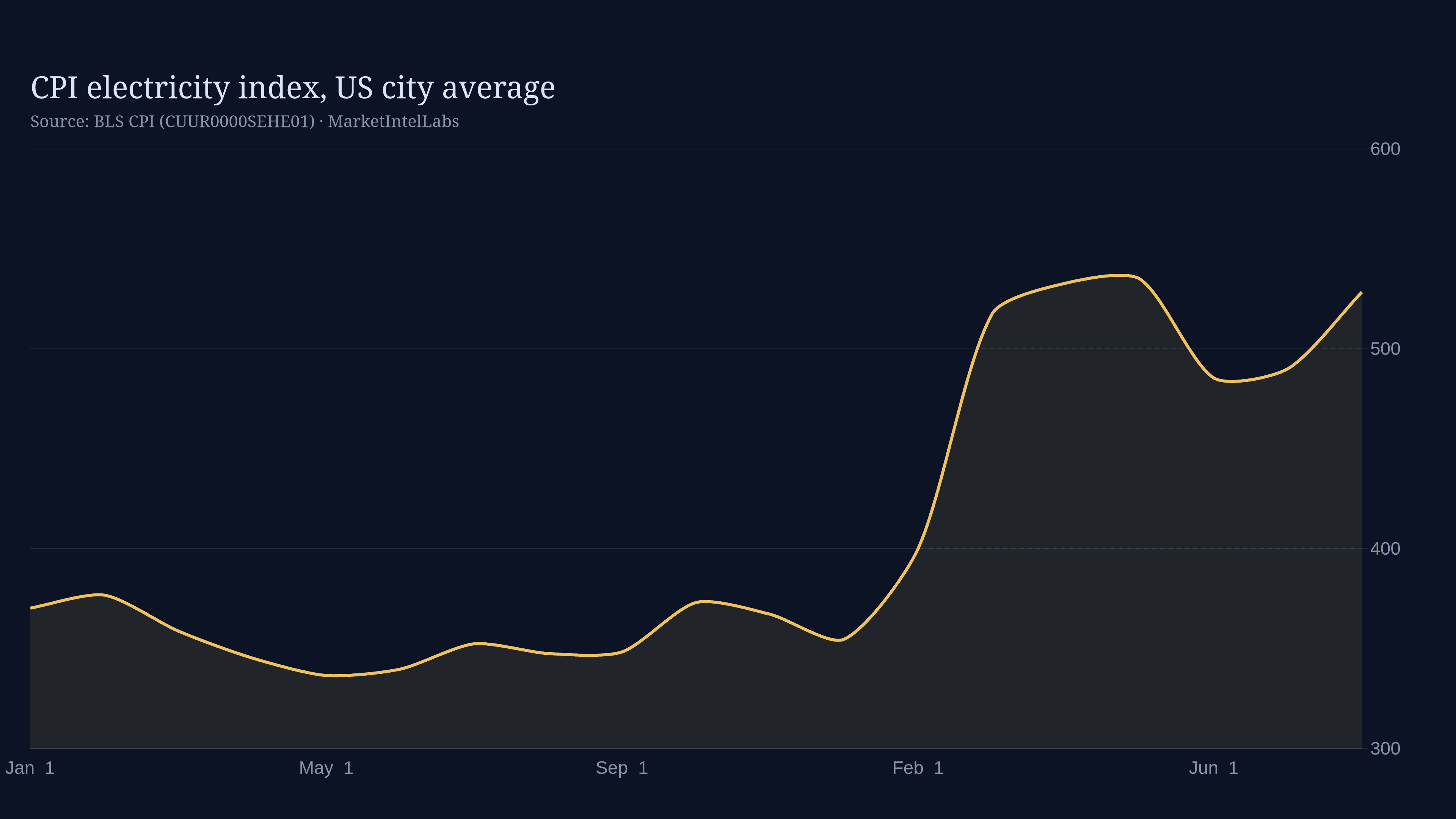
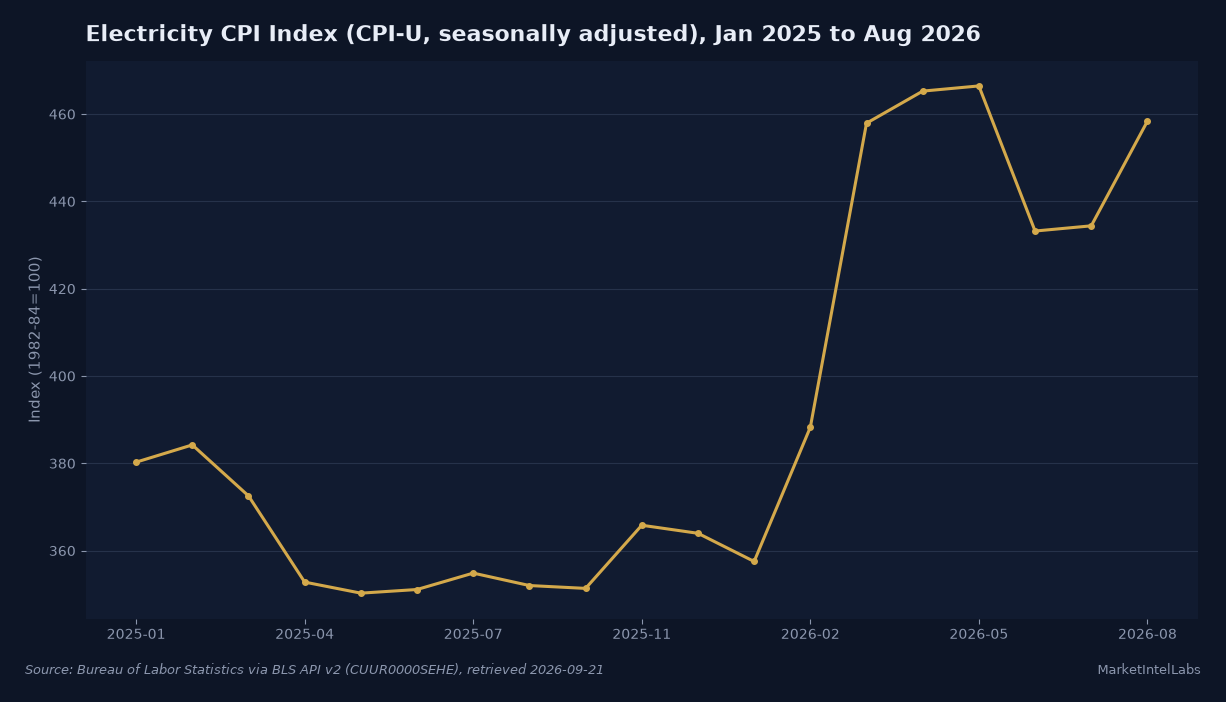
Electricity prices are now 30.2 percent higher than they were a year ago, and August's inflation report shows the increases are accelerating. The Bureau of Labor Statistics' electricity index jumped 5.5 percent in August alone, its largest one-month move of 2026. The average price of a kilowatt-hour across US cities stood at 19.6 cents in August, per the BLS average-price data. Headline CPI gets the attention at 3.4 percent, but the line item lighting your home is running nearly ten times faster than core inflation.
The three drivers
Energy did not do the damage in August, contrary to the usual pattern. The gasoline index was essentially flat, down 0.04 percent on the month, and the broader energy index rose 1.29 percent. What moved the headline was shelter and electricity, not the tank. At the pump, the national average for regular gasoline stood at $4.32 a gallon in the week of September 14 (a record diesel print same week), up 27 cents over the four weeks since August 17, according to EIA weekly data. Diesel is worse: retail diesel sat at $6.285 a gallon that week, above the prior nominal weekly peak of about $5.81 from June 2022 in current dollars, as refinery capacity went offline (see how diesel at $6.31 hit the household bill), and freight diesel eventually shows up in everything a truck delivers.
Electricity deserves its own paragraph because the trajectory is ugly. After a June and July that looked like relief (the index actually fell and then went flat), August snapped back with a 5.5 percent jump. Over the year the index is up 30.2 percent, which dwarfs every other major category in the report. The average price of a kilowatt-hour, the number that lands on the utility bill, is 19.6 cents, and utilities across the country have already filed late-summer rate cases that take effect October 1. Expect the September print, due October 14, to extend the streak.
Shelter remains the slow bleed. It rose 0.3 percent in August and 3.0 percent over the year, so on a $2,200 rent you are paying about $6 more per month than in July and roughly $65 more than a year ago. The deceleration from 2025's 4-plus percent pace is real, but shelter is about a third of the CPI basket, so a 3 percent shelter run keeps the headline from ever falling below 3 while it lasts.
Food is the one bright spot. The food-at-home index was essentially flat in August, down 0.04 percent, and sits 2.2 percent above a year ago. Groceries are behaving. Restaurant meals keep climbing faster, up 0.3 percent on the month, so the gap between cooking and eating out widened again.
The household math
Put the month together in dollars. Electricity's 5.5 percent August move is roughly $6 to $9 more per month for a home running 900 kilowatt-hours, and shelter adds $6 on a $2,200 rent, so the month-over-month damage runs about $12 to $15 per month before the October utility rate filings land. Against a year ago the stack is heavier: the 30.2 percent electricity increase works out to roughly $40 more per month on that same 900 kilowatt-hours, shelter is about $65 more, and the pump adds on top of that, with regular gasoline near $4.32 a gallon in mid-September per EIA weekly data.
Consumer rates moved the wrong way too. The Freddie Mac 30-year fixed averaged 6.95 percent in the week of September 17, up from 6.66 percent four weeks earlier, after the Federal Reserve's move toward tightening pushed long yields higher. On a $400,000 mortgage, that four-week rise is about $80 more per month for a new borrower (the gas-and-mortgage squeeze, in dollars). Anyone waiting for a window to refinance is watching a window close.
What to watch
The September CPI report lands October 14 at 8:30 a.m. Eastern, per the BLS release schedule. The questions are whether electricity's August spike was a one-month blip or the start of a second leg, and whether gasoline holds near $4.30 as refinery capacity stays offline. Core inflation at 2.4 percent is close to the Federal Reserve's target; the household's basket, weighted toward the lights, the tank and the roof, is not. That divergence is the cost-of-living story of the fall.
The practical takeaway: October utility bills are already set by filed rates, so the surprise risk is concentrated in fuel. A household that trims 50 kilowatt-hours a month (thermostat discipline and LED swaps) banks roughly $10 a month at current prices, and locking a mortgage rate now beats waiting for relief the yield curve is not offering. This content is for informational purposes only and does not constitute financial advice. Past performance is not indicative of future results. Consult a qualified financial advisor before making investment decisions.
Get daily intelligence delivered
Create a free account for the Daily Brief every weekday and The Week Ahead every Sunday. No card required.