Quantum Space QSPC stock: closes SPAC merger, raises $300M

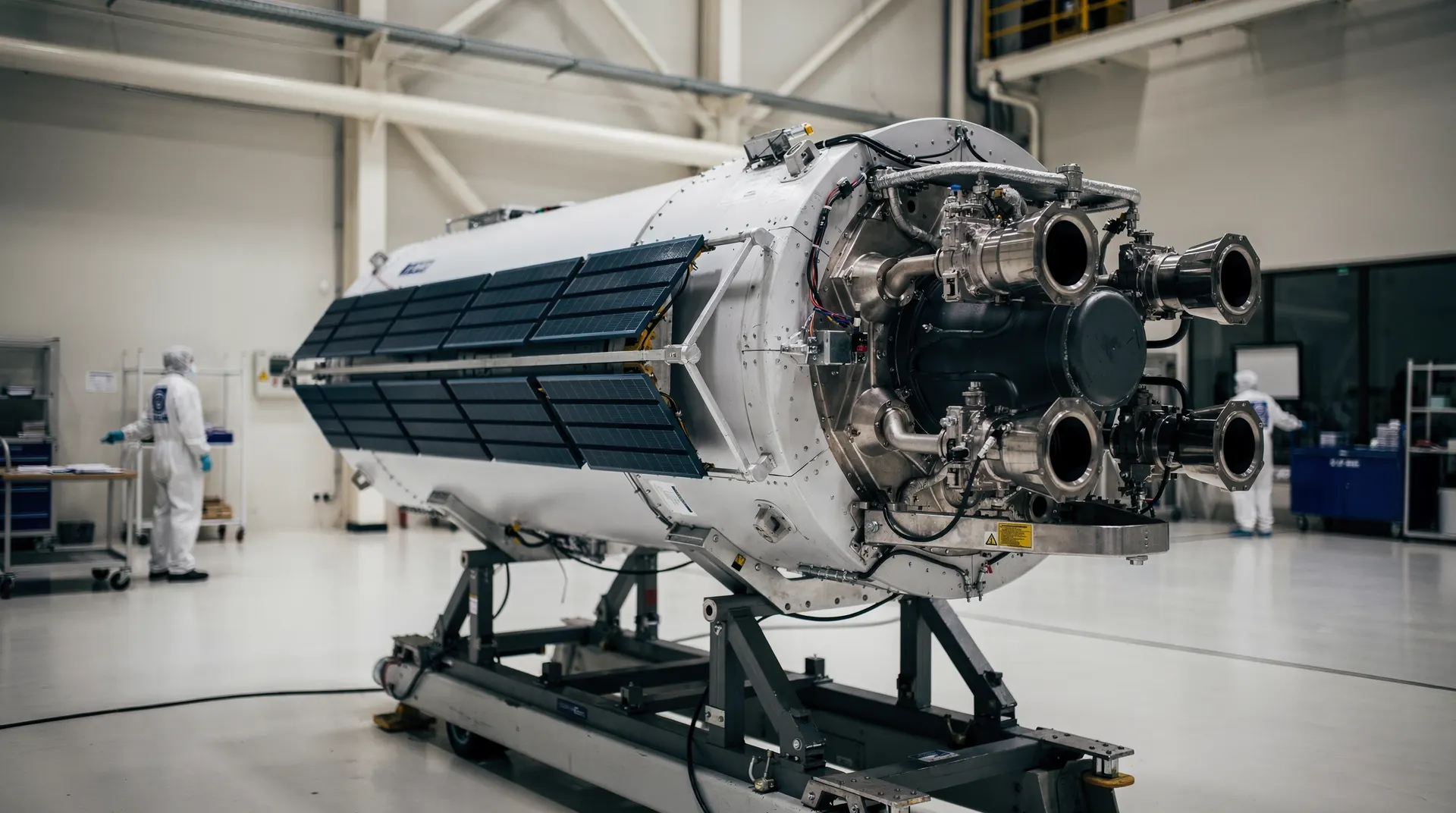
Quantum Space, the maneuverable spacecraft company led by former NASA administrator Jim Bridenstine, has finished its reverse-merger into a blank-check company and starts trading on the New York Stock Exchange on November 24 under the ticker QSPC. The deal with Inflection Point Acquisition Corp. VI brought in about $300 million of new capital and values the combined company at a pro forma equity value of roughly $958 million, according to a company statement released November 23.
The closing caps a months-long path to public markets that began in June, when Quantum Space said it would merge with a shell company rather than pursue a traditional IPO. Bridenstine, who ran NASA during the Trump administration, has cast rapid access to capital as essential because the military is buying spacecraft that can change orbit on command. The company lists the U.S. Space Force, the Department of Defense and NASA among its customers and says it holds contracts and agreements with those agencies.
Related reading: Agility Robotics debuts as first pure-play humanoid on Nasdaq.
The stock arrives into a thinly traded corner of the market where a handful of space names list through SPACs rather than IPOs, a route Rocket Lab, Spire and BlackSky all took in the 2021 cycle. Quantum Space's valuation sits far below the $1.2 billion headline the companies advertised in June and below the roughly $253 million of trust cash that earlier deal documents described. The implied equity value of $958 million reflects the terms shareholders and the two private investment in public equity, or PIPE, financings ultimately accepted.
What Quantum Space actually builds
Quantum Space is not a quantum computing company. The name refers to the company's mission of building spacecraft that maneuver in orbit, refuel at on-orbit depots and reposition themselves for national security, civil and commercial payloads. Co-founder Kam Ghaffarian, an executive chairman known for backing space stations and lunar projects, describes space as an increasingly contested domain where the ability to maneuver, reposition and extend mission life is what protects a strategic advantage.
Related reading: Agility Robotics AGLT: first US humanoid-robot stock nears $465M.
The core product is a coordinated system of two vehicles. The Ranger is the maneuverable spacecraft that carries a payload to a requested orbit, and the Scout accompanies it as a smaller support vehicle. Proceeds from the SPAC are earmarked to accelerate production of both, with on-orbit refueling as the technology that lets a single vehicle serve multiple missions instead of one.
The pitch to the Pentagon is resilience. Traditional satellite constellations are large, fixed targets; a maneuverable craft can dodge debris, shift coverage and reposition over a crisis zone within hours. That framing has made defense procurement the company's early revenue source, and the statement frames the extra capital as funding that expansion for government and commercial missions alike.
Related reading: Starfish Space's first Otter servicing satellite fails during NASA's SSPICY mission.
The risk in a $958 million space stock
Going public through a SPAC leaves the company with a real balance sheet but also with scrutiny that did not always attach to the 2021 wave. Several earlier space SPACs, including Momentus and Astra, blew through their proceeds and saw share prices fall to a fraction of their listing values. Quantum Space says proceeds are reserved for production, a more concrete use than the general working capital many shells promised, but the company still carries the same execution risk: spacecraft programs slip, and defense contracts are decided by budgets outside a young company's control.
The share structure is another thing an investor sees on day one. The combined company lists Class A-1 common stock on the NYSE and a separate warrant line, QSPC WS, on NYSE American, and the shell's old Nasdaq symbols were halted and are expected to be delisted. Redemptions, lock-ups and the PIPE discount are standard SPAC mechanics that can pressure a new float, which is one reason a newly listed space stock often trades below its initial reference range.
Related reading: Q-CTRL raises US$290 million, minting a quantum unicorn.
The milestone matters beyond one ticker. Quantum Space is one of the first US companies to take maneuverable, refuelable spacecraft to public markets, and its path will be a read on whether defense-focused space tech can sustain itself with public capital. With roughly $300 million raised into a $958 million structure, the market is paying for the Ranger and Scout to leave the design phase and reach orbit on the schedule the Space Force wants.
What to watch next
First trading day is November 24, so volume and price stability relative to the merger reference are the immediate signal. After that, the milestones to track are a first on-orbit demonstration of the Ranger spacecraft, any expansion of the Space Force and Department of Defense contracts, and whether the PIPE investors hold through the lock-up rather than selling into the float. A successful refueling demonstration in orbit would be the first hard evidence that the maneuverability thesis works, and that is the calculation that will ultimately set QSPC apart from the shell-company ghosts of the 2021 cycle.
This content is for informational purposes only and does not constitute financial advice.
Get daily intelligence delivered
Create a free account for the Daily Brief every weekday and The Week Ahead every Sunday. No card required.