10-year holds 5% as bond market does the Fed's tightening


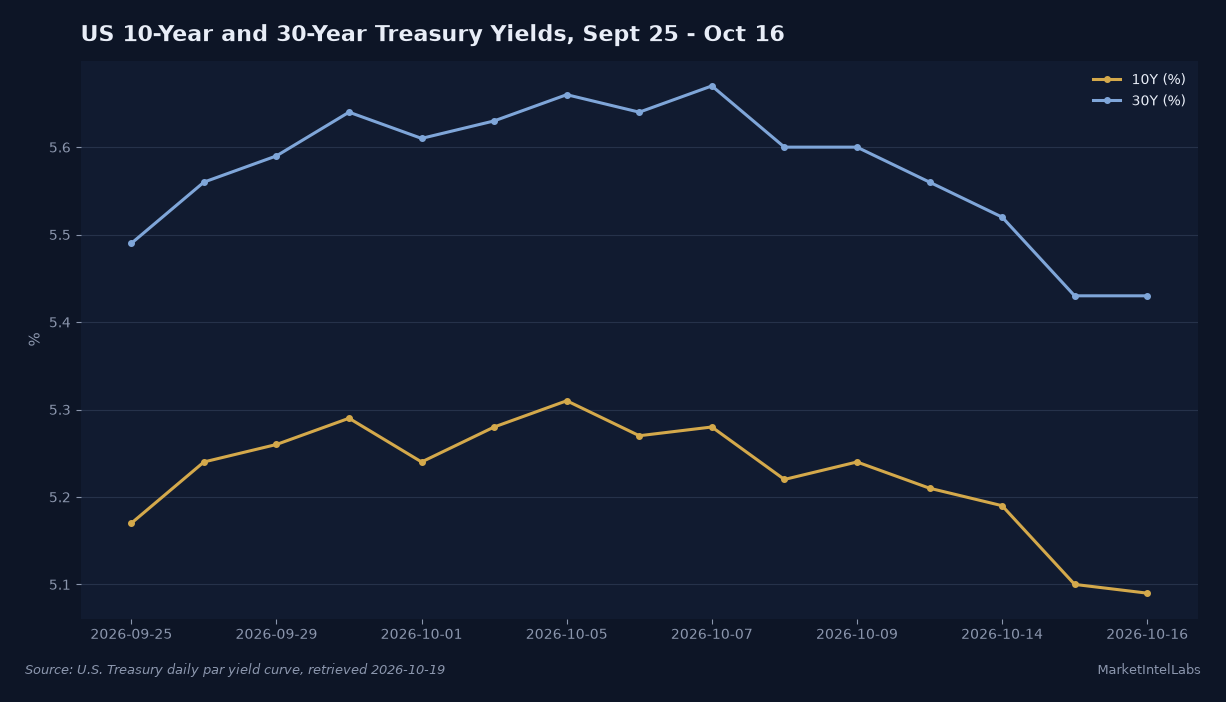
Ten-year Treasury yields are easing from their early-October peak, but the level is the story: at 5.09 percent on October 16, the long end is still imposing a degree of policy restraint that the Federal Reserve, sitting in its communications blackout, has not yet had to vote on. The week of October 19 is a quiet one for scheduled macro data, which makes the October 28 FOMC decision the single most market-relevant policy event on the calendar, and the bond market is doing much of the debating in advance.
Let me put the numbers behind that framing, because the distinction matters for what comes next. September CPI accelerated for a second straight month, to 3.7 percent year over year from 3.4 percent in August, per the Bureau of Labor Statistics. The move was almost entirely energy: gasoline rose 9.1 percent on the month and now sits 34.2 percent higher than a year ago, and the energy index as a whole is up 20.4 percent year over year. The core measure, which strips out food and energy, also firmed two-tenths to 2.6 percent. That second fact matters more than the headline: it disconfirms the comfortable reading that the inflation scare is purely transitory energy passthrough.
Related reading: Fed Holds Rates at 3.88% as M2 Hits Fastest Growth of the Cycle: October CPI and FOMC Preview.
Against that, the labor market is cooling. September nonfarm payrolls added just 29,000 jobs against roughly 84,000 expected, and July and August were revised down a combined 60,000. The unemployment rate ticked up to 4.2 percent, though the household survey showed a strong 406,000 employment gain and an entry of 485,000 workers into the labor force, which is why the rate rose despite solid job creation. Wage growth slowed to its lowest annual pace since May 2021. That is disinflationary, and it is the counterweight the Fed will weigh against the CPI print.
The policy arithmetic is unusually clean. The effective fed funds rate is 3.88 percent. The committee is in a communications blackout running through October 29 ahead of its October 28 decision, which market participants overwhelmingly read as a hold: fed funds futures implied hold odds of 86.5 percent, even as prediction markets put a 54 percent probability on an actual hike at the October meeting.
For the broader framework, see our Fed policy coverage.
Related reading: 10-Year Treasury Yield Hits 5.3%, Highest Since 2002.
That gap, between an 86.5 percent hold expectation and a 54 percent hike price, is the market doing what it always does into a blackout: pricing the distribution rather than the most likely path. A committee that has spent a year saying it is data dependent is walking into a meeting with inflation re-accelerating. The historical read, two straight energy-led acceleration months, would normally put a hike on the table. What keeps it off is the softening labor data and the rare sight of wage growth at a multiyear low. The Fed's "data dependent" framing is more likely to tolerate a temporary overshoot than risk a policy error that chills an already soft labor market.
The bond market has been the more honest transmitter of this bind. The 10-year yield touched 5.31 percent on October 5, its highest close of the period, and has since eased to 5.09 percent; the 30-year has moved from 5.66 percent to 5.43 percent. That the long end stays elevated well above the fed funds target is a term-premium repricing, not an expectation of imminent tightening. An inflation-scarred market is demanding more compensation for holding duration, and it is willing to do so even as the front end prices a hold. In practical terms, a 5 percent plus 10-year is doing tightening work that a hold at 3.88 percent does not, and it hits the economy through the financing channel rather than the policy channel.
Related reading: What to Watch: September Employment Situation.
The cross-asset transmission this week is visible in equities. Growth and long-duration names bore the repricing into the CPI print: QQQ fell 2.5 percent to start the week and SPY 1.1 percent, a risk-off tone consistent with higher-for-longer, not with an imminent recession call. The curve steepening pressures the parts of the capital stack most sensitive to duration and credit costs, which has been the through-line of the recent AI-infrastructure repricing. For dollar positioning, elevated long-end yields keep real rate differentials supportive of the dollar, which has been firm against emerging-market currencies.
The bear case deserves its turn. If core inflation grinds higher for another month or two, the hold baseline breaks, and a hike at a later meeting becomes live. In that scenario duration stays under pressure, the curve steepens further, and the equity risk-off we saw to start the week becomes durable rather than a one-day repricing. The labor data is the offset: soft payrolls and slowing wages are genuinely disinflationary, and they are the reason the base case remains a patient hold that tolerates a temporary overshoot.
Related reading: Waller Discussion at Bloomberg New Economy Forum: Higher Yields Doing Some of the Fed's Work.
What to watch next. The FOMC decision on October 28 and the accompanying statement and chair press conference are the week's decisive communication, given the blackout has otherwise quieted official voices. The October PCE reading, due after the November CPI slate, will tell us whether the core firming is a one-off or a trend. And the 10-year yield at 5 percent is itself an information event: if it breaks the October 5 peak, the market will be telling us it no longer believes the hold, and the policy discussion will change even if the dots do not.
This content is for informational purposes only and does not constitute financial advice. Past performance is not indicative of future results. Consult a qualified financial advisor before making investment decisions.
Get daily intelligence delivered
Create a free account for the Daily Brief every weekday and The Week Ahead every Sunday. No card required.