OpenAI Grid Protectors Program: up to 1 gigawatt of data center power cuts when the grid is strained

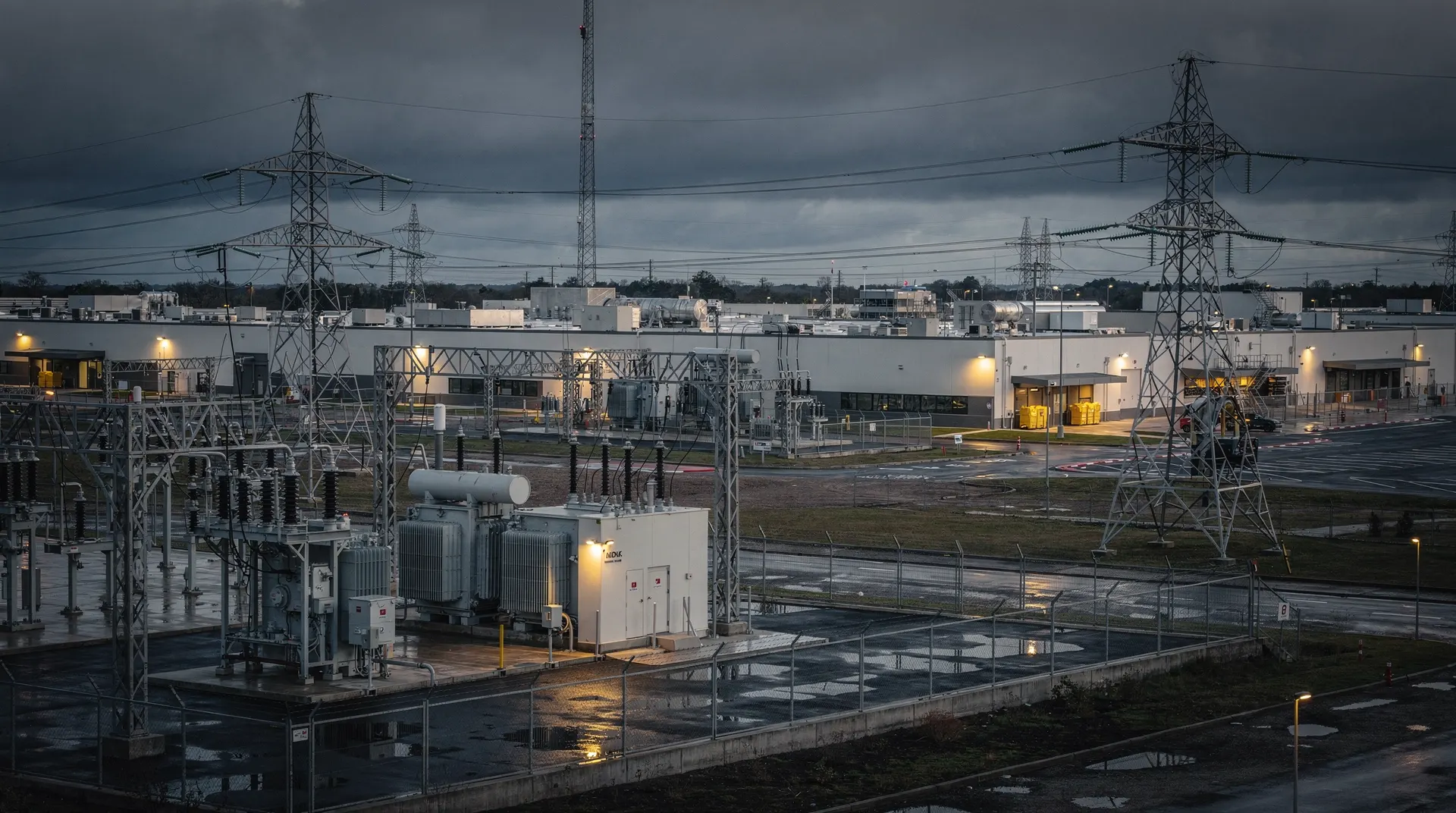
OpenAI said it will cut as much as 1 gigawatt of electricity at its planned Effingham County, Georgia data center campus whenever the local grid is under strain, converting what began as a condition of local approval into a default design feature for every campus the company develops on its own. The announcement, made Monday under the brand “Grid Protectors Program,” moves load-shedding from a site-specific concession into a stated operating standard, and it lands two weeks before a federal deadline that could decide whether such voluntary flexibility becomes binding grid policy.
The Georgia campus, officially named Project Camellia, sits in the Savannah Gateway Industrial Hub and is the only facility OpenAI plans to launch on its own rather than through a partner. It will draw up to 3.2 gigawatts, spread across four buildings on about 1,400 acres, with initial operations targeted for 2028 and full buildout by 2032. OpenAI estimated the project at more than $30 billion at completion and has a 25-year power agreement with Georgia Power, the Southern Company utility, which the Georgia Public Service Commission approved in August. Under that contract, OpenAI can be asked to trim as much as 1,000 megawatts of the campus's draw during periods of peak grid stress, a reduction the company compared to the electricity use of roughly 700,000 homes. The program also commits the site to work with grid operators on on-site generation or storage and to use batteries and power controls to smooth swings in demand.
Related reading: Jämsä AI Data Center: Sesterce Plans €10B Campus.
The significance for investors is the shift from a one-off Georgia bargain to a stated default. John McCarrick, OpenAI's head of energy policy, told Axios that the company now intends to carry the flexibility framework into every campus it develops directly, distinct from sites it runs through partners such as Oracle, Crusoe and Related Digital, with the exact terms of each arrangement negotiated separately with the utility serving that site. He also described a quiet repricing of the industry's old benchmark: about a year ago, he said, a major hyperscaler was still publicly defending “five nines” reliability, the traditional 99.999 percent uptime standard, and he does not think any operator is making that argument today. AI companies that spent the past two years racing to lock in guaranteed, uninterruptible power are now volunteering to give some of it back when grids are strained, in exchange for goodwill, faster permitting and political cover in the communities hosting their buildouts.
Georgia Power has framed the arrangement as a net benefit to existing customers rather than a cost shifted onto them. In its filings the utility projects about $950 million a year in incremental revenue from new large-load customers like OpenAI, which it translates into roughly $2.85 billion of customer savings between 2029 and 2031. It now estimates a typical residential customer using 1,000 kilowatt-hours a month will save at least $15 a month, or $180 a year, starting in 2029, up from the $102 a year the company had cited as recently as December. “Data centers are paying more so families and small businesses can pay less,” Georgia Power chairman and CEO Kim Greene said when the contract won approval.
Related reading: Google Locks In 702 MW of Fuel-Cell Power From AEP for Its AI Data Centers.
The bigger market question is what OpenAI's gesture signals for the price of scaling AI power. A Duke University study has estimated that allowing data centers to shift their electricity use could save $40 billion to $150 billion in capital investment over the next decade, because flexible loads would let utilities defer building peak generation and transmission. OpenAI is not the only frontier lab reading that math; it is among the clearest moves to make flexibility an explicit cost it is willing to accept on its own balance sheet, in a buildout where power has become the binding constraint on data center expansion. The pledge runs against the direction shareholders of power-dependent names have watched for two years, when the market narrative was that AI operators would pay almost anything to lock up capacity.
The announcement is also timed to a regulatory deadline. In June, the Federal Energy Regulatory Commission issued show-cause orders to all six major U.S. grid operators, PJM, MISO, SPP, CAISO, ISO-NE and NYISO, requiring each to justify why its tariffs for large loads such as data centers are not unjust and unreasonable. One of FERC's mandated reform areas touches exactly the flexibility OpenAI has signed up for in Georgia: large flexible loads paired with behind-the-meter generation, alongside rules on cost transparency, co-location and interconnection. All six operators requested and received roughly 90 extra days to develop proposals through stakeholder processes, and those filings are now due November 16.
Related reading: AI Data Center Power: Vantage Locks 1GW of 800 VDC, IREN Adds 300MW in Spain.
That timing makes the program look less like spontaneous goodwill and more like a pre-emptive marker laid down before regulators act. If FERC's eventual tariff reforms require data center operators to accept curtailable load as a condition of fast interconnection, OpenAI can argue it accepted that obligation voluntarily, on terms it helped define, rather than having flexibility imposed on it afterward by six different grid operators with six different rulebooks. The harder test is whether the pledge survives contact with specifics. OpenAI has not disclosed which campuses beyond Effingham County will get Grid Protectors commitments, how large the curtailment windows will be at sites with different grid conditions, or whether the arrangements will be enforceable obligations or aspirational targets closer to the cost-coverage pledges it made for the broader Stargate buildout earlier this year.
For the market, the spread between the announcement and the enforcement is where the risk sits. Utilities in regions with tighter reserve margins than Georgia's, including parts of PJM's footprint, may demand firmer commitments before granting the same fast-tracked interconnection OpenAI received from Georgia Power. Whether this month's FERC filings turn OpenAI's voluntary framework into the industry's floor, rather than its ceiling, is the next thing worth watching for anyone placing stakes on the cost and pace of the AI infrastructure buildout.
Related reading: AI Data Center Orders Reach 100 MW, but Plans Are Not Demand.
This content is for informational purposes only and does not constitute financial advice. Past performance is not indicative of future results. Consult a qualified financial advisor before making investment decisions.
Get daily intelligence delivered
Create a free account for the Daily Brief every weekday and The Week Ahead every Sunday. No card required.