Mortgage Rates Fall to 7.24%, Lowest in Five Weeks


The 30-year fixed mortgage rate fell to 7.24% in Freddie Mac's latest weekly survey, its lowest reading in five weeks, after two straight weeks pinned at 7.40%. The retreat is now two consecutive weekly declines, and it pulls the most-watched US home-loan rate off the ceiling it had been testing since early October.
Freddie Mac's Primary Mortgage Market Survey, released Thursday, put the average 30-year rate at 7.24%, down from 7.32% a week earlier and from 7.40% in each of the two weeks before that. The last survey at or below this level came on September 24, when the rate printed 7.03%. The midpoint, in plain terms: the market has given back most of the October run, yet the rate still sits about a full percentage point above where it was one year ago.
Related reading: Mortgage Applications Rebound 3.4% as 30-Year Rate Slips to 7.37%.
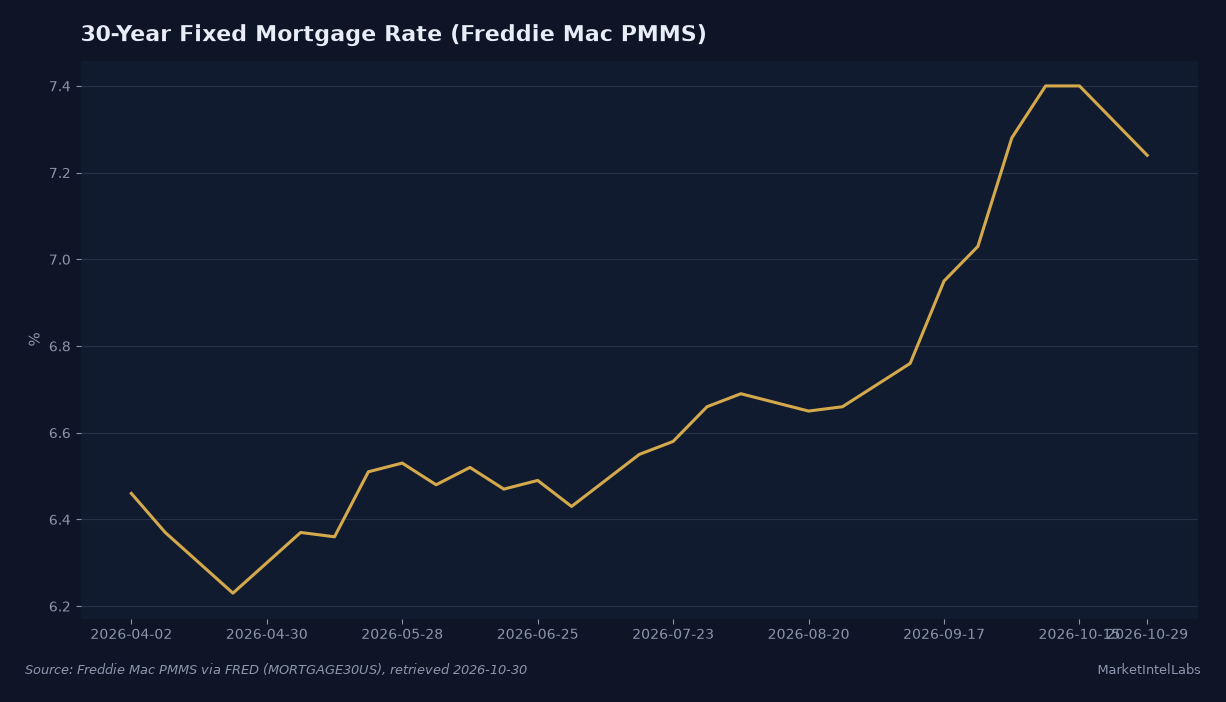
The drivers are the same that pushed the rate up in the first place. The Federal Reserve this week held its target range at 3.75% to 4.00% with a December increase still on the table, and the 10-year Treasury yield has been flirting with 5.00%. Mortgage rates move with the long end of the Treasury curve more than with the fed funds rate itself, so the survey is tracing the bond market's read of the Fed path, inflation, and the deficit-fueled supply of longer-dated debt.
What the number means in household dollars is where affordability math matters. On the national median existing-home price of $393,300, the principal-and-interest payment on a 30-year loan with 20% down works out to about $2,144 a month at 7.24%. That is roughly $17 a month below the $2,161 the same loan cost at last week's 7.32%, a small but real easing for the marginal buyer.
For the broader framework, see our Fed policy coverage.
Related reading: Mortgage Rates Hit 6.95 Percent and Locked-In Sellers Are Not Biting.
The year-over-year comparison is the sobering one. A year ago the 30-year fixed rate averaged 6.17%, which put that same median-price loan at about $1,921 a month. Today's buyer is paying roughly $223 more each month, an increase of about 11.6% in the size of the loan payment alone. Three-quarters of that gap is rate, not price: the median price is only modestly below year-ago levels, while the rate has risen more than a point.
The demand side is starting to register a pulse. Mortgage applications rose 3.4% last week, the first rebound in a month, and purchase volume is still running about 18% below a year ago. The data does not support calling this a turn: one week of applications does not reset a market where the typical buyer has lost meaningful purchasing power over the past year. But the direction matters, and a continued drift lower in rates is the one force that can lift an otherwise frozen demand side without waiting on prices to fall.
Related reading: Mortgage Applications Hit a 21-Month Low as Purchase Demand Slips 16%.
The bull case here is modest and mechanical. A rate in the low 7s instead of 7.40% brings a slice of buyers back to the edge of qualification, restores some refinance incentive for borrowers locked into higher 2026 rates, and takes the edge off the price cut cycle sellers have resorted to. The bear case is structural. Even at 7.24%, housing remains close to its least affordable level in decades, inventory is only beginning to rebuild, and the regional story still favors the Sun Belt's supply response over the Northeast's scarcity. A single weekly survey pointing down does not change the underlying affordability ceiling; it just lowers it slightly.
What is dated next keeps the focus on rates. The next Freddie Mac PMMS survey releases Thursday, November 5, and each weekly print between now and then is a data point on whether the October plateau is breaking. Beyond the survey, the Federal Reserve's next decision lands mid-December, and markets currently price a live chance of a hike, which would pressure the long end again. For anyone watching the housing market, the through-line is the same as it has been all year: the mortgage rate is the leading indicator, and everything else in housing is reacting to it.
Related reading: Mortgage Rates Hold at 7.40 Percent as 30-Year Loans Reshape the Fall Housing Market.
The regional split matters as much as the national average. In the Sun Belt, where builders added supply through the cycle, a lower rate meets an inventory that is already growing, so the response tends to show up in steadier starts and a more willing developer. In the Northeast and much of the coastal market, where inventory stayed scarce through the downturn, the same rate move mostly feeds through to asking prices rather than volume. National surveys smooth these into one line; buyers experience the divergence directly.
There is also a refinance angle this rate level reopens, if narrowly. A borrower who took a 30-year loan in early October at 7.40% has an incentive to revisit pricing once the market can offer 7.24%, and every basis point counts against the cost of a new origination. The caveat is the same affordability one: cash-out refinancing only helps households with real equity, and plenty of recent buyers have barely built any because their payments have mostly serviced interest at elevated rates.
What would change the setup decisively is not another one-eighth point of relief but a sustained move that takes the 30-year rate meaningfully below 7.00%. That is the kind of shift that unblocks pent-up demand rather than just nudging it. As it stands, the market is doing what a market does after a spike: settling back toward the level the bond market's own pricing supports, and leaving affordability improved but still historically strained.
This content is for informational purposes only and does not constitute financial advice. Past performance is not indicative of future results. Consult a qualified financial advisor before making investment decisions.
Get daily intelligence delivered
Create a free account for the Daily Brief every weekday and The Week Ahead every Sunday. No card required.