Mortgage Rates Hold at 7.40 Percent as 30-Year Loans Reshape the Fall Housing Market


The 30-year fixed mortgage rate printed at 7.40 percent in Freddie Mac's Oct. 15 Primary Mortgage Market Survey, matching the prior week and up 113 basis points from 6.27 percent a year ago. That single number is this week's housing story, because it quietly redraws the affordability math for every buyer and every listing that depends on one. At 7.40 percent, the principal-and-interest payment on a $400,000 loan runs about $302 a month, or roughly $3,600 a year, higher than it did in October 2025.
The path into this level was fast. The 30-year rate sat at 6.76 percent on Sept. 10, cleared 7.03 percent on Sept. 24, and jumped to 7.40 percent in the first week of October, where it held for the Oct. 8 and Oct. 15 prints. Rising long-term Treasury yields, filtering through inflation expectations and Fed policy timing, did most of the work. Mortgage spreads have widened too, and lenders have passed that along, so the rate reached the highest level in at least the last twelve months within a single quarter.
Related reading: Mortgage Rates Hit a 2026 High of 6.95% While Housing Inventory Piles Up.
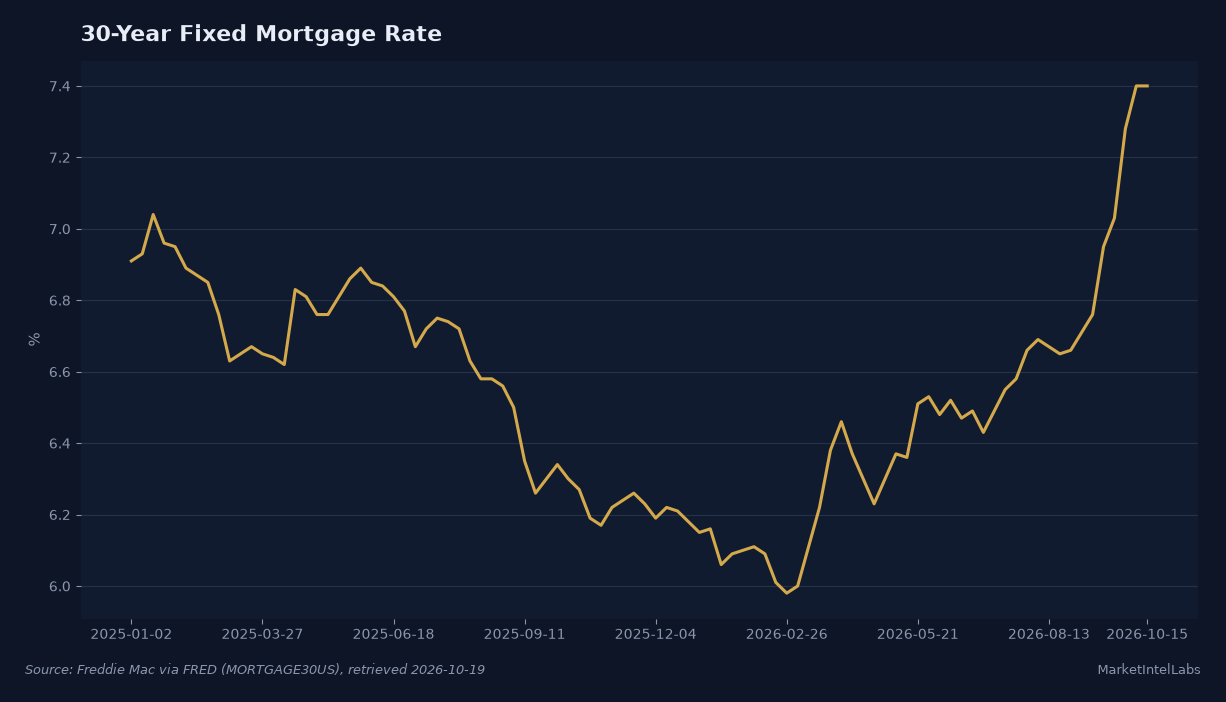
The affordability impact is immediate. A buyer financing $350,000 faces a monthly payment near $2,423 at 7.40 percent, versus about $2,160 at 6.27 percent a year ago, before taxes and insurance. That is more than $260 a month of lost purchasing power, which in most metros is the difference between a starter home and the next price band. The typical buyer has two options: borrow less or wait, and both show up in the numbers below.
Related reading: Housing Inventory Climbs 6.7% as Sellers Cut Prices.
Borrowers appear to be choosing both. Purchase application volume remains soft relative to the rate level, and the pattern is the inverse of last spring, when 6.2 percent rates pulled buyers off the sidelines. Sellers are reacting in their own way. Active listings in September reached about 1.16 million nationally, up from roughly 1.10 million a year earlier, a sign that more inventory is finally reaching the market even as demand cools. That is the silver lining in an otherwise expensive week: the supply side is no longer the dominant constraint it was in 2023 and 2024.
New construction tells the same two-sided story. Housing starts in August ran at a seasonally adjusted annual rate of 1.275 million, down 2.6 percent from July's revised 1.309 million and down 1.2 percent from 1.291 million a year earlier, according to the Census Bureau and HUD. Single-family starts, however, rose 7.6 percent month over month to 918,000, the bright spot in the release. Building permits came in at 1.394 million, up 3.5 percent year over year. Builders are front-loading the single-family work they can sell while pulling back on multi-family in a market where financing costs squeeze every project.
Related reading: Mortgage Rates Hit 6.95%: The Payment Math That Turns Inventory Into Price Cuts.
Inventory is finally moving in the buyer's direction after three years of acute scarcity. The seasonally adjusted months' supply of new homes ran at 8.5 months in August, down from 9.0 in July but still well above the 4-to-6-month range that signals a balanced market. Existing-home inventory, as tracked by monthly active listings, has been climbing steadily through 2026. More options, even without lower rates, is genuine relief, and it is why price appreciation has flattened. The national Case-Shiller index rose just 0.1 percent between June and July, an annualized pace barely above zero.
Why buyers are not rushing in is worth spelling out. Even with more inventory on the market, a buyer who locked 6.27 percent a year ago would have financed the same home for roughly $263 less a month, which is the entire 12-month rise in the payment on a $350,000 loan. Sellers who priced during the low-rate era are equally reluctant to give up a rate they cannot replace, which is one reason price cuts remain the most common price action in many metros even as asking prices hold. The result is a market defined less by a single direction than by a standoff between a payment ceiling and an asking-price floor.
Related reading: Mortgage Rates Reach 7.40% as Housing Completions Fall.
The next dated event on the calendar is Tuesday, Oct. 20, when the Census Bureau and HUD release September new residential construction: starts, permits, and completions for that month. That report will show whether builders held their single-family momentum through a month in which the 30-year rate climbed from 7.03 percent to 7.40 percent. The September print matters more than usual because it is the first construction data collected entirely after the rate run-up began.
The implication for the rest of fall is not dramatic, but it is clear. A 7.40 percent rate means the market keeps splitting: more listings, softer price growth, and sales volume that stays modest because monthly payments are the binding constraint. For renters and repeat buyers alike, the lever that moves this market is now almost entirely the rate path, and that path sits with the bond market and the Fed rather than with builders or sellers. Expect a slow, price-flat fall, with October's housing starts on Tuesday setting the near-term tone for whether builders keep responding to the buyers who can manage the math.
This content is for informational purposes only and does not constitute financial advice. Past performance is not indicative of future results. Consult a qualified financial advisor before making investment decisions.
Get daily intelligence delivered
Create a free account for the Daily Brief every weekday and The Week Ahead every Sunday. No card required.