Mortgage Applications Rebound 3.4% as 30-Year Rate Slips to 7.37%


Mortgage applications snapped a four-week slide last week as the 30-year fixed rate eased to 7.37%, the lowest print in three weeks. Total application volume rose 3.4% on a seasonally adjusted basis for the week ending October 23, according to the Mortgage Bankers Association's Weekly Applications Survey released October 28, with purchase activity climbing 4% and refinance volume up 3%.
The swing was enough to lift the survey off a month of declines, but it did not change the shape of the market. On an unadjusted basis the composite gained 3%, purchase applications added 3%, and refinance volume was flat to lower once seasonality is stripped out. The refinance index still ran 61% below the comparable week in 2025, and purchase applications sat 18% behind last year's pace, a gap that has hardly budged all autumn.
Related reading: Mortgage Applications Hit a 21-Month Low as Purchase Demand Slips 16%.
Rates drove the modest pickup. The average contract rate on a 30-year conforming loan, one at or below the $832,750 limit, fell to 7.37% from 7.41% a week earlier, its lowest in three weeks. Joel Kan, MBA's deputy chief economist, said the decline gave borrowers some relief, and called out conventional loans as leading the rebound. Jumbo 30-year rates eased to 7.28%, FHA-backed 30-year rates to 7.12%, and 15-year fixed rates to 6.70%. Because the drop was small, the relief was real but narrow, and it arrived with a tell: borrowers increasingly reached for adjustable-rate loans.
The ARM share of application volume rose to 11.3%, the highest in more than a year, as more buyers and refinancers chose an instrument that starts cheaper than a fixed loan. A 5/1 ARM averaged 6.41% last week, nearly a full point below the 30-year fixed rate. That is the affordability math playing out in the data: when a fixed loan no longer fits the monthly budget, buyers trade long-term certainty for a lower immediate payment. The refinance share of total activity slipped to 38.9% from 39.0%, and most of that volume remains cash-out work by owners who locked in sub-5% rates years ago.
For the broader framework, see our Fed policy coverage.
Related reading: MBA Mortgage Applications Fall 4.2% as Rates Hit 7.49%.
Here is the plain-dollar version of the same picture. On a median-priced existing home of $417,500, the September figure from the National Association of Realtors, a buyer putting 20% down finances about $334,000. At 7.37% the principal and interest payment is roughly $2,306 a month. One year ago, when the average 30-year rate was 6.19%, per Freddie Mac data for the comparable week, that same loan cost about $2,043. A buyer today is paying close to $263 more each month for the same house, about 13% more on the mortgage line alone, and that is before higher insurance and property taxes feed in. Affordability, not demand, remains the binding constraint on this market.
The rebound also has to be read against a low base. Application volume had fallen for four straight weeks and sat near its weakest level of the year, so a 3.4% bounce restores only part of what the decline took away. The composite index remains well below its level from this spring, when the 30-year rate traded in the high 6% range and purchase demand was running closer to last year's pace. The market is still down from where it started 2026 even after two weeks of falling rates, and the MBA does not report any improvement in the backlog or the pace of new listings that would suggest a full demand recovery.
Related reading: Mortgage Applications Drop 5.3% Even as the 30-Year Rate Falls to 7.41%.
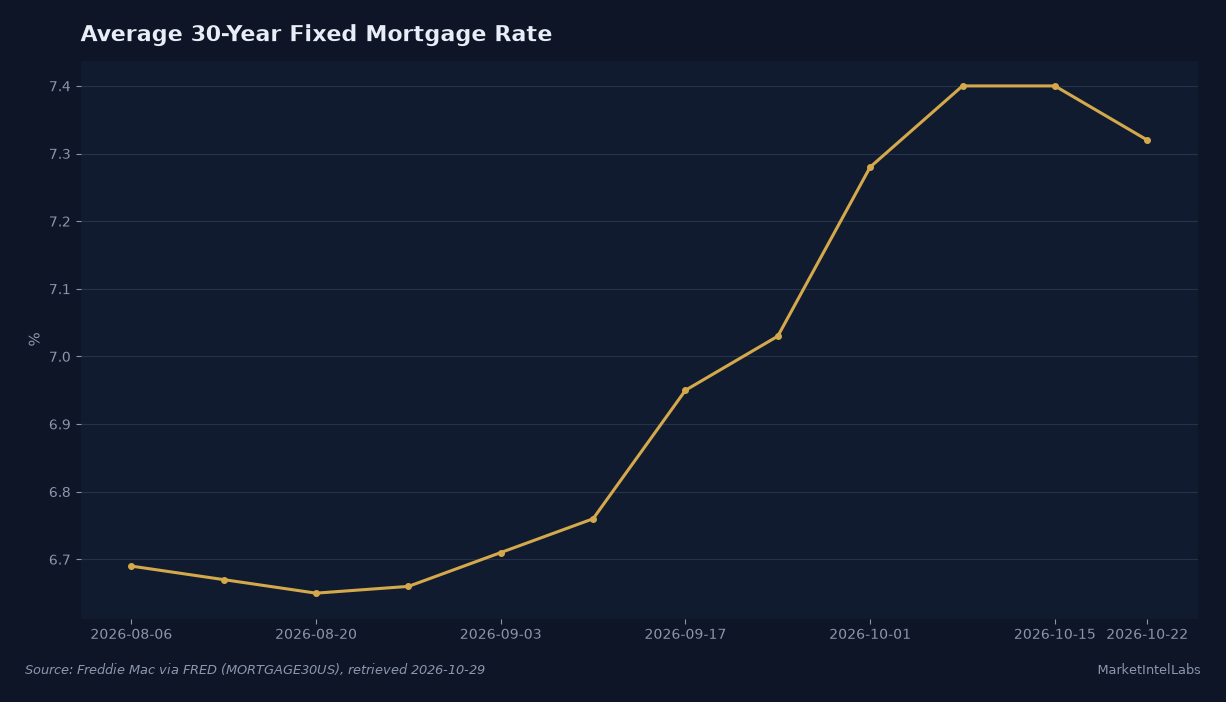
There is a genuine bull case in this week's survey. Rates have now declined for two straight weeks, the ARM share signals buyers are scrounging for the cheapest entry, and a sustained slide toward the mid-6% range could finally thaw purchase volume heading into the normally slow winter months. The Federal Reserve held its target range steady at the October meeting, and futures markets continue to price an eventual easing, which argues mortgage rates could drift lower into year-end.
The bear case is just as concrete. Kan was blunt that many homebuyers have put their purchase plans on hold, and one week of +4% purchase applications does not erase an 18% year-over-year deficit. Rates remain more than a percentage point above the same week last year, refinancing is structurally broken for the millions of owners sitting on cheaper mortgages, and inventory, while up, is still not cheap enough to make the math work for first-time buyers. A 13% affordability gap relative to last year means even a seventh straight weekly rate decline would only take a sliver out of the wall of high monthly payments.
Related reading: Mortgage Rates Hit 7.40% as Housing Demand Cools.
What matters next is whether the rate dip has legs. The Freddie Mac Primary Mortgage Market Survey for this week is due later today, and it will show whether the 7.32% level that prevailed the prior week held or slipped further. Watch the MBA's Wednesday print for confirmation that purchase volume can hold above its seasonal floor, and watch the ARM share: if it keeps climbing, it is the market's clearest signal that fixed-rate financing has priced itself out of reach for a growing share of buyers.
This content is for informational purposes only and does not constitute financial advice. Past performance is not indicative of future results. Consult a qualified financial advisor before making investment decisions.
Get daily intelligence delivered
Create a free account for the Daily Brief every weekday and The Week Ahead every Sunday. No card required.