EQT Range Resources merger: $50 billion-plus all-stock deal creates America's largest gas producer

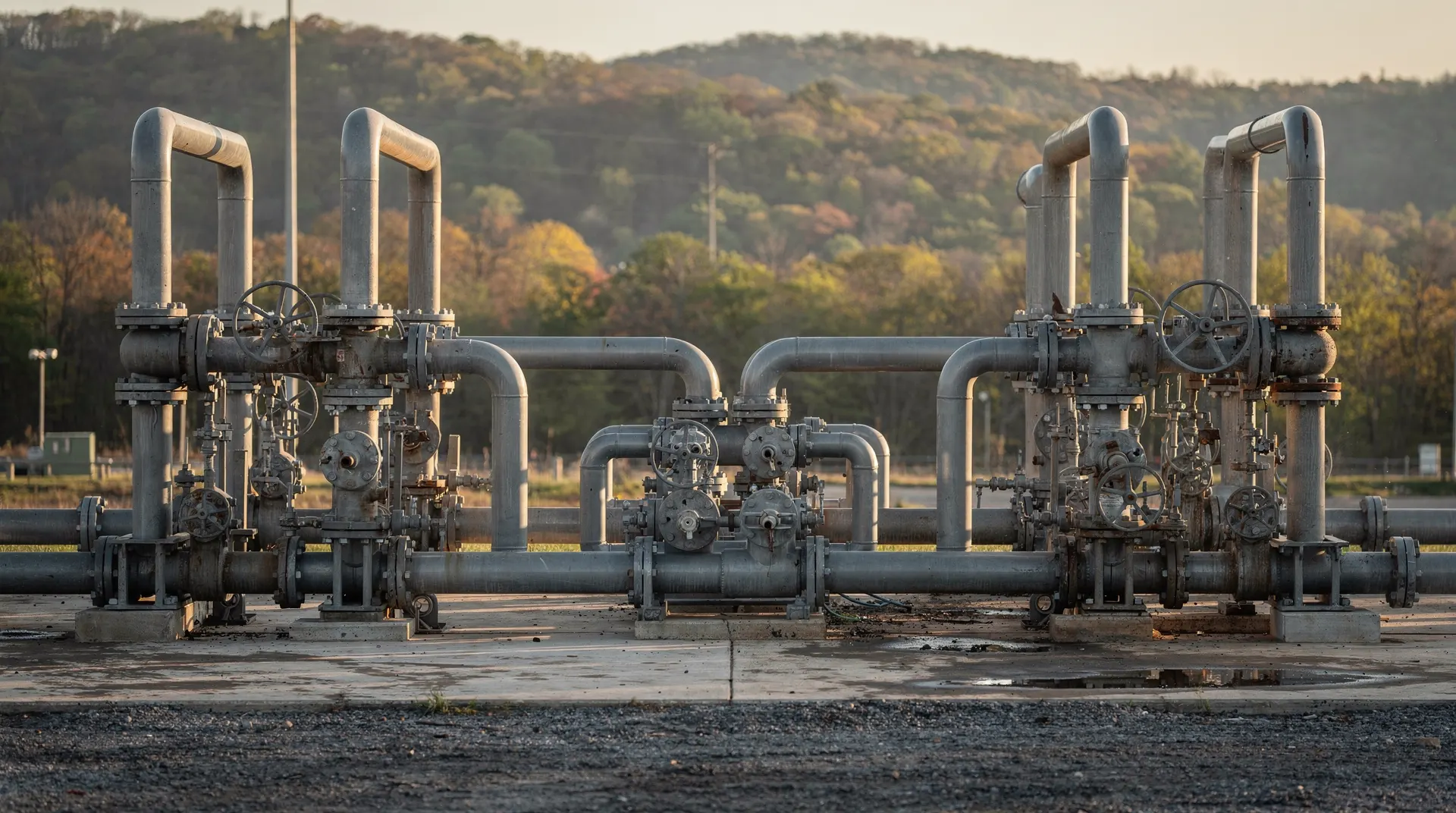
The two biggest gas producers in the Appalachian basin are becoming one company. EQT Corporation (NYSE: EQT) said Monday it will acquire Range Resources (NYSE: RRC) in an all-stock deal that the pair call the creation of America's largest natural gas producer, with a pro forma enterprise value above $50 billion.
Under the agreement, each outstanding Range share converts into 0.987 of an EQT share, an exchange that values Range at $54.91 per share, or $12.83 billion in equity value. That is roughly a 20.6% premium to Range's close on Oct 23. When the merger completes, EQT shareholders would own about 73% of the combined company and Range shareholders about 27%. Both boards approved the deal unanimously, and the companies expect it to close in Q1 2027, subject to shareholder votes and regulatory approval, including the Hart-Scott-Rodino antitrust review.
Related reading: IonQ Stock Falls on $1.3B Elisity All-Stock Deal.
Stripped of the merger paperwork, this is the consolidation of the two largest natural gas producers in the Marcellus and Utica shales into the dominant independent in the sector. The combined company would produce more than 9 billion cubic feet equivalent per day and hold more than 30 years of drilling inventory across roughly 3 million net acres, backed by more than 3,700 miles of midstream infrastructure. EQT describes itself as building the country's largest and only fully vertically integrated gas producer, from wellhead to marketing.
For equity holders, the deal is a statement about gas-weighted production as an asset. EQT is buying scale at the bottom of the cost curve, and by paying in its own stock it keeps the purchase within reach of its shareholders' balance sheet. Range holders are being asked to trade a standalone producer for shares in a larger, lower-cost machine in exchange for a moderate premium, a structure that leaves them carrying EQT's execution risk rather than a cash exit.
For the broader framework, see our crude oil coverage.
Related reading: IFM Investors to Buy Majority Stake in Associated British Ports in $13.4 Billion Deal.
The bull case: scale and a demand-led thesis
Management is framing the deal around demand, not supply. In the announcement, the boards pointed to LNG exports and the power load from data centers and AI buildouts as the long-run pull on gas. At the current strip, the two companies project combined free cash flow of about $20 billion over the next five years, built on an unlevered free-cash-flow breakeven below $2 per MMBtu. Within two years they expect $325 million in base annual cost savings, with a pathway above $600 million in the longer term.
The scale argument is direct: a producer with the lowest cost base and the longest inventory is the one best positioned to ride a demand-led gas cycle without having to chase acreage at the top. That logic also casts a shadow over the rest of the field. A combined EQT-Range carries more marketing power, and gas-weighted independents with comparable inventories but smaller scale may now face renewed consolidation questions of their own.
Related reading: Emera Canadian Utilities Merger: A C$14.3B All-Share Deal Forms a Top-20 Utility.
The bear case: deal risk and dilution
The bear side starts with the structure. Any all-stock deal dilutes the acquirer, and Range holders are accepting paper rather than cash at a time when a 20.6% premium is modest by historical merger standards. There is approval risk from two directions, the shareholder vote and the HSR antitrust review, plus integration risk at the largest independent gas producer in North America. Natural gas remains a volatile commodity, and a retracement in prices between today and a Q1 2027 close could undercut the cost-savings math. In a break-up scenario, both stocks would reprice on the terms of a failed deal rather than on fundamentals.
Everything points back to the calendar. The next visible catalyst is Tuesday's close: both companies still plan to release third-quarter results when trading ends on Tuesday, Oct 27, even though they have canceled their scheduled earnings calls. After that, the road map runs through HSR clearance and the shareholder votes toward a Q1 2027 target close. For holders of both stocks, the Tuesday print is the first real look at the businesses about to be joined, and the deal math gives the market a benchmark against which to grade them.
Related reading: Tesla Stock Jumps 3.8% on Merger Speculation: Q3 Earnings Loom Wednesday.
This content is for informational purposes only and does not constitute financial advice. Past performance is not indicative of future results. Consult a qualified financial advisor before making investment decisions.
Get daily intelligence delivered
Create a free account for the Daily Brief every weekday and The Week Ahead every Sunday. No card required.