ECB signals December move as euro sinks to 19-month low


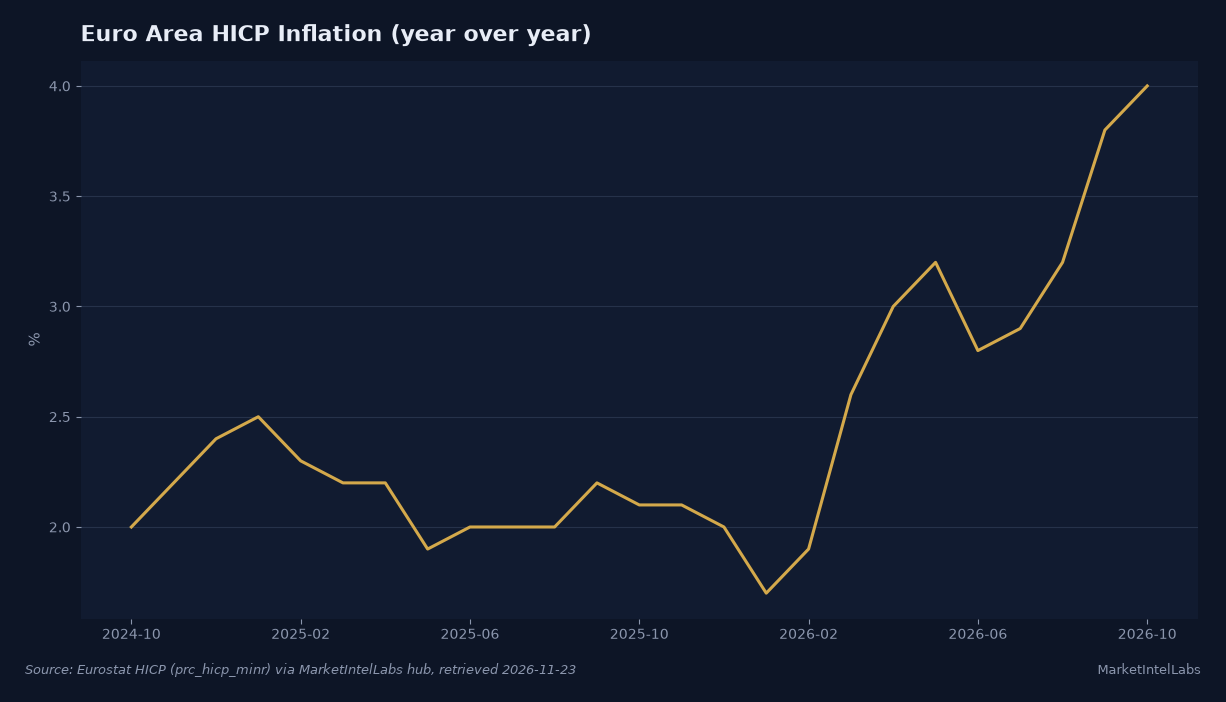
European Central Bank Governing Council decision 14:15 CET, October 29, kept the deposit facility rate at 2.5 percent and put a December move on the table, saying the rate path "depends on the assessment of the inflation outlook in light of incoming economic and financial data." Three weeks on, the euro area outlook has not brightened: euro-area HICP inflation ran at 4.0 percent in the year to October, up from 3.8 percent in September and 2.1 percent a year earlier, and the euro has slid to 1.10 against the dollar, its 19-month low.
Related reading: Bank of Japan holds rates at 1.25 percent, signals a December hike.
The Governing Council decision on October 29 was a hold, but the statement carried an unusually direct forward signal. It said the Council "is not pre-committing to a particular rate path" while adding that a decision on rates "would possibly already be taken at the December monetary policy meeting, if incoming data confirm the medium-term inflation outlook." What it left unsaid matters as much in the currency market: the Council did not repeat the easing bias of the summer, and it kept the door open for a hike rather than a cut.
The data since then have pushed in that direction. October HICP, published mid-November by Eurostat, put the annual rate at 4.0 percent, the highest since the index began climbing through 2026. The prior-year comparison is stark: 2.1 percent in October 2025. Energy and services are the two drivers of the step-up, and both sit ahead of the Council's target path. The hub page for the euro-area series, updated from the Eurostat table, carries the full run.
For the broader framework, see our Fed policy coverage.
Related reading: Norges Bank Holds Policy Rate at 4.5%, Keeps the Door Open to Another Hike.
Markets have repriced the currency for a harder bank in response. The euro traded near 1.10 against the dollar through the week, at the lows of its 52-week range, as the ICE dollar index held at 103.67. The DAX fell 2.6 percent to 24,803 over the week, and the iShares MSCI Eurozone ETF (EZU) dropped about 2.8 percent to 61.76, the equity side pricing a tighter euro-area credit impulse just as the currency weakens.
The policy debate widened this week. Reuters reported on November 18, citing two sources, that the Governing Council will discuss whether to raise the reserve requirement on banks when it meets in December, a tool that would offset some of the cost of a hike by clawing cheap ECB deposits out of bank funding. Bundesbank President Joachim Nagel said on November 20 that the bank will "likely need to act in December," but that inflation expectations remain anchored. The two remarks frame the meeting: the case for action rests on the inflation print, and the pushback rests on what a hike would do to growth and bank margins.
Related reading: Eurozone GDP Grew 0.4% in Q3, Inflation of 4.0% Tests ECB.
What the markets price versus what the document supports is a gap worth naming. The euro at a 19-month low embeds an expectation of at least one more tightening step, and European equity at the week's lows prices slower growth if that step arrives. The Council's own language is softer: it conditioned December on incoming data and framed the reserve-requirement idea as a discussion, not a decision. That is typical of the Governing Council, which rarely pre-commits, and it cuts both ways.
The next dated step is the Governing Council's December monetary policy meeting, where the statement's own wording points to a rate decision "possibly already" on the agenda. The reserve-requirement discussion is reported for this week. Watch the euro, the DAX and the euro-area curve into that meeting; the currency, not the equity index, has done the most repricing so far.
Related reading: Bank of England hike to 4.0% is the week's defining international print.
The reserve-requirement piece is the part a USD investor should read carefully. Europe's banks hold roughly three trillion euros of deposits at the ECB, of which a working threshold is exempt; lifting the requirement pulls reserves out of the free pool, tightens bank liquidity and, by extension, delivers some monetary tightening without a headline rate change. The Governing Council has used the tool sparingly, and its mechanics reward an interpretive read of the statement, not the headline. For a dollar-based reader the two legs point in the same direction: a harder ECB is supportive of European rate differentials against the US, yet the euro still sits weak, which says the dollar's strength, not euro-area fundamentals, is doing the yield work at 103.67.
This content is for informational purposes only and does not constitute financial advice. Past performance is not indicative of future results. Consult a qualified financial advisor before making investment decisions.
Get daily intelligence delivered
Create a free account for the Daily Brief every weekday and The Week Ahead every Sunday. No card required.