Defense Production Act Oil Determination: Federal Capital Targets U.S. Refining and Pipelines as SPR Falls to 282.7 Million Barrels


Washington invoked a Cold War financing authority on Thursday to put federal capital behind domestic petroleum production, refining and logistics, a move that hands producers, refiners and midstream operators a new tool for expanding capacity while private financing stays hard to come by. In a Presidential Determination published to the White House at 20:41 UTC, the President acted under section 303 of the Defense Production Act (50 U.S.C. 4533), finding that domestic petroleum production, refining and logistics capacity are essential to the national defense and that U.S. industry cannot provide them in a timely manner on its own due to constrained financing.
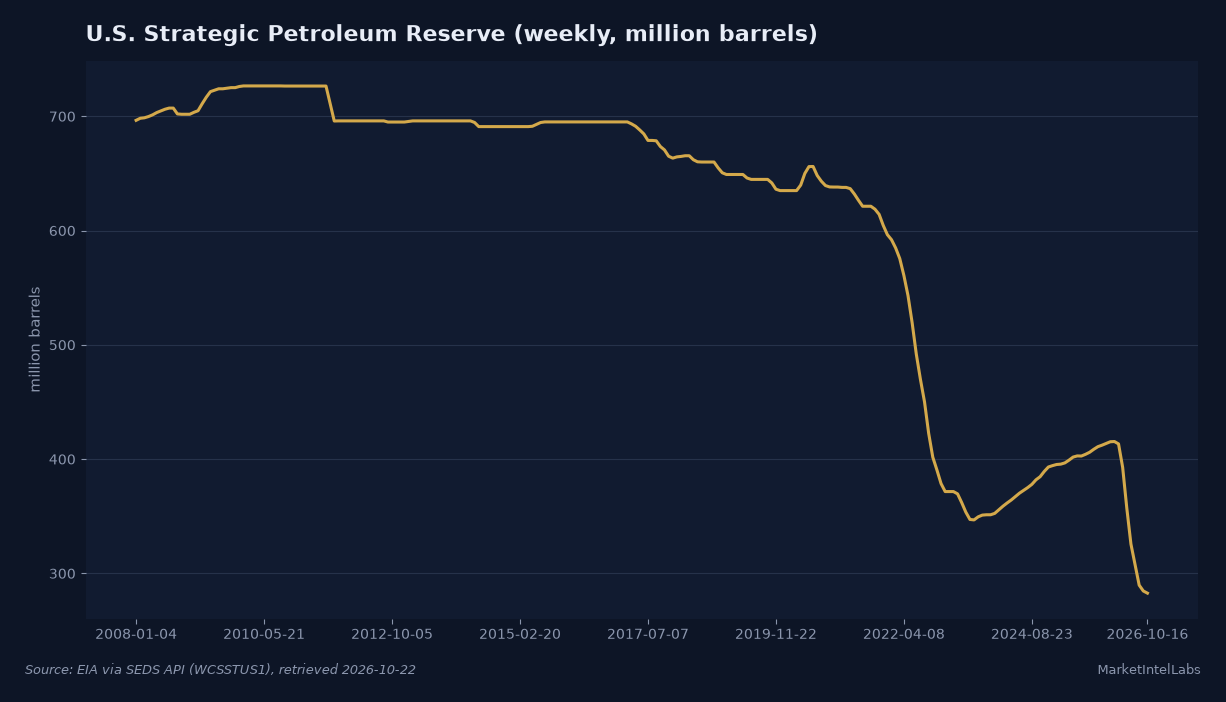
The determination lands with the Strategic Petroleum Reserve at 282.7 million barrels for the week ended October 16, its lowest level since the early 1980s after emergency releases, per EIA series WCSSTUS1. National average retail gasoline ran $4.28 a gallon for the week ended October 19, per EIA series EMM_EPMR_PTE_NUS_DPG, while ICE Brent for December delivery changed hands near $112.92 a barrel late Thursday.
Related reading: Hurricane Isaias shuts in 1.28M bpd of Gulf oil production: what it means.
What the determination actually does
Section 303 of the DPA is the law's expansion-of-capacity authority. It lets the government provide the tools needed to grow domestic production of goods deemed essential to national defense, including purchase commitments, loan support and direct purchases, when private industry cannot move fast enough on its own. The Thursday determination applies that machinery specifically to the oil complex: exploration and production, gathering and transmission pipelines, storage and marine terminals.
On the bottleneck, the finding is explicit. It states that without presidential action under section 303, industry cannot reasonably be expected to provide this capacity in a timely manner, citing constrained financing, long lead times, permitting and infrastructure bottlenecks, and supply chain limitations. That framing matters for markets because it identifies the precise failure the authority is meant to fix: not a shortage of oil in the ground, but a shortage of capital willing to be locked into long-lived, capital-hungry energy projects at current returns.
For the broader framework, see our crude oil coverage.
Related reading: G7, IEA release 100 million barrels to break the diesel squeeze.
It sits inside the standing national energy emergency declared by Executive Order 14156 on January 20, 2025, and invokes section 303(a)(7) to waive several of the act's procedural requirements for the purpose of expanding this capacity. The effect is procedural speed: fewer hoops between a decision to support a project and the money actually flowing into it.
Who stands to gain
The direct beneficiaries are the three layers of the domestic oil business named in the finding. Refiners, who have watched margins swing wildly through this crisis, gain a pathway to federally supported capacity projects at a time when financing new or expanded refining is scarce. Midstream operators sit in the middle of it: the pipelines, storage terminals and marine loading facilities the determination explicitly lists are the same assets shippers and refiners need to move crude to market and products to consumers.
Related reading: Crude Sheds Risk Premium Near $98; Diesel Crack Stays ~$106.
Upstream producers would gain a backstop for development capital in basins where drilling still needs a higher price or cheaper money to justify long-horizon investment, but only to the extent Washington follows the authority with executed purchase commitments and financing. The determination itself commits no dollars; as the administration signals, money moves only once specific projects are actually backed.
There is a market logic to naming logistics rather than stopping at the wellhead. The bottlenecks binding U.S. energy right now are not always in the ground. They are in the rights of way, the storage tanks and the export docks that connect supply to demand, and a financing tool that targets those chokepoints addresses a real physical constraint rather than subsidizing barrels the market is already producing.
Related reading: Ukraine's drones put 2 to 4.3 million barrels a day of Russia's refining offline. Diesel cracks are at records..
What it means for oil
For supply security, the direction of travel is clear. Federal purchase commitments and financing reduce the cost of capital for capacity expansion, which over time lowers the risk of structural tightness in U.S. crude, refining and transport. That is a supply-side cushion against the kind of shock the market is pricing now, with ICE Brent for December delivery still near $112.92 after a more than four-dollar swing on the day.
The levels put that move in context. Brent eased off the $130.18 daily spot high it printed on October 8 and the $135.51 spike on October 2, settling at $115.22 by October 20 (FRED, DCOILBRENTEU). Support sets up near the $112 zone where the December contract was testing late Thursday, with resistance back at $126 to $130, the shelf that capped the early-October recovery.
Positioning shows the crowd is not leaning on this story yet. CFTC weekly Commitments of Traders data for the report date October 13 put non-commercial funds in NYMEX WTI crude at 344,653 long contracts against 244,310 short, a net long of roughly 100,000 contracts, leaving room for speculative fuel if prices break higher. The forward curve carries the same reading: EIA's Europe Brent spot for the week to October 16 averaged $125.59 against a December contract near $112.92, a backwardation that pays for today's tightness while deferred months discount the capacity build.
On prices, the effect is longer-term rather than immediate. The authority creates a mechanism for future supply; it does not put a single barrel of crude into the Strategic Petroleum Reserve on Thursday. Analysts will watch whether the determination is followed by actual commitments, because the market's response to a standing authority differs sharply from its response to executed purchases. A financable supply expansion argues for a lower terminal price for crude over the coming years; a determination that never funds a project changes nothing about today's balance.
The determination is also a signal about policy priorities during an oil crisis. It is a structural, supply-side answer to a price shock, aimed at expanding domestic capacity rather than drawing down the reserve or leaning on short-term releases. That choice matters for how traders position: it suggests Washington sees tightness as a capacity problem to be grown through, not merely a spot crisis to be managed around.
What to watch next is concrete. Federal Register publication of the determination makes the terms official and docketed, and any specific purchase commitments or financial instruments executed under it will reveal which projects the government is actually backing. Until then, the practical question for the energy complex is whether a financing backstop shifts the hurdle rate on enough projects to move the forward production curve, and whether midstream and refining assets that have been starved for capital finally start to get it.
This content is for informational purposes only and does not constitute financial advice. Past performance is not indicative of future results. Consult a qualified financial advisor before making investment decisions.
Get daily intelligence delivered
Create a free account for the Daily Brief every weekday and The Week Ahead every Sunday. No card required.