US Trade Blacklist on Megaspeed: What the Entity List Changes for AI Chips


The U.S. trade blacklist on Megaspeed is a seven-name export-control rule, not a blanket ban on Alibaba or Nvidia. The Commerce Department's Bureau of Industry and Security filed its final rule for public inspection on November 23, 2026, naming Singapore-based Megaspeed International, Alibaba's Singapore subsidiary Apex Enterprise Solutions and five other companies. For every listed company, the rule calls for a license to export, reexport or transfer any item subject to the Export Administration Regulations, with applications reviewed under a presumption of denial. The named buyers and the license standard matter more than the label "blacklist": an exporter has to identify the transaction party before it knows whether this particular restriction applies.
The Federal Register's public-inspection record identifies this as document 2026-23999, a final rule filed November 23 and scheduled for November 25 publication. Its draft date field says the rule takes effect on the public-inspection date, but still contains placeholder text where the publication date and some savings-clause dates will appear. That distinction is worth keeping: the signed rule is visible now, while a final printed citation and completed calendar dates were not in the public-inspection text as of November 24. For the initial account of the news, see our report on the Megaspeed listing. This feature examines the rule's exact reach, the dispute about Apex, and the commercial questions it leaves open.
Related reading: BIS Remote-Access Semiconductor Rule: 12 Million TPP Makes Linked Data Centers a Licensing Question.
There is a priced company on each side of the transaction. Alibaba trades in New York as BABA and owns the named Singapore subsidiary, according to Reuters' account and Alibaba's response. Nvidia trades as NVDA and lists Megaspeed International as a preferred cloud partner on its own partner marketplace. Neither the BIS rule nor that marketplace page discloses how much Nvidia hardware the seven companies were due to buy after November 23. Calling the listing a known dollar loss for either issuer would turn a regulatory event into an invented earnings figure.
What the Seven-Name Rule Actually Says
BIS's final-rule text names three entities under Malaysia: MSFusion Sdn. Bhd., PT Megaspeed International and Speedmatrix Sdn Bhd. It names three under Singapore: Apex Enterprise Solutions (Singapore) Private Limited, Megaspeed International Pte. Ltd. and Swiftdata Pte. Ltd. The seventh, Megaspeed (Thailand) Co., Ltd., appears under Thailand. These are legal names and destinations, not a ban on every business operating in those countries. A supplier screening a contract needs to know which company is buying or receiving the equipment, not just where a server sits.
Related reading: Megaspeed investigation: Trump administration confirms probe of Nvidia-linked firm over chip diversion.
BIS's stated reason is a "significant risk" that the named entities are or may become involved in diversion of advanced computing commodities to unauthorized end uses or end users. BIS does not present in this short rule a transaction-by-transaction finding that each of the seven diverted a particular shipment. Nor does the rule identify a customer in China, publish the serial numbers of processors, or quantify suspected diverted equipment. Those omissions do not erase the decision, but they set the limit of what the decision itself proves.
The rule says its End-User Review Committee voted on the additions. Commerce chairs that interagency committee, joined by State, Defense, Energy and, where appropriate, Treasury. According to the same BIS text, additions require a majority vote; removal or modification requires unanimity. That procedural asymmetry is economically relevant. A company can dispute an entry, as Alibaba has done, but a public denial does not itself alter the list or the licensing standard.
Related reading: BIS stays the Affiliates Rule through 10 January 2027, resetting the export-control clock on chip names.
Why seven entries instead of one? BIS placed the different legal entities in their respective destination sections of the Entity List and applied the same all-items license requirement and presumption-of-denial policy. The record does not establish that all seven are wholly owned by one parent. Reuters described links among the companies and identified Apex as Alibaba's subsidiary with business ties to Megaspeed. A shared rulemaking is not a corporate organization chart. It should not be described as proof that Alibaba owns Megaspeed itself.
How an Entity List Entry Changes a Chip Transaction
The operative phrase is "all items subject to the EAR." BIS's rule does not limit its new license condition to a specified Nvidia accelerator model. Items subject to the Export Administration Regulations can include hardware, software and technology within U.S. export jurisdiction. If one of the seven named entities is a purchaser, intermediate consignee, ultimate consignee or end user in a covered export, reexport or in-country transfer, the exporter has a listing-specific license requirement. Other export restrictions may also apply; this one is additional, not a replacement for chip-performance rules or destination controls.
In its Entity List guidance, BIS tells exporters to screen transaction parties, identify the applicable license requirement and review policy, and not confuse an Entity List entry with a ban on all dealings with the listed company. A service arrangement without an item subject to the EAR cannot be pronounced illegal merely because the counterparty appears on this list. Conversely, shipping through a third-country company does not make a covered item disappear from U.S. jurisdiction. Both points matter to a cloud business that buys equipment, operates data centers and rents access to computing capacity.
A presumption of denial is a license-review standard, not a statement that the agency is prohibited from receiving applications. BIS can receive and evaluate a request; the starting policy is adverse to approval. Commercially, that means an exporter cannot assume a scheduled delivery proceeds as before. It must determine the item's jurisdiction, screen the named parties and obtain a license if required. A prospective buyer might still operate equipment already installed, subject to whatever other laws and contractual restrictions apply. This rule does not announce confiscation of the equipment already on site.
There is also a distinction between a named subsidiary and the whole group. The November 23 BIS rule lists Apex Enterprise Solutions (Singapore) Private Limited by name. The BIS rule does not list Alibaba Group Holding Limited or every Alibaba operating business. Reuters reported that Apex is Alibaba's Singapore subsidiary; Reuters reported that Alibaba disputed Apex's inclusion. Investors should therefore measure direct exposure at the named legal entity before extrapolating a constraint across the parent's entire cloud operation. The scope could change in later rules, but this document alone does not make that change.
The Federal Register text also answers who can change the designation. The End-User Review Committee can remove or modify an entry through its unanimous decision process; BIS publishes a resulting change in the Federal Register. BIS's Entity List FAQ describes how a listed party can submit a written request with supporting documentation for removal or modification. An appeal narrative in the press is not the same thing as a filed request, an agency vote or a published amendment. For now, the seven entries and their licensing terms are the relevant dated record.
Why This Listing Lands in the AI Chip Supply Chain
The action follows an existing argument over how advanced U.S. chips reach customers through data centers outside China. Reuters reported on November 23 that U.S. officials were examining suspected diversion tied to Megaspeed and described Apex's business relationship with the cloud company. That is reporting about an investigation and relationships, not an adjudication against the companies. The BIS rule itself offers a narrower and more precise claim: the seven names present a significant risk of diversion to unauthorized uses or users. It does not identify a completed illegal transfer by Apex.
A second BIS action provides useful regulatory context without changing the basis for this listing. On November 16, the agency said it had issued an interim rule addressing remote access to advanced semiconductors through data centers in third countries; the related Federal Register rule was published November 19. That policy addresses access to computing capacity when the chips remain in another jurisdiction. The November 23 Entity List rule instead attaches a licensing condition to transactions involving particular named entities. Physical shipment and remote use can interact in a cloud business, but the documents describe separate legal mechanisms. One should not be substituted for the other.
Nvidia's fiscal 2026 annual report shows why a license standard can have a commercial cost even before the seven companies' contract values are known. The company reported a $4.5 billion first-quarter fiscal 2026 charge related to H20 inventory and purchase obligations after U.S. licensing requirements hurt expected demand. It also said only about $60 million of H20 revenue had been generated under later licenses at the annual-report date. Those are historical figures for a different export-control episode, not estimated losses from Megaspeed. They show the kind of inventory and revenue sensitivities that investors might examine in subsequent disclosures.
Alibaba's stated position is different from BIS's risk assessment. In a November 24 statement reported by Reuters, Alibaba said the inclusion of Apex was "erroneous" because Apex had never diverted advanced computing chips subject to U.S. export restrictions, and said it would seek legal avenues to defend its rights and reputation. The BIS rule does not need to accuse Apex of a completed diversion to list it: the rule cites significant risk of being or becoming involved. That difference between a denial of past conduct and a government assessment of prospective risk is the center of the dispute.
What Alibaba's Numbers Show, and What They Cannot Show
Alibaba's November 19 September-quarter results make clear why an export-control decision involving one subsidiary attracts investors' attention. Its AI Cloud and Compute Services revenue was RMB60.973 billion for the quarter ended September 30, 2026, compared with RMB39.914 billion a year earlier, a reported 53% increase. AI-related product revenue was RMB17.918 billion, according to the same company earnings release. The figures describe a growing segment, not Apex revenue or Megaspeed purchases. Alibaba did not break out Apex as its own reported operating segment in that release.
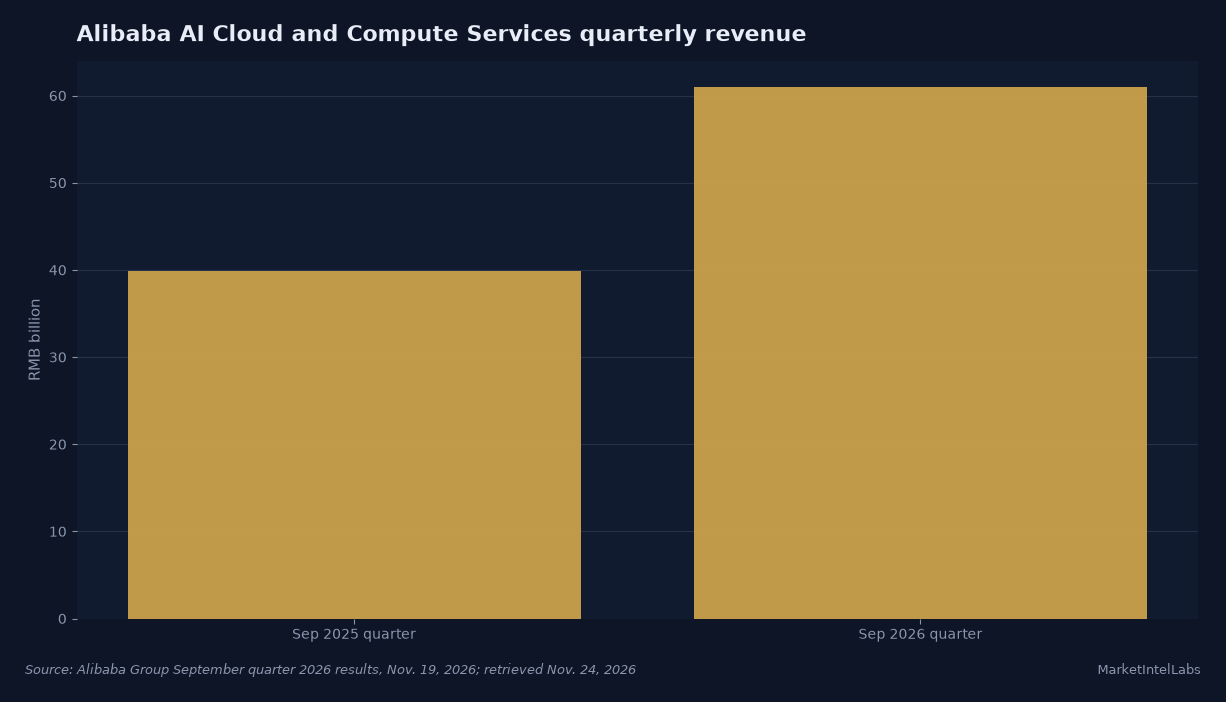
The chart tells us why cloud matters to Alibaba. It does not tell us what the blacklist will cost. It compares two quarterly revenue figures from Alibaba's November 19 results; it does not allocate any of that segment's revenue to Apex, to U.S.-origin chips, or to the seven listed companies. No public number in the BIS rule permits a subtraction from RMB60.973 billion to estimate revenue at risk. A serious estimate would require outstanding purchase commitments, the legal entities on contracts, equipment specifications, licensing status and where the compute is delivered. Those items are not disclosed together in the available record.
Alibaba also said revenue from external AI Cloud and Compute Services customers rose 64% year over year and recurring revenue from those customers, excluding compute-equipment solutions, rose 67%. That growth makes access to processors a material strategic question, yet it does not prove immediate disruption to the customers already served. The company announced its own T-Head Zhenwu V900 chip with a commercial release scheduled for the first quarter of 2027. A planned proprietary chip can diversify future supply, but a date for release is not evidence that it can replace restricted U.S. accelerators in every workload now.
What Would Change the Assessment Next
The next document to check is the Federal Register's scheduled November 25 publication of document 2026-23999. Readers should compare the published effective date, the completed savings clause, the seven legal names and their license-review columns with the public-inspection version. The public-inspection filing already establishes that a final BIS rule was available on November 23; publication will supply the settled page citation and replace any placeholders. Any later BIS amendment would be a separate event.
The second checkpoint is an actual agency decision on a removal or modification petition, if one is filed. Under the BIS description of its End-User Review Committee, a change takes a unanimous decision and is reflected in a later public rule. An Alibaba statement promising legal avenues does not supply a timetable for that process. A court challenge, if filed, would have its own docket and relief; the current record contains no court order setting aside the listing. Until one of those documents exists, a projected reversal date is conjecture.
The commercial checkpoint is issuer disclosure. Alibaba could quantify Apex's arrangements and any changes to cloud capacity commitments. Nvidia could identify whether listed partners affected orders or inventory, as it did when discussing earlier H20 restrictions in its annual report. Export-license decisions themselves are generally not laid out as a complete public sales ledger, so silence in a quarterly filing would not prove no commercial effect. The more reliable measure is a specific reported commitment, charge or revised outlook, tied to the listed legal entities rather than to the entire AI sector.
Frequently Asked Questions
Is Megaspeed banned from buying all Nvidia chips?
The BIS rule requires a license for exports, reexports or in-country transfers of all items subject to the EAR when a named entity, including Megaspeed International, is a party to the covered transaction. License applications face a presumption of denial, but the document does not say all commercial dealings are forbidden, nor does it cancel every piece of equipment previously installed. The answer for a specific chip depends on jurisdiction, parties and licensing.
Is Alibaba itself on the U.S. Entity List?
The November 23 BIS final rule names Apex Enterprise Solutions (Singapore) Private Limited, identified by Reuters and Alibaba as an Alibaba subsidiary. It does not name the listed parent Alibaba Group Holding Limited. The distinction matters for screening contracts and for estimating exposure; a named subsidiary is not the same thing as a designation of every affiliate.
Did BIS prove that Apex diverted chips to China?
No such completed shipment is established in the published public-inspection text of this rule. BIS cites a significant risk of the seven companies being or becoming involved in diversion to unauthorized end uses or end users. Alibaba disputes Apex's inclusion and says Apex has never diverted restricted advanced computing chips. Reuters' investigation reporting should not be recast as a judicial finding.
When does the Megaspeed listing take effect?
The Federal Register says BIS filed document 2026-23999 for public inspection on November 23, 2026, and scheduled publication for November 25. The public-inspection text says the rule is effective on the public-inspection date but retains placeholder wording where the exact date should appear. For a shipment or licensing decision, verify the final published rule and its completed savings-clause dates rather than relying on an unfinished placeholder.
Can Alibaba get Apex removed from the list?
BIS's Entity List FAQ allows a listed party to request removal or modification with supporting documentation. The final rule says the End-User Review Committee needs unanimity to remove or modify an entry, and a resulting change is published in the Federal Register. Reuters reported that Alibaba would pursue legal avenues, but that statement establishes no favorable agency decision or published amendment.
The next meaningful change will be documentary, not rhetorical: a completed Federal Register citation, a later modification, a court ruling or a quantified company disclosure. Until then, the rule defines a narrow but consequential chokepoint in the AI supply chain: seven named entities, all items subject to the EAR, and licenses reviewed under a presumption of denial. The balance-sheet cost is still unknown.
This content is for informational purposes only and does not constitute financial advice. Past performance is not indicative of future results. Consult a qualified financial advisor before making investment decisions.
Get daily intelligence delivered
Create a free account for the Daily Brief every weekday and The Week Ahead every Sunday. No card required.