Druzhba pipeline strikes keep Russia's diesel squeeze in place as US pump prices hold at $6.28, up 73% year over year (EIA w/e Oct 19)

Ukraine's campaign against Russian oil infrastructure broadened from refineries to a major trunk pipeline this week, and the diesel market is already pricing the risk. Tambov Governor Yevgeny Pervyshev confirmed Ukrainian drones struck the region overnight on October 19-20, sparking a fire, and OSINT analysts (the Exilenova+ monitoring project and the Telegram channel Astra) attributed the blast to the Nikolskoye linear production and dispatching station.
That node is a key station on the Druzhba pipeline with capacity of up to 300,000 tons of oil a day, per Meduza's October 20 reporting. Pervyshev declined to name the target; the fire itself he confirmed, and nobody was reported injured.
Related reading: Russia's product squeeze: ULSD crack near $92, loadings -81%.
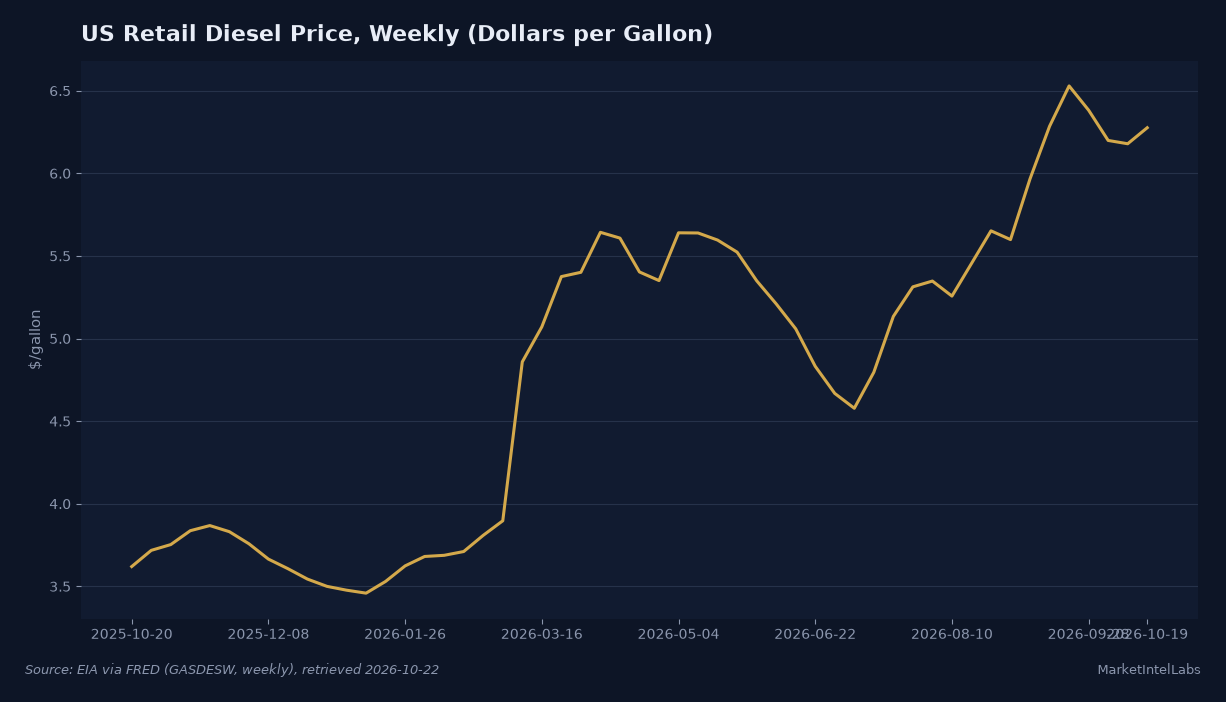
The strike extends a widening pattern on the tracker at a moment when Russia's role as the world's second-largest diesel supplier looks fragile. The drone campaign has repeatedly taken aim at refineries, and this week added the Druzhba node to a list that already includes the Baltic Petersburg terminal fire of October 18 and the October 15 strike on the Ryazan refinery. Every hit takes either refining or trunk-logistics capacity out of the system or forces a reroute, and that is where the product market is paying: US retail diesel printed $6.276 for the week of October 19, up 73% from a year earlier, according to EIA (GASDESW) data and MarketIntelLabs' freight-cost desk. That level sits 3.9% below the 52-week high of $6.529 set on September 21, so the climb is steep but not an all-time surge.
It is worth separating this Russian supply thread from the Middle East escalation that lifted Brent near $111 and WTI toward $99 this session. Those crude barrels carry Gulf and Strait-of-Hormuz war-risk; this story is about distillates and the physical logistics of moving Russian product out. The two can stack, and a market that already carries a freight premium near $20 a barrel has little room to absorb a fresh disruption to either route.
For the broader framework, see our crude oil coverage.
Related reading: Ukraine's drones put 2 to 4.3 million barrels a day of Russia's refining offline. Diesel cracks are at records..
The main offsetting force is a US waiver that keeps more Russian diesel flowing into premium markets, which is why crack prices have not broken further despite the strikes. That cap is a policy decision rather than a market clearing, which cuts both ways: it can hold and keep the squeeze contained, or it can be tightened just as the tracker adds another offline node. The two-sided picture, not a one-way breakout, is what the tape is pricing.
Watch whether the campaign keeps moving down the trunk toward further Druzhba nodes or export terminals, and whether the waiver holds through the winter. If sustained export flows are actually disrupted, diesel has room to reprice from a level already 73% above a year ago; if the waiver or diplomacy caps the risk, the squeeze can ease as quickly as the crude bid faded. This is an incremental update on a standing thread, and the strikes are the cause.
Related reading: Diesel Prices Hold Records as Russia's Ban Locks Out 10% of Seaborne Trade.
Related reading: Ukraine's drones knocked out nearly a third of Russia's refining. Diesel just hit a record because of it..
This content is for informational purposes only and does not constitute financial advice. Past performance is not indicative of future results. Consult a qualified financial advisor before making investment decisions.
Get daily intelligence delivered
Create a free account for the Daily Brief every weekday and The Week Ahead every Sunday. No card required.