Treasury's A7 designation blocks a $91.5B shadow payment web tied to Iran oil

The U.S. Treasury designated the A7 Network a significant transnational criminal organization on October 1, a sanctions escalation aimed at a Russia-tied shadow banking web that moved an estimated $91.5 billion and has helped Iran sell oil outside the dollar system. Treasury's action under Operation Economic Outcast pairs an Office of Foreign Assets Control (OFAC) designation with a Financial Crimes Enforcement Network (FinCEN) proposed rule that would prohibit U.S. transmittals of funds tied to A7's Sub-Agents, plus an alert flagging the network for U.S. financial institutions. The step is the first to sanction the network itself rather than a handful of its entities, and it lands a direct hit on a payment lane that links Iranian crude sales to the shadow fleet, Russia's parallel trade finance, and a blocked ruble-backed token.
What got blocked, in practical terms, is the plumbing A7 used to launder illicit payments as ordinary trade. Treasury describes A7 as a network of Sub-Agents, third-country companies purpose-built to receive and remit funds while falsifying trade documents and goods descriptions. Since money is fungible across these shells, the designation reaches not only A7 itself but any entity owned directly or indirectly 50% or more by a blocked person. That means U.S. banks, money transmitters, and crypto firms must freeze and report any A7-linked exposure, and non-U.S. parties face the same exposure rules if they cause a U.S. person to touch the network, wittingly or not.
The size of the system underscores why Treasury moved up the chain. FinCEN's probe put A7 Sub-Agent transaction volume at more than $17 billion between January 2025 and June 2026. The network's own claim, cited in the rulemaking, was more than 2,000 transactions a day at a total volume above 7.5 trillion rubles, about $91.5 billion or roughly 13% of Russia's 2025 foreign trade. Treasury states A7 has channeled this web to Iran's Islamic Revolutionary Guard Corps, proxies such as Hamas, cybercriminals, and procurement actors seeking restricted goods. It has also been linked to Nobitex, Iran's largest digital asset exchange, which OFAC designated on June 2, 2026.
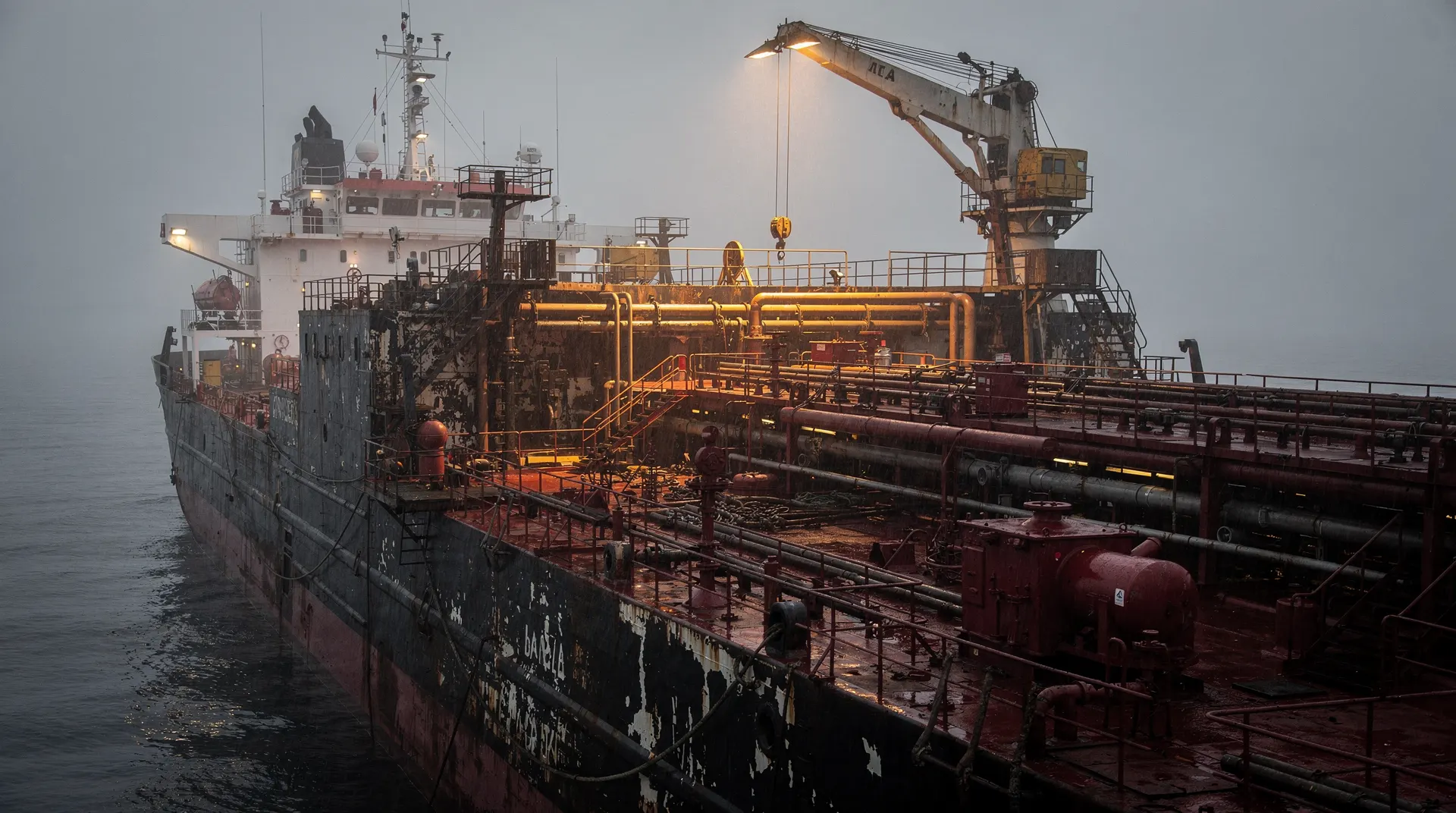
For commodities traders the oil side is the live thread. Treasury says one A7 Sub-Agent transacted directly with firms tied to Iran's shadow fleet, the web of tankers and front companies that moves Iranian crude against sanctions, and that this Sub-Agent and its sister company received nearly $140 million from entities involved in Iranian sanctions evasion. A separate Sub-Agent moved roughly $1.6 million to a company linked to Iranian evasion and weapons procurement. The A7A5 token, a ruble-backed stablecoin issued by the previously blocked Old Vector LLC, gives the network an alternate rail outside correspondent banking, and its designation now reads as part of a broader squeeze on tokenized sanctions workarounds.
There are two ways to read the market consequence, and both deserve weight. The enforcement case is straightforward: OFAC blocks carry strict-liability civil penalties, automated screening is cheap, and dollar-settled institutions now have a clear red-flag list from FinCEN's alert. That raises the compliance cost of doing business with anyone in the A7 orbit, toward the point where legitimate trade re-routes. The evasibility case is just as real. A7 is a distributed network of corporate shells in third countries, it pivots identity to mask its operators, and prior blocks of individual firms may have pushed volume further into the Sub-Agent layer rather than stopping it. Sanctions can price a network out of the formal dollar system even when they cannot arrest every node.
The next dated catalyst is procedural but material for the oil complex: the FinCEN proposed rule takes effect only after a public comment period that runs 30 days from Federal Register publication, so the compliance floor firms must build to has not yet gone fully live. In the meantime the OFAC block is immediate, and the effect on Iranian discount flows, and on the spread between those and benchmark crude, is what traders will watch. Treasury says the message is that anyone who builds illicit finance infrastructure for America's adversaries loses access to the dollar system, which is the most direct statement yet about where the enforcement line sits.
Related coverage: Treasury targets Iran auto and rail giants as oil revenue nears zero, OFAC's September 28 Venezuela oil licenses open trade, not a free payment route, Diesel is the story: Russia and China cut fuel, not crude. Follow our oil coverage for the crude-side read.
Sources: U.S. Treasury press release, October 1, 2026; OFAC recent actions, October 1, 2026; FinCEN Notice of Proposed Rulemaking; FinCEN Alert; Treasury block of A7 LLC and Old Vector LLC, August 14, 2025.
This content is for informational purposes only and does not constitute financial advice. Past performance is not indicative of future results. Consult a qualified financial advisor before making investment decisions.
Get daily intelligence delivered
Create a free account for the Daily Brief every weekday and The Week Ahead every Sunday. No card required.