SpaceX Tesla Merger: FT Reports Director Talks, but No Deal Is Filed

Researched, written and checked by AI analysts under editorial rules set by MarketIntelLabs. No person reads each article before it publishes. Automated gates check sources, dates and figures. MarketIntelLabs LLC is responsible for everything published here. Corrections are logged publicly. How we work · Corrections and counts

A SpaceX Tesla merger is still a reported negotiation, not an announced transaction. The Financial Times reported on November 24 that five directors have been assigned to separate committees to negotiate a possible all-stock combination. Reuters relayed the FT account and said it could not independently verify it. For Tesla shareholders, the question is not whether two companies run by Elon Musk can be put under one roof. It is what fraction of the resulting company a Tesla share would represent, who would command its votes, and whether independent directors could show that the exchange is fair. Our earlier news report on Musk, a possible SpaceX deal and the shareholder vote covers the immediate announcement cycle; this feature tests the mechanics against the public filings.
Reuters said the FT named Tesla directors Robyn Denholm, Kathleen Wilson-Thompson and Jack Hartung, and SpaceX directors Roelof Botha and Randy Glein. The reported advisory lineup is Morgan Stanley and Goldman Sachs for SpaceX and Evercore for Tesla. Reuters said Tesla and SpaceX did not immediately respond to its requests for comment outside regular business hours. Tesla’s 2026 proxy identifies the three Tesla directors, but the proxy describes Denholm and Wilson-Thompson on a 2025 compensation committee, not a newly disclosed merger committee. As of November 24, the issuer filings and investor materials reviewed here do not establish a signed SpaceX Tesla merger agreement, its exchange ratio or those reported merger committee appointments.
Related reading: Tesla Stock Jumps 3.8% on Merger Speculation: Q3 Earnings Loom Wednesday.
That distinction matters to valuation. An Investing.com account carried by Yahoo Finance calls the reported prospective transaction a $3.5 trillion merger, citing the FT. The number is a description of a potential combined equity value, not an offer to pay Tesla investors $3.5 trillion, a cash payment or an agreed price per share. With neither an agreed consideration schedule nor a definitive merger agreement in the public record, a stockholder cannot calculate the actual consideration from the headline.
What Tesla and SpaceX have disclosed
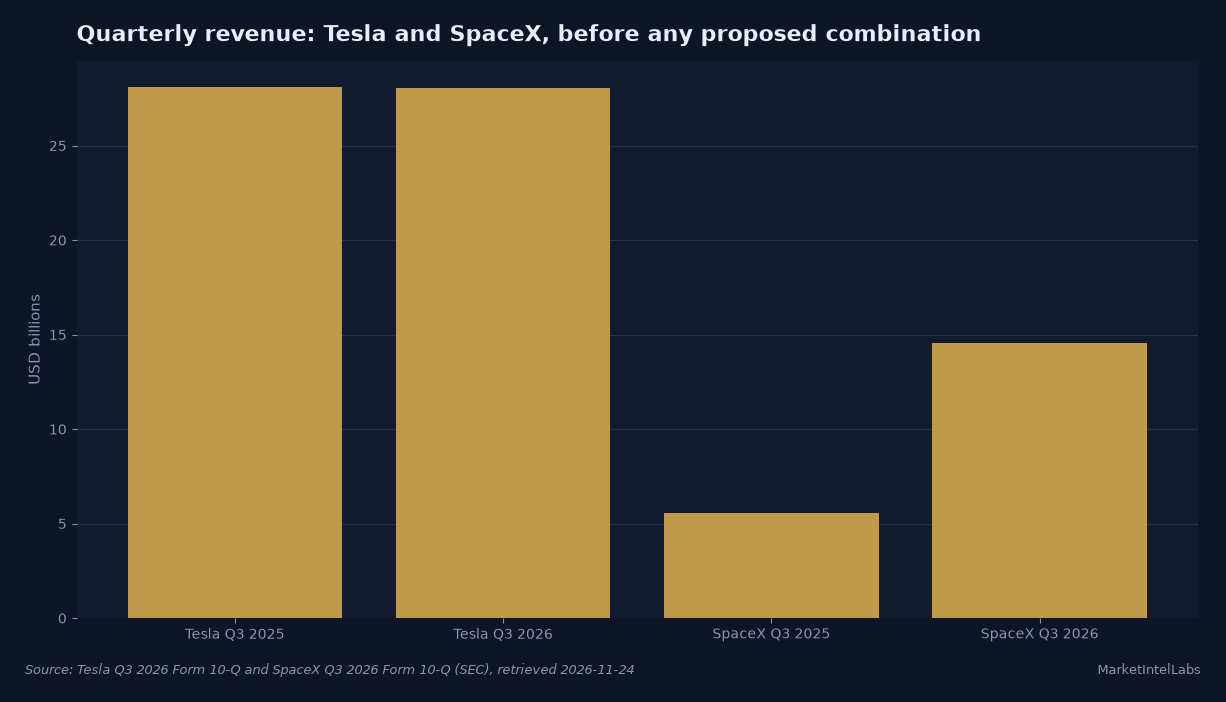
Tesla’s quarter ended September 30, 2026 gives a baseline for what existing investors own. Its Form 10-Q reports $28.046 billion of quarterly revenue, down slightly from $28.095 billion a year earlier; automotive revenue was $20.560 billion and energy generation and storage revenue $2.881 billion. Operating income was $718 million versus $1.624 billion in the comparable quarter. The market can argue about Tesla’s future autonomy economics, but the filed operating business remains dominated by automotive sales. A merger would add a distinct launch, broadband and computing exposure rather than simply expanding the same car company.
Related reading: Intel shareholders sue chipmaker over 29% stock plunge, shares fall further.
SpaceX’s own September 2026 Form 10-Q reports $14.575 billion in third-quarter revenue against $5.576 billion a year earlier. Its segment breakdown lists $1.767 billion from Space and $5.248 billion from Connectivity, with the SI category much larger in the quarter. These are revenue categories for a business with its own assets, contracts, financing needs and disclosure regime. The release is useful for checking scale, not for inferring the price Tesla should pay. SpaceX’s October share count and its voting classes make a quoted company valuation especially poor shorthand for how any combined company would be governed.
The original chart below compares reported quarterly revenue in the two filings, not market capitalization. The figures belong to different issuers and their accounting classifications should not be treated as interchangeable profit streams. It deliberately avoids an invented “combined 2027 revenue” series: the companies have published no merger forecast, and elimination of intercompany transactions would be necessary if they combined. One useful interpretation is that SpaceX has become too large to treat as a small add-on to Tesla’s existing accounts. Another is that the faster revenue growth does not by itself establish a fair exchange ratio.
Tesla’s 2026 proxy gives the first governance anchor. It lists Musk as beneficially owning 699,580,882 shares, or 19.8% of the class on the proxy’s measurement date. Beneficial ownership is a proxy-defined measure, not a live vote count for November 24; new awards, dispositions and the final record date can change it. The same proxy describes a 2025 special committee of Denholm and Wilson-Thompson appointed to consider Musk’s compensation. A compensation mandate does not automatically carry over into authority to negotiate an acquisition of another Musk-led company. A fresh board resolution, adviser engagement and actual conflict protocols would be material new facts.
SpaceX’s registration statement filed with the SEC provides the second governance anchor. Its S-1 says Musk will beneficially own a majority of voting power after the offering and expects SpaceX to be treated as a controlled company. That document also says the Class B stock elects a majority of SpaceX’s board while its holder retains the required Class B voting majority. The September 2026 SpaceX 10-Q states the mechanical rule: Class A gets one vote per share, Class B gets ten, and Class C ordinarily has no vote. The S-1’s blank post-offering ownership percentages should not be filled with a guessed 84% figure, even though a secondary report quotes such an estimate.
The exchange ratio is the stock question
An all-stock merger, if agreed, would allocate shares in a surviving issuer or a new holding company to the owners of each predecessor. The relative values assigned to Tesla and SpaceX determine the exchange ratio. If more shares are issued to SpaceX holders than Tesla holders expect, existing Tesla investors own a smaller fraction of the enterprise even if they receive no immediate cash bill. If SpaceX is assigned too low a value, its holders have the opposite complaint. This is why a quoted combined market value tells an investor almost nothing about the bargain without a share count, an agreed valuation for each side and a defined voting structure.
Consider a deliberately hypothetical illustration, not a reported proposal. Suppose the two sides were each assigned half of a new company’s equity on a fully diluted basis. An existing Tesla shareholder’s economic fraction would be halved relative to their fraction of Tesla alone, but they would gain a claim on SpaceX operations. Suppose instead Tesla holders received two-thirds and SpaceX holders one-third. Tesla dilution would be less, while the perceived benefit from adding SpaceX would have to support a higher relative Tesla valuation. Neither example tells you which mix is fair. It shows why shareholders need the same per-share cap table that the advisers would model, including options, convertible securities, compensation awards and any special voting class.
There is a second, separate transfer: who gets to choose the directors and approve later transactions. If SpaceX Class B supervotes were carried intact into a combined company while Tesla holders received ordinary shares, Musk’s voting percentage could rise far more than his economic share. If the supervotes were converted to one vote each or retired in a new holding company, the result could be very different. Reuters reported that a combination could give Musk majority control, but no published merger terms show how that would occur. SpaceX’s existing ten-to-one rule cannot simply be applied to Tesla shares to calculate a future control percentage.
For an investor assessing Tesla stock, three documents matter more than a speculative price chart. First is a definitive merger agreement with the exact exchange formula, any collar that changes the ratio with share prices, and termination provisions. Second is the proxy or registration statement setting out conflicts, fairness analysis, ownership and governance after closing. Third is the shareholder-vote notice establishing which holders can vote and the applicable threshold. The SEC’s published Form S-4 is a template for registering securities issued in a merger; whether these parties use that form or another structure depends on the deal they actually propose. Today there is no disclosed exchange ratio to insert into a Tesla per-share estimate.
The balance of risk is asymmetric for different shareholders. A Tesla investor seeking exposure to SpaceX might welcome a stock deal rather than an outright cash purchase funded with debt. SpaceX investors may see Tesla’s public listing and distribution as useful. But an inflated price paid in Tesla stock, opaque private-company asset marks or retained supervoting rights could make the same deal costly for Tesla minorities. The comparison is not “space versus cars.” It is the incremental cash flows and liabilities acquired per unit of ownership and voting power surrendered.
Why five directors would matter, if confirmed
The FT’s five-director account, as reported by Reuters, is plausible as a process for two related-party issuers, but plausibility is not a board announcement. Tesla’s proxy names Denholm, Wilson-Thompson and Hartung as directors and explains the earlier compensation committee’s mandate. SpaceX’s SEC filings identify its own share structure. Neither the Tesla proxy nor those earlier documents verifies that all five people accepted a specific merger negotiation assignment on November 24. Until the parties disclose a charter, minutes, or a signed agreement, describe their reported roles as the FT’s account, not as an action established in an issuer filing.
Why independent directors? Musk is at once Tesla’s chief executive and its largest disclosed individual beneficial owner, while the SpaceX S-1 says he has majority voting power there. An adviser whose client is one company cannot erase the other side’s conflicts. A credible process would explain which directors are disinterested, which side chooses each adviser, who sets the range of acceptable valuations and whether Musk is excluded from bargaining. A committee can commission analyses and say no; merely calling one “independent” is not a finding that the price is fair. The published terms and their treatment of the votes are the tests.
Reuters reported, following the FT, that the purported committees have hired Morgan Stanley and Goldman Sachs for SpaceX and Evercore for Tesla. Those are not independently established engagement facts in the public filings reviewed here. It is possible for banks to work on preliminary models without an agreed transaction or without a fairness opinion addressed to shareholders. A future filed opinion would require readers to inspect assumptions, fee arrangements, financial projections and the transactions it compared, not only the opinion’s concluding range. The deal could be restructured or abandoned before any such filing.
There is an additional reason a retail investor should resist treating the merger as a pure ownership story. SpaceX’s 10-Q reports $51.294 billion in cash and cash equivalents as of September 30, and the quarter’s SI segment reflects an expanding business mix. Tesla has its own capex priorities in vehicles, autonomy and energy. Consolidating the companies would force a combined board to allocate capital among those activities. A higher share price on merger hopes can coexist with worse per-share economics if future spending needs rise faster than the added earnings power.
A related complication is existing economic exposure. Tesla’s September 2026 10-Q includes an unrealized gain on a SpaceX equity investment in its financial statements. That line does not specify a merger price and should not be confused with ownership of the whole company. In any agreed combination, the treatment of existing stakes and transactions between related entities would need to be described clearly so readers do not count the same SpaceX interest twice. A consolidated revenue headline without eliminations could make both growth and valuation comparisons look stronger than they are.
Votes, regulators and the calendar
Yahoo Finance’s syndicated Investing.com story says a Tesla special meeting would be necessary and suggests a vote requiring more than half of all possible votes. That threshold is a reported characterization, not a substitute for the companies’ charters, the chosen transaction structure or definitive voting documents. The difference between a majority of votes cast and a majority of outstanding shares can be decisive: nonvoting shares affect the latter denominator. A proposal that changes control rights might also raise questions about class votes. Shareholders should read the actual meeting notice rather than extrapolate from the election or compensation votes in an older proxy.
Regulatory review is another clock, separate from shareholder approval. The Federal Trade Commission’s premerger notification guide explains that covered transactions require filing under the Hart-Scott-Rodino Act and generally cannot close before the statutory waiting period has run or early termination is granted. It also explains that a request for additional information can extend the review. Those are general process rules, not evidence that a filing has been made or that regulators have reached a view on this combination. Reuters, citing the FT, says the parties are studying potential overlap and government issues, including defense work and Tesla’s China exposure. Those risk descriptions remain reporting about a proposal, not announced objections from an agency.
If a deal were announced in December, an announcement would be the start of public scrutiny, not the closing date. An agreement could be contingent on financing or other conditions, regulatory clearance and shareholder votes. The timeline of filings, a vote and any review is too uncertain to call year-end a completion deadline. Yahoo Finance’s account says people involved in the reported talks cautioned that committees were not yet close to agreement. Reuters cites a prior Bloomberg report that a deal could be announced as early as December. “Could” is the operative word; neither issuer has published a December timetable.
The incoming Congress is also a date on the political calendar, not a statutory merger approval committee. The 20th Amendment sets the new Congress’s term to begin at noon on January 3, unless a different day is appointed by law. Hearings, requests for documents or legislative scrutiny after that date might affect the political environment of a defense contractor and a carmaker with overseas production. They do not replace the FTC’s merger review, SEC disclosure obligations or the parties’ corporate votes. We have not found a filed congressional action specific to a SpaceX Tesla merger and will not describe one as scheduled.
The positive case is straightforward but conditional: Tesla shareholders might acquire a proportionate stake in an already operating launch and connectivity business while giving a combined issuer more ways to fund capital-intensive projects. SpaceX’s filed revenue growth provides evidence of a substantial separate business, while Tesla’s filed operating income shows why using Tesla shares as currency would demand care. The negative case is equally concrete: a high valuation for the contribution, conflicts around Musk and asymmetric voting rights could dilute Tesla’s share of future profits or weaken the ability to challenge management. Neither case has a probability attached until there are terms.
For investors watching Tesla stock now, price reactions can tell you the market values the optionality of a deal. They cannot tell you whether the final bargain would benefit Tesla owners. Our earlier analysis of SpaceX stock, AI spending and merger talk shows how separate operating questions can be bundled into one trade. The next useful signal is not another headline about potential scale; it is a dated issuer announcement that describes committee membership, an agreed share exchange or a decision to end talks.
Frequently Asked Questions
Is the SpaceX Tesla merger official?
No definitive agreement was identified in the Tesla and SpaceX SEC filings and issuer materials reviewed as of November 24, 2026. The Financial Times reported merger talks and director assignments, and Reuters relayed that account while saying it could not verify it independently. A reported negotiation is not a signed deal or a closing.
Would Tesla shareholders receive SpaceX shares?
Not necessarily. In a hypothetical all-stock transaction, investors could receive shares in a surviving company or new holding company, or remain holders of a renamed combined issuer. Reuters reported that advisers were working on an all-stock structure, citing the FT. No public exchange ratio, consideration schedule or surviving legal entity has been disclosed by the companies.
Would Elon Musk control the combined company?
That cannot be calculated without the transaction’s cap table and voting terms. Tesla’s 2026 proxy lists Musk at 19.8% beneficial ownership on its measurement date. SpaceX’s 10-Q gives its Class B shares ten votes each, and its S-1 says Musk retains majority voting power at SpaceX. Whether those votes survive a merger is an unanswered deal term.
Will Tesla stock be diluted by a SpaceX deal?
An issuance of new shares could reduce existing Tesla owners’ percentage of the combined issuer. That dilution could be offset economically if the acquired assets are worth the ownership surrendered, but there is no disclosed exchange ratio or valuation from which to judge. A higher trading price before any agreement is not proof of favorable per-share terms.
When could a SpaceX Tesla merger be announced?
Reuters says Bloomberg reported a possible announcement as early as December 2026; Yahoo Finance’s syndicated FT account describes year-end as a possible target but says negotiators were not close to agreement. Neither issuer has committed to that timetable. An announcement would still be distinct from a shareholder vote or a closing.
Watch for a dated agreement and the first filing that puts a number beside each side of the exchange. Without both the economic split and the voting split, a $3.5 trillion headline is not a valuation of a Tesla share.
This content is for informational purposes only and does not constitute financial advice. Past performance is not indicative of future results. Consult a qualified financial advisor before making investment decisions.
What we don't know yet
- Neither company has disclosed a signed merger agreement or exchange ratio.
- Neither issuer filing reviewed here confirms the FT-reported membership and remit of the merger committees.
- The parties have not specified a voting structure for a combined company or a date for a Tesla shareholder vote.
Get daily intelligence delivered
Create a free account for the Daily Brief every weekday and The Week Ahead every Sunday. No card required.