ssa maximum taxable earnings 2027: $192,300 wage base


The Social Security taxable maximum for 2027 is $192,300. That is the most annual earnings on which a worker pays the 6.2% Social Security payroll tax, according to the Social Security Administration's contribution and benefit base table. It rises from $184,500 in 2026. An employee earning at least the new maximum throughout 2027 would pay up to $11,922.60 in Social Security tax, compared with $11,439 on the same basis in 2026. The difference is $483.60 if earnings reach both ceilings.
That does not mean every worker's tax bill rises by $483.60. Someone earning $100,000 in either year remains below both ceilings, so the taxable maximum itself changes none of that worker's Social Security withholding if pay stays the same. The change matters most to workers whose annual earnings cross the old ceiling. Medicare withholding does not stop at $192,300: it has a separate tax and no wage cap. The answer is a tax boundary, not a limit on what someone may earn.
The agency published the 2027 amounts in its October 26 Federal Register notice. That document also sets a 3.6% cost-of-living adjustment for benefits payable in January 2027. The two changes arrive together, but they are calculated from different measures. For a closer look at the benefit side, our analysis of the 2027 Social Security COLA explains what the increase means for a monthly check; this feature examines the wage side.
How the wage base reached $192,300
The wage base has climbed for years, but not in a straight line. The SSA historical series puts it at $128,400 in 2018, $137,700 in 2020 and $147,000 in 2022. It then rose to $160,200 in 2023, $168,600 in 2024, $176,100 in 2025 and $184,500 in 2026. Next year's $192,300 is a continuation of that climb, rather than a new payroll tax rate or a special surcharge.
A household can feel the change even though the statutory percentage stays at 6.2%. Take an employee whose covered wages reach $192,300 in each of the two years. In 2026, only the first $184,500 are subject to employee Social Security tax; in 2027 the additional $7,800 are too. Multiplying that added taxable slice by 6.2% yields $483.60 more in annual employee Social Security withholding. This is a comparison holding wages constant at the higher level, not a forecast of anyone's paycheck.
The difference is smaller if pay ends between the two limits. At $188,000 of covered pay, for example, the newly taxable slice in 2027 would be $3,500, and 6.2% of that slice is $217. Earnings, payroll timing and employment arrangements can differ, so examples should not be mistaken for a personalized tax calculation. A payroll statement is the place to compare actual year-to-date covered wages with the applicable limit.
Why does the cap move if the tax rate is unchanged? Congress established a formula under which the taxable maximum ordinarily follows wage growth. That reflects a choice to update the dollar boundary as national earnings rise, while leaving the rate as a separate policy decision. The agency's guide to wage-indexed amounts makes clear that the wage base is one of several Social Security parameters tied to average wages. Benefit COLAs, by contrast, use a consumer price measure.
The wage formula and what it does to a paycheck
SSA's 2027 determination worksheet shows the calculation rather than simply publishing a rounded number. It multiplies the 1994 base of $60,600 by the ratio of the 2025 national average wage index, $72,800.33, to the 1992 index, $22,935.42. The result is $192,353.14, rounded to the nearest $300 to produce $192,300. The formula also prevents the base from falling below the prior year's level under the conditions the agency describes.
The index year lags the tax year by two years. The SSA national average wage index release says the 2025 index rose 4.23% from 2024. That wage measure informs the 2027 base even though a worker will encounter the new withholding limit on 2027 pay. It is not a forecast of that person's 2027 raise, nor a measure of household inflation. A pay increase may change someone's tax dollars for reasons independent of the cap.
For employees, the mechanism is easier to see by splitting annual covered wages into two segments. SSA applies the 6.2% employee Old-Age, Survivors, and Disability Insurance tax up to the $192,300 limit in 2027. Wages above it do not attract more of that specific employee tax for that year. Employers separately pay 6.2% on covered wages up to the same base, as SSA states in its rate and base description. The employer's share is not another deduction from an employee's listed gross pay.
For self-employment income, the statutory OASDI rate is 12.4%, according to that SSA description. A simple multiplication of the 2027 base by 12.4% gives $23,845.20 as the OASDI tax associated with income at the ceiling before individual tax-return rules and adjustments. That is not a full self-employment tax estimate. Medicare tax and income-tax treatment remain separate, and workers with both wages and self-employment income need the relevant rules applied to their own records.
The IRS withholding guide draws the line most likely to be missed: only Social Security tax has a wage-base limit. Medicare wages have no comparable ceiling and the regular employee Medicare rate is 1.45%. The IRS also describes a separate 0.9% Additional Medicare Tax withholding rule once an employer pays an individual more than $200,000 during a calendar year; that threshold is not the Social Security taxable maximum. A worker crossing $192,300 can still see Medicare withholding on later paychecks.
There is a second distinction. The taxable maximum also limits the annual earnings that enter a Social Security benefit computation, but reaching it in a single year does not entitle anyone to a particular retirement check. SSA's benefit calculation explanation uses up to 35 years of indexed earnings to determine average indexed monthly earnings before applying the benefit formula. The retirement age and claiming date affect the payment too. Our retirement-age explainer covers why the claiming calendar can change the monthly amount even when a person's earnings record is fixed.
The distinction between a wage base and a benefit adjustment matters for financial planning without prescribing any action. A salaried worker near the ceiling can compare year-to-date Social Security wages with payroll withholding, but should not assume every item on a W-2 equals covered wages. A retiree already receiving benefits instead looks to the COLA notice, not the payroll wage ceiling, to understand the next payment. Mixing those two federal numbers turns a useful rule of thumb into a misleading projection.
The chart: ten years of taxable earnings limits
The original chart below plots the annual SSA wage bases from 2018 through 2027. It uses the values in the agency's contribution and benefit base series, including the 2026 and 2027 figures. The vertical bars show the dollar threshold for covered earnings, not an average worker's pay or the actual tax paid. The sharper step from $147,000 in 2022 to $160,200 in 2023 belongs in the history, while the latest step is $7,800.
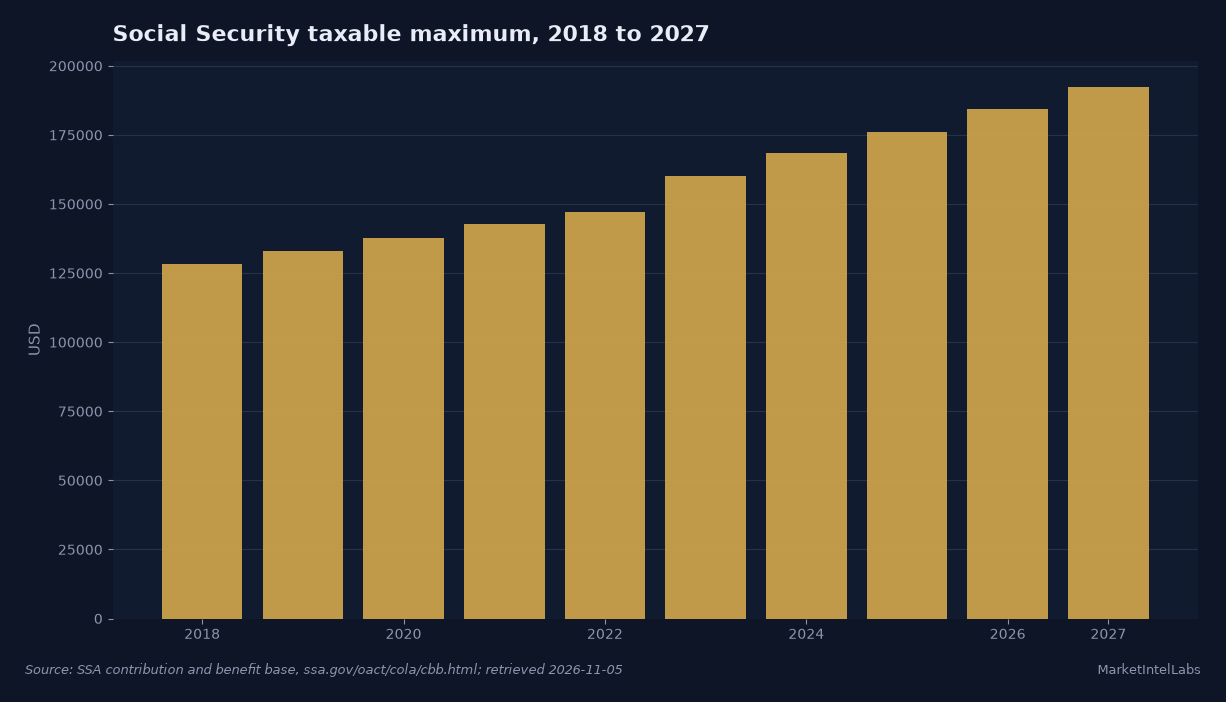
The plot's 2027 endpoint needs a denominator when it is translated into a paycheck. Compare workers with the same earnings in both years, not different people with different salaries. At or above both limits, the incremental employee tax arises only from the newly covered $7,800 slice. Below $184,500, the base change alone produces no incremental Social Security tax. Between $184,500 and $192,300, the incremental amount depends on how much pay exceeds the old ceiling.
The series also prevents an easy but wrong narrative: a rising ceiling does not show that every family's wages rose at the same pace. SSA uses a national average wage index to set the rule, not a median household paycheck. A worker whose own earnings have lagged the index may never meet the limit. Another worker may hit it early in the year and see the Social Security withholding line stop later. The same published ceiling therefore produces very different year-end experiences.
What the primary documents actually establish
SSA's Federal Register notice specifies that the $192,300 contribution and benefit base applies to remuneration paid in 2027 and self-employment income earned in tax years beginning in 2027. It identifies the 2025 national average wage index as $72,800.33. The notice is a dated agency determination, not a third-party estimate of next year's earnings or a proposal awaiting a later vote.
SSA's calculation page adds a mechanical check: $60,600 multiplied by the 2025-to-1992 wage-index ratio yields $192,353.14 before rounding. Its historical table confirms the previous year's $184,500 level. The IRS withholding page describes the employee and employer tax rates as 6.2% each and explicitly distinguishes uncapped Medicare wages. Those sources answer different questions. The Federal Register gives the effective year; SSA shows how the base was calculated; the IRS explains the paycheck categories.
The documents do not say that a person earning $192,300 will get the maximum possible Social Security retirement benefit. SSA's benefit formula depends on an indexed earnings history and the year of first eligibility. It also does not say that payroll tax disappears once the cap is crossed. Only the capped Social Security component stops on wages above that limit. Medicare keeps applying, and other taxes may be relevant. An accurate household estimate therefore starts by identifying which line on the pay stub a number describes.
Another official 2027 threshold helps show why the word maximum needs care. SSA's quarter-of-coverage determination says $1,970 of earnings earns one Social Security credit in 2027, with no more than four credits in a year. That eligibility threshold is separate from the $192,300 tax base. A worker does not need to earn anywhere near the taxable maximum to earn four credits. Neither the credit threshold nor the taxable maximum is itself a promise of a particular benefit amount.
Readers may notice that the COLA figure and the wage-base increase differ. SSA says the 3.6% increase in monthly benefits for eligible recipients is based on its cost-of-living procedure; its COLA summary points to a consumer price index. The taxable maximum instead follows the wage index, with a rounding rule. We read the coexistence of those figures as a reminder to separate the inflation facing an existing recipient from the national wage calculation governing payroll contributions. Neither series measures an individual household precisely.
That distinction also prevents a false promise of relief. Crossing the wage base might reduce the Social Security withholding line on a later paycheck, but the timing depends on when covered wages accumulate. It is not a permanent change to the 6.2% employee rate or to Medicare tax. If a worker starts a new job during the year, payroll records and the tax return can be more complicated than a single employer's year-to-date counter. The official limit is a starting point for questions, not a personal tax ruling.
What is dated next
The calendar hinge is January 2027, when the higher taxable maximum applies to 2027 wages. SSA's October 26 notice also says the 3.6% benefit COLA applies to December 2026 benefits payable in January 2027. Those are related dates for two different groups of readers. An employee watching payroll should look for the new Social Security wage base on 2027 checks; a beneficiary watching monthly income should look for the benefit adjustment and any other deductions affecting the deposit.
After that, the next annual COLA announcement is expected in October 2027, according to SSA's published COLA calendar explanation. That does not pre-announce a 2028 taxable maximum. The future base will require another relevant wage index and agency determination under the applicable formula. A new law could also change the framework, but none is assumed here. For now the verified figure is $192,300 for 2027, and the questions that would change a household calculation are covered wages, number of employers and the type of tax being examined.
For those following the retirement side of the ledger, our earlier benefit-focused report discusses the January payment change. It should not be used as a substitute for the payroll calculation here. The clean comparison for 2027 is the employee's Social Security withholding against the new $192,300 ceiling, then a separate look at uncapped Medicare withholding. That separation will matter more than any headline about a larger maximum when the first 2027 pay stub arrives.
Frequently Asked Questions
What is the Social Security taxable maximum for 2027?
It is $192,300 of covered earnings. SSA's published contribution and benefit base shows $184,500 for 2026 and $192,300 for 2027. The 2027 figure applies to wages paid in 2027 and to self-employment income in tax years beginning that year, as the agency's Federal Register notice specifies. Earnings above the base are not subject to the Social Security portion of the payroll tax.
How much more Social Security tax could I pay in 2027?
An employee with at least $192,300 in covered earnings in both years would pay a maximum of $11,922.60 of employee Social Security tax in 2027, versus $11,439 in 2026. The difference is $483.60, using the unchanged 6.2% employee rate. If covered pay is below the old $184,500 limit and does not change, the limit increase alone adds nothing. Individual withholding depends on actual covered wages and payroll circumstances.
Does Medicare tax stop at the Social Security wage base?
No. The IRS withholding explanation says Medicare tax has no wage-base limit. Regular employee Medicare withholding is 1.45% on covered wages, and a separate 0.9% Additional Medicare Tax withholding rule applies once an employer pays an individual more than $200,000 in a calendar year. That separate $200,000 withholding trigger must not be confused with the $192,300 Social Security base.
Is the 2027 taxable maximum the same as the Social Security COLA?
No. The maximum is a dollar ceiling on earnings subject to Social Security tax and rises using a wage-index formula. The 2027 benefit COLA is a 3.6% increase linked to a consumer price measure for eligible recipients, according to SSA. One number concerns payroll earnings and the other concerns benefits. A beneficiary's actual deposit can also reflect deductions and circumstances beyond the published percentage.
Does paying tax on the maximum earnings mean I get the maximum retirement benefit?
No. SSA bases retirement benefits on up to 35 years of indexed earnings and applies a formula to the resulting monthly average. Claiming age can change the monthly payment. Earning at least $192,300 in one year reaches that year's taxable earnings limit, but it says little by itself about the rest of a person's record or eventual benefit. The SSA benefit calculation guide lays out those separate steps.
This content is for informational purposes only and does not constitute financial advice. Past performance is not indicative of future results. Consult a qualified financial advisor before making investment decisions.
Get daily intelligence delivered
Create a free account for the Daily Brief every weekday and The Week Ahead every Sunday. No card required.